
The Annunciation of the Most Holy Theotokos
The Annunciation of our Most Holy Lady the Theotokos and Ever-Virgin Mary
Kept 25 March — The archangel Gabriel's salutation to the Virgin; the conception of the Word
The Annunciation (Greek Evangelismos, "the good tidings") commemorates the day on which the archangel Gabriel was sent from God to the Virgin Mary at Nazareth to announce that she would conceive and bear the Son of God, and on which, at her free consent — "Behold the handmaid of the Lord; be it unto me according to thy word" — the eternal Word took flesh in her womb. It is the seventh of the Twelve Great Feasts, kept on March 25, nine months before the Nativity of Christ; the Church sings it as "the head of our salvation and the manifestation of the mystery that is from eternity."

The Gospel
The event is told by the Evangelist Luke (1:26–38). In the sixth month after the conception of John the Forerunner, the angel Gabriel was sent to Nazareth in Galilee, to a virgin betrothed to Joseph of the house of David, and her name was Mary. Entering, he greeted her: "Rejoice, thou that art highly favoured; the Lord is with thee; blessed art thou among women." Troubled at the word, she pondered what manner of salutation this might be. The angel told her not to fear, for she had found grace with God, and that she would conceive and bear a son, and call His name Jesus; He would be great, the Son of the Most High, and of His kingdom there would be no end. Mary asked, "How shall this be, seeing I know not a man?" And Gabriel answered: "The Holy Spirit shall come upon thee, and the power of the Most High shall overshadow thee; therefore also that holy thing which shall be born of thee shall be called the Son of God." Then, in her free assent, she spoke the word by which the world was renewed: "Behold the handmaid of the Lord; be it unto me according to thy word." And the angel departed from her.
Theology of the feast
The Fathers see in the Annunciation the beginning of the whole economy of our salvation — the "root" of which the Nativity, Cross and Resurrection are the fruit. On this day the Word who is without beginning takes a beginning in time; the uncontainable God is contained in the Virgin's womb; heaven and earth are joined. The feast turns on the Virgin's free consent: God does not compel, but awaits the "yes" of the creature, and in Mary's obedient word the whole race speaks its assent to God. As Eve's disobedience opened the door to death, so — the hymns proclaim — the obedience of the New Eve opens the door to life; the greeting Chaîre ("Rejoice") reverses the sorrow of the Fall. The feast is thus at once a feast of the Theotokos (it is her Annunciation, and she is its centre) and a feast of the Lord (its content is the Incarnation of the Word); the Church holds both together.
The mystery is guarded against two errors: the Word truly took flesh — He was not merely lodged in a man already existing (against Nestorius, the reason the title Theotokos, "God-bearer," is defended) — and He took a complete humanity, body and rational soul, from the Virgin's substance (against those who would make the flesh a garment only). "That which He has not assumed He has not healed," and He assumed all that is ours save sin.
Date and rank
The Annunciation is set on March 25, exactly nine months before the Nativity (December 25); the ancient reckoning also linked the date to the first day of creation and to the day of the Passion, so that the Word's conception and the world's redemption were seen to fall on one day. Because the mystery it celebrates is the very hinge of salvation, the feast holds a unique place in the Typikon: falling always within Great Lent (and sometimes in Holy Week or even on Pascha itself), it is never wholly transferred or set aside — the Liturgy of the day is served even on the strictest fasting days, and where it coincides with Pascha the two feasts are celebrated together (Kyriopascha, "the Lord's Pascha"). It has a one-day forefeast (March 24) and a leavetaking on March 26, which is the Synaxis of the Archangel Gabriel, the minister of the good tidings.
Iconography
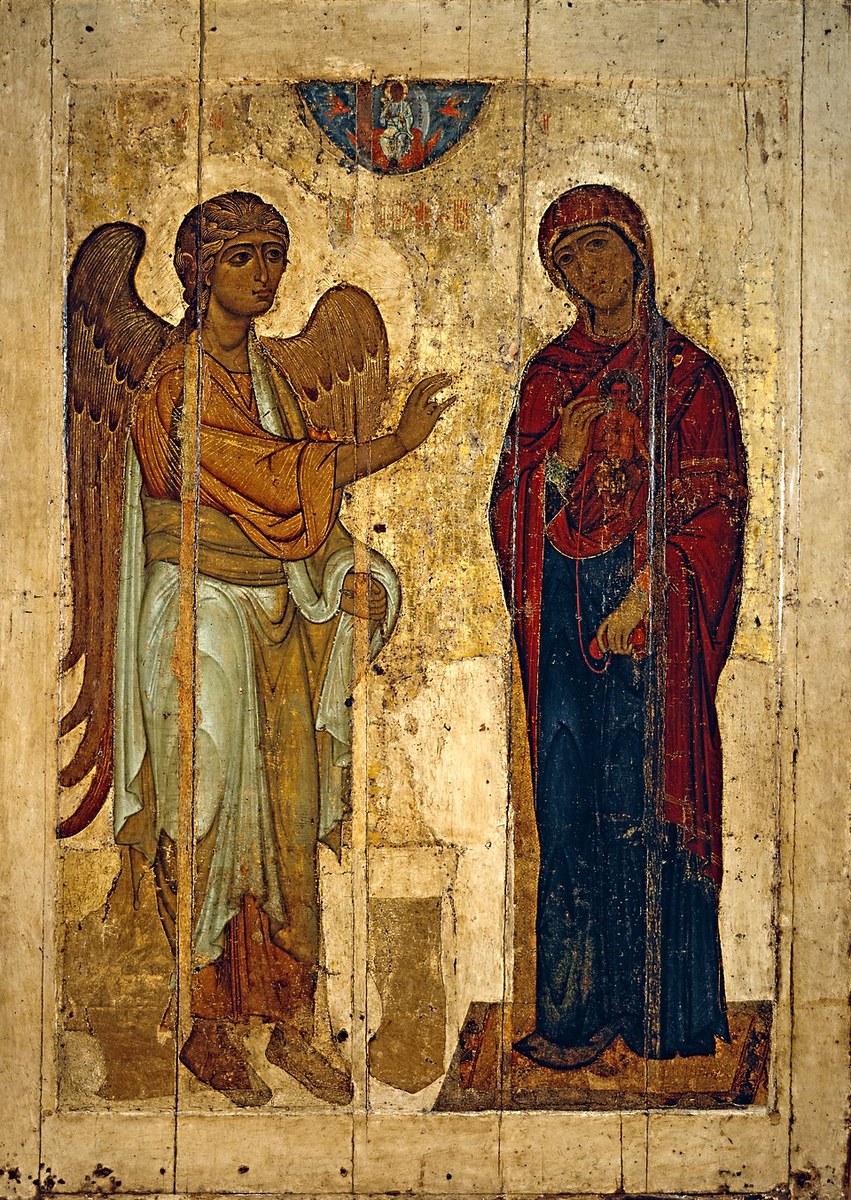
The icon of the Annunciation shows the archangel Gabriel approaching from the left, his right hand raised in speech or blessing, one foot forward as if in swift descent; the Virgin stands or sits at the right, often before a throne, holding the spun scarlet thread (from the tradition that she was weaving the veil of the Temple), her hand raised in a gesture that is at once of questioning and of acceptance. A ray from heaven, sometimes with the dove of the Spirit, descends toward her. In the rare and beautiful "Annunciation with the Child in the womb" (the type of the twelfth- century Ustyug Annunciation stored here) the incarnate Word is already shown within the Virgin's breast, making visible the moment of the conception.
Hymns
Apolytikion — Tone 4
Today is the head of our salvation, and the manifestation of the mystery that is from eternity: the Son of God becometh the Son of the Virgin, and Gabriel announceth the good tidings of grace. Wherefore let us also cry out with him to the Theotokos: Rejoice, thou who art full of grace; the Lord is with thee.
Kontakion — Tone 8
To thee, the Champion Leader, we thy servants dedicate a feast of victory and of thanksgiving as ones rescued out of sufferings, O Theotokos; but as thou art one with might which is invincible, from all dangers that can be do thou deliver us, that we may cry to thee: Rejoice, O unwedded Bride.
Original translation from the Greek
Appointed readings
Epistle — Hebrews 2:11–18
11For both he that sanctifieth and they who are sanctified are all of one: for which cause he is not ashamed to call them brethren, 12Saying, I will declare thy name unto my brethren, in the midst of the church will I sing praise unto thee. 13And again, I will put my trust in him. And again, Behold I and the children which God hath given me. 14Forasmuch then as the children are partakers of flesh and blood, he also himself likewise took part of the same; that through death he might destroy him that had the power of death, that is, the devil; 15And deliver them who through fear of death were all their lifetime subject to bondage. 16For verily he took not on him the nature of angels; but he took on him the seed of Abraham. 17Wherefore in all things it behoved him to be made like unto his brethren, that he might be a merciful and faithful high priest in things pertaining to God, to make reconciliation for the sins of the people. 18For in that he himself hath suffered being tempted, he is able to succour them that are tempted.
Gospel — Luke 1:24–38
24And after those days his wife Elisabeth conceived, and hid herself five months, saying, 25Thus hath the Lord dealt with me in the days wherein he looked on me, to take away my reproach among men. 26And in the sixth month the angel Gabriel was sent from God unto a city of Galilee, named Nazareth, 27To a virgin espoused to a man whose name was Joseph, of the house of David; and the virgin’s name was Mary. 28And the angel came in unto her, and said, Hail, thou that art highly favoured, the Lord is with thee: blessed art thou among women. 29And when she saw him, she was troubled at his saying, and cast in her mind what manner of salutation this should be. 30And the angel said unto her, Fear not, Mary: for thou hast found favour with God. 31And, behold, thou shalt conceive in thy womb, and bring forth a son, and shalt call his name JESUS. 32He shall be great, and shall be called the Son of the Highest: and the Lord God shall give unto him the throne of his father David: 33And he shall reign over the house of Jacob for ever; and of his kingdom there shall be no end. 34Then said Mary unto the angel, How shall this be, seeing I know not a man? 35And the angel answered and said unto her, The Holy Ghost shall come upon thee, and the power of the Highest shall overshadow thee: therefore also that holy thing which shall be born of thee shall be called the Son of God. 36And, behold, thy cousin Elisabeth, she hath also conceived a son in her old age: and this is the sixth month with her, who was called barren. 37For with God nothing shall be impossible. 38And Mary said, Behold the handmaid of the Lord; be it unto me according to thy word. And the angel departed from her.