
Dedication of the Church of the Resurrection (Anastasis) in Jerusalem
Kept 13 September — The Encaenia of 335; kept with the Forefeast of the Elevation of the Cross
On September 13 the Church commemorates the dedication (Encaenia) of the Church of the Resurrection in Jerusalem — the great basilica complex raised by the emperor Constantine over Golgotha and the empty Tomb of Christ, after his mother Helena's finding of the Cross — consecrated on 13 September 335 by a vast assembly of bishops under Macarius of Jerusalem. In the ancient Jerusalem church the Encaenia was one of the three greatest festivals of the year, kept for eight days; the public showing of the Cross on its second day is the origin of the feast of the Elevation on September 14, for which this day also serves as forefeast. Russian usage calls the day the "Resurrection of the Word" (Voskresenie Slovushchee).

Golgotha buried and recovered
The places of the Lord's Crucifixion and Resurrection lay just outside the walls of first-century Jerusalem, in a disused quarry holding a garden and rock-cut tombs (John 19:41–42). After the destruction of the city under Titus in 70 and the suppression of the Bar Kokhba revolt, the emperor Hadrian rebuilt Jerusalem from about 135 as the pagan colony Aelia Capitolina, and the site of the Tomb was buried under an earth platform carrying a temple precinct — the tradition, reported by Eusebius and Jerome, names a shrine of Venus (Aphrodite) over the Tomb and Golgotha. The Christians of Aelia kept the memory of the place through the two centuries of its burial; that continuous local memory is the thread on which the whole later history hangs.
After the Council of Nicaea (325), Constantine — moved, Eusebius says, by divine prompting, and encouraged by bishop Macarius I of Jerusalem — ordered the pagan platform demolished, the soil carried away, and the holy places laid bare. Against expectation the rock-cut Tomb emerged intact. The emperor wrote to Macarius (the letter is preserved in Eusebius's Life of Constantine) commanding a basilica to be raised there surpassing every church in the world, and charging the governors of the eastern provinces to supply whatever the work required.
Helena and the finding of the Cross
The empress Helena, Constantine's mother, journeyed to Palestine around 326–328, already about eighty years old, endowed the excavation and building works, and founded basilicas at Bethlehem and on the Mount of Olives. The tradition of the Church — attested from the later fourth century by Cyril of Jerusalem's letters and catecheses (which speak of the Wood of the Cross found in Jerusalem under Constantine), then in narrative form by Ambrose, Rufinus, Socrates, Sozomen, and Theodoret — relates that in the excavations beside Golgotha three crosses were found, with the nails and the title; and that the Lord's Cross was distinguished when, at the counsel of Macarius, its touch healed a dying woman (later accounts add the raising of a dead man). Helena took part of the Cross to Constantinople, and the greater part remained in Jerusalem in a silver reliquary in the bishop's keeping — where the pilgrim Egeria saw it venerated on Great Friday half a century later. Eusebius's silence about the Cross is the chief critical difficulty in the tradition; the Church's calendars celebrate the finding without resolving the historical question (see the Elevation of the Cross, September 14, where it is treated at length).
The Constantinian complex
The buildings that arose between about 326 and 335 formed a single processional complex along the city's main colonnaded street. From the east one entered through a propylaea into an atrium; then the Martyrium (Μαρτύριον, "the witness"), the great five-aisled congregational basilica; then an open colonnaded court, the Triportico, with the rock of Golgotha standing in its south-east corner; and at the west the Tomb itself, which the masons had cut free from the surrounding rock so that it stood as a freestanding aedicule. Around the Tomb rose the Anastasis (Ἀνάστασις, "Resurrection"), the great rotunda whose form — a domed cylinder ringed by columns — was echoed for a thousand years in baptisteries and sepulchral churches across Christendom; the rotunda in its monumental form appears to have been completed in the years after the dedication of the basilica. Eusebius describes the gilded coffered ceiling of the Martyrium, its polished stone, and the "new Jerusalem" built facing the old — consciously answering the ruined Temple across the valley.
The dedication of 335 and the Encaenia
Constantine appointed the dedication for the thirtieth year of his reign (his tricennalia). The bishops assembled at the council of Tyre in the summer of 335 were commanded to proceed to Jerusalem, where they were joined by hierarchs from every province of the East — Eusebius, an eyewitness, lists Macedonia, Pannonia, Bithynia, Thrace, Cilicia, Cappadocia, Syria, Mesopotamia, Phoenicia, Arabia, Palestine, and Egypt, with a bishop from Persia — and the church was consecrated with a splendour, he says, beyond anything since the apostles. The date, 13 September 335, is fixed by the later liturgical tradition of Jerusalem; scholars have long observed that it displaced, or answered, both the anniversary of the dedication of the temple of Jupiter Capitolinus at Rome and — in the reckoning of the Jerusalem church itself — stood as the new counterpart of Solomon's dedication of the Temple at the feast of Tabernacles. The Byzantine synaxaria draw exactly this parallel: "the new Israel, fulfilling the old law, honours Thy Tomb with Encaenia, O Word."
The anniversary became a fixed feast of the Jerusalem church — the Encaenia (τὰ Ἐγκαίνια, "the renewal" or "dedication"), in Slavonic usage the Obnovlenie ("Renewal") of the church of the Resurrection. The pilgrim Egeria, who kept the feast in Jerusalem in the early 380s, describes it as ranking with Pascha and Epiphany: it was kept for eight days, the churches were adorned as at Pascha, the city filled with monks from Mesopotamia, Syria, Egypt, and the Thebaid and with bishops — forty or fifty, she says, when the pilgrims counted — and no one thought himself excused from the solemnity. She notes expressly that the day was kept the more gloriously because the Cross of the Lord had been found on the same day, and that on the feast's days the Cross was brought out and venerated. The fifth-century Armenian lectionary of Jerusalem confirms the structure: the Encaenia on 13 September, and on its second day, 14 September, the showing (elevation) of the precious Cross to all the people. As the veneration of the Cross spread through the whole East, the second day eclipsed the first: the Elevation became a universal Great Feast, and the Dedication remained as its eve — which is why the Byzantine calendar to this day keeps on September 13 the Encaenia together with the forefeast of the Elevation.
The later fortunes of the church
The Constantinian complex stood for almost seven centuries, damaged and repaired through the Persian sack of 614 (when the Cross itself was carried off to Persia and returned by Heraclius in 630) and the Arab conquest of 638. In 1009 the Fatimid caliph al-Hakim ordered its systematic demolition; the Martyrium basilica was never rebuilt. The Byzantine restoration under Constantine IX Monomachos (completed 1048) and the Crusader rebuilding (dedicated 1149) produced the present Church of the Holy Sepulchre, in which the rotunda of the Anastasis, on its Constantinian foundations and enclosing the aedicule of the Tomb, still shelters the same rock. The feast of the Dedication has been kept without interruption; at the church itself the Jerusalem Patriarchate celebrates the Encaenia annually on this day.
The feast in Russian usage
In the Russian tradition the day is popularly called Voskresenie Slovushchee — approximately "the [day] called Resurrection" — because it bears the name of the Resurrection without being Pascha. Churches dedicated to the Resurrection of the Word (rather than to Pascha itself, to which no church is dedicated) kept this day as their patronal feast, and on it the divine services may be celebrated with paschal hymns; Moscow alone had many such "Slovushchee" churches, and the custom remains alive.
Feast and commemoration
September 13 (church date; Old Calendar civil September 26). The Menaion appoints a triple service: the Encaenia, the forefeast of the Elevation of the precious and life-giving Cross, and the martyr Cornelius the Centurion. The Encaenia holds first place at Vespers, with three Old Testament readings of the dedication of Solomon's Temple and the house of Wisdom; the hymns of the Cross stand beside it throughout, since the next day is the Great Feast of the Elevation. The feast is kept universally in the Byzantine rite. On the Greek Old Calendar and in Slavic Old Calendar jurisdictions the same church date falls on civil September 26. The commemoration is also, in its origin, the festal anniversary proper of the Church of the Holy Sepulchre, and it is so kept by the Patriarchate of Jerusalem.
Hymns
Troparion
As Thou didst show forth the splendour of the firmament on high, so also hast Thou shown the beauty of the holy dwelling-place of Thy glory here below, O Lord. Establish it for ever and ever, and accept the supplications which we unceasingly offer Thee therein, at the intercessions of the Theotokos, O Thou who art the life and resurrection of all.
Original translation from the Greek
Kontakion
The Church has been shown to be a heaven of many lights, shedding its light upon all the faithful; wherein we stand and cry: establish this house, O Lord.
Original translation from the Greek
Appointed readings
Epistle — Hebrews 3:1–4
1Wherefore, holy brethren, partakers of the heavenly calling, consider the Apostle and High Priest of our profession, Christ Jesus; 2Who was faithful to him that appointed him, as also Moses was faithful in all his house. 3For this man was counted worthy of more glory than Moses, inasmuch as he who hath builded the house hath more honour than the house. 4For every house is builded by some man; but he that built all things is God.
Gospel — Matthew 16:13–18
13When Jesus came into the coasts of Caesarea Philippi, he asked his disciples, saying, Whom do men say that I the Son of man am? 14And they said, Some say that thou art John the Baptist: some, Elias; and others, Jeremias, or one of the prophets. 15He saith unto them, But whom say ye that I am? 16And Simon Peter answered and said, Thou art the Christ, the Son of the living God. 17And Jesus answered and said unto him, Blessed art thou, Simon Bar-jona: for flesh and blood hath not revealed it unto thee, but my Father which is in heaven. 18And I say also unto thee, That thou art Peter, and upon this rock I will build my church; and the gates of hell shall not prevail against it.
Iconography
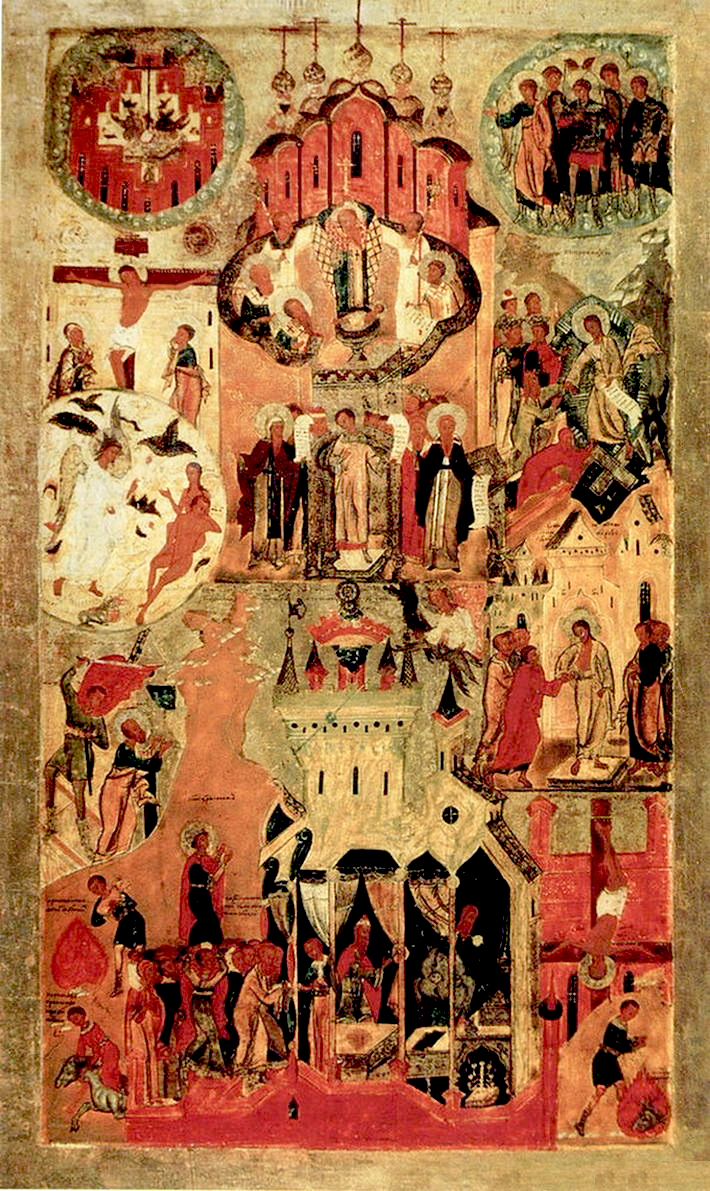
The icon of the feast, called in the Slavic tradition "the Renewal of the Temple of the Resurrection," typically sets the consecrating bishops — Macarius of Jerusalem at their head, sometimes with Constantine and Helena — before a domed sanctuary representing the Anastasis rotunda, blessing or sprinkling the church; the composition borrows from the iconography of church consecration generally, and in some recensions the Tomb aedicule or the risen Christ appears within the building. The stored image is a Russian icon of the late sixteenth or early seventeenth century combining the Renewal of the Temple of the Resurrection with the Praise of the Theotokos, from the iconostasis tradition of the feast; the dedication scene fills the composition beneath the enthroned Mother of God.