
Nativity of the Theotokos
Kept 8 September — Great Feast; birth of the Mother of God to Joachim and Anna
The Nativity of the Most Holy Theotokos (September 8) is the first Great Feast of the church year: the birth of the Virgin Mary at Jerusalem to the righteous Joachim and Anna, aged and childless, whose long reproach of barrenness God ended in answer to prayer. The Church receives the story from ancient tradition, above all the second-century Protoevangelium of James, and reads in it the opening of the economy of salvation — the hymns call the child "the firstfruits of our salvation," for from her the Sun of righteousness, Christ our God, would rise. Kept in the East since at least the sixth century, the feast is celebrated with forefeast, four days of afterfeast, and leavetaking on September 12.

Joachim and Anna and the reproach of barrenness
The New Testament says nothing of the birth or parentage of the Mother of God. What the Church keeps of it she keeps from tradition, whose oldest and most influential written witness is the Protoevangelium of James, an apocryphal infancy narrative composed about the middle of the second century. The book was never received as Scripture — its account of matters touched by the canonical Gospels was firmly set aside — but its story of the Virgin's parents and birth was received into the Church's devotional memory, shaped the synaxaria and the festal hymnography, and fixed the iconography of the feast down to the present day.
The narrative presents Joachim, a man of great wealth and greater righteousness, who brought double offerings to the Lord, saying that the surplus was for the whole people and the offering for his own forgiveness. By later tradition he was of the royal line of David through the tribe of Judah, while his wife Anna — by the same tradition a daughter of the priest Matthan — carried priestly blood, so that the child of both would unite in herself the kingship and priesthood of Israel. But the couple had grown old childless, and childlessness in Israel was read as a curse. On a great feast day Joachim's offering was turned back — "it is not lawful for thee to offer thy gifts first, seeing thou hast begotten no seed in Israel" — and the old man, searching the records and finding that every righteous man in Israel had raised up seed, would not return home in his shame, but went into the wilderness to his flocks, pitched his tent, and fasted forty days and forty nights, saying that prayer should be his meat and drink until the Lord looked upon him.
Anna, doubly bereaved — "widowed of her husband and childless in her womanhood," as the narrative has her lament — put off her mourning garments about the ninth hour and went into her garden to pray. Seeing a nest of sparrows in the laurel tree, she poured out the lament that the hymnographers would never tire of paraphrasing: that she alone was fruitless before the Lord, unlike the birds of heaven, the beasts of the earth, the waters, and the earth itself, which all bring forth in their season and bless God.
The annunciation to the parents and the birth
Then an angel of the Lord stood before her: "Anna, Anna, the Lord hath heard thy prayer; thou shalt conceive and bear, and thy seed shall be spoken of in the whole world." Anna answered with a vow: whether the child were male or female, she would bring it as a gift to the Lord, to minister before him all the days of its life. Messengers — and an angel — came to Joachim in the wilderness with the same news, and he came up from the desert with his flocks for offerings. Anna went out to meet him and hung upon his neck at the gate — the scene the tradition locates at the Golden Gate of Jerusalem and iconography made into the tender image of the embrace of Joachim and Anna, kept on December 9, the feast of Anna's conception. In due course — the manuscripts vary between the seventh and ninth month — Anna bore a daughter, and said, "My soul is magnified this day." She named the child Mary (Mariam), suckled her, and made of her bedchamber a sanctuary where nothing common or unclean might pass; and when the child was three years old the parents fulfilled the vow, bringing her to dwell in the temple of the Lord — the event kept as the feast of the Entry on November 21.
The tradition of the Holy City places the birth itself at Jerusalem, in the house of Joachim and Anna near the Sheep Pool (the Probatike, the pool of Bethesda of John 5); the church of Saint Anne, built by the Crusaders over a Byzantine predecessor beside the pool's excavated porticoes, marks the spot shown to pilgrims since early Christian times. A rival ancient tradition gave Sepphoris in Galilee as the home of Joachim and Anna, and later piety has also claimed Nazareth; the Byzantine synaxaria and the liturgy of the feast assume Jerusalem.
Origins and history of the feast
The feast arose in the East, and at Jerusalem. By the fifth–sixth centuries a great basilica of the Theotokos stood by the Probatic pool on the site identified with her birthplace, and the feast of September 8 is most plausibly explained as the anniversary festival of that shrine, spreading from Jerusalem to the whole East as the Marian feasts of the Holy City did. In the sixth century Romanos the Melodist composed a kontakion on the Nativity of the Virgin — the received kontakion of the feast, "Joachim and Anna were freed from the reproach of childlessness," is transmitted under his name — and by the end of that century the feast was securely established: the emperor Maurice (582–602) is credited with ordaining its general observance in the empire. Rome received it in the seventh century, when September 8 appears among the four feasts of the Mother of God honoured with stational processions under Pope Sergius I (687–701), himself a Syrian by descent; from Rome it passed to the whole West, which still keeps the same date.
The eighth century clothed the feast in the hymnography it wears today. Andrew of Crete (c. 660–740) preached a celebrated cycle of four homilies on the Nativity of the Theotokos and composed the second canon of the feast (Tone plagal 4), transmitted in the Menaion under his name; John of Damascus (†c. 749), whose homilies likewise celebrate the feast, is the "kyr John" of the first canon (Tone 2). Among the stichera of Great Vespers the Menaion preserves ascriptions to Sergius (the idiomelon "Today God who rests upon the spiritual thrones…") and to Germanus of Constantinople. Later Byzantine preachers — among them Photius, Leo the Wise, and Gregory Palamas — returned to the theme repeatedly, and the feast has been kept ever since as the first of the great Theotokian feasts of the fixed year.
Theology: the beginning of the economy of salvation
The Church's year opens on September 1 and meets, seven days later, its first Great Feast — and the arrangement preaches. The liturgical year begins with the birth of the Mother of God and ends with her Dormition on August 15: the whole annual cycle of the mystery of Christ is framed within the life of the woman through whom the mystery entered the world. The Vespers stichera of the day call her birth "the firstfruits of our salvation" (τὴν ἀπαρχὴν τῆς ἡμῶν σωτηρίας), and the troparion announces that this nativity "proclaimed joy to all the inhabited earth," because from her would rise the Sun of righteousness. Nothing of the redemption is yet accomplished — and yet everything is begun: the feast celebrates the appearing in the world of the human being in whom the Incarnation will become possible, the "living heaven," the temple prepared for the Word.
The manner of the birth carries its own theology. Mary is conceived and born in the ordinary way of human nature, of a father and a mother — but of aged and barren parents, in answer to prayer, so that her birth stands in the long biblical line of God's gifts from barren wombs: Isaac of Sarah, Samuel of Hannah, and, at the other end of the same mystery, John of Elizabeth. The kontakion binds the whole economy into one sentence: in her birth Joachim and Anna are freed from the reproach of childlessness — and Adam and Eve from the corruption of death. The barrenness of one Jewish household and the sterility of the whole fallen race are healed by the same child. Orthodox theology, while glorifying the Virgin as all-holy (Panagia) and immaculate, has not defined her birth in the terms of the later Latin dogma of the Immaculate Conception; the feast's own texts are content to celebrate a true child of Adam, the fruit of nature perfected by grace, in whom the old humanity begins to be made new.
Feast and commemoration
September 8 (church date; Old Calendar civil September 21), one of the Twelve Great Feasts and the first Great Feast of the church year, kept universally in the Byzantine rite with an All-night Vigil. The festal cycle is compact: a single day of forefeast on September 7, and four days of afterfeast, during which the festal hymns govern the services, until the leavetaking (apodosis) on September 12, when the service of the feast is sung again in fullness. Within the afterfeast, September 9 is the synaxis of the righteous ancestors of God, Joachim and Anna, whose prayers obtained the child the feast celebrates. The Saturday and Sunday before and after the Exaltation of the Cross, which follow at once, have their own proper readings, so this stretch of September is among the most ordered weeks of the liturgical year.
In Russian usage the clergy vest in blue, the colour appointed there for feasts of the Theotokos; Greek practice knows no fixed system of liturgical colours, and festal (often light or gold) vestments are used according to local custom — the difference is one of usage, not of rank. The feast falls outside every fasting season; when September 8 is a Wednesday or Friday, the day's fast is kept but relaxed in the feast's honour, fish, wine and oil being permitted.
Hymns
Troparion — Tone 4
Thy nativity, O Theotokos, hath proclaimed joy to all the inhabited earth; for from thee arose the Sun of righteousness, Christ our God: loosing the curse, he gave the blessing, and abolishing death, he granted us life eternal.
Original translation from the Greek
Kontakion — Tone 4
By thy holy nativity, O immaculate one, Joachim and Anna were freed from the reproach of childlessness, and Adam and Eve from the corruption of death; thy people also, redeemed from the guilt of transgressions, keep its feast and cry unto thee: the barren one beareth the Theotokos, the nourisher of our Life.
Original translation from the Greek
Magnification
We magnify thee, O most holy Virgin, and we honour thy holy parents, and we glorify thine all-glorious nativity.
Original translation from the Slavonic
Appointed readings
Epistle — Philippians 2:5–11
5Let this mind be in you, which was also in Christ Jesus: 6Who, being in the form of God, thought it not robbery to be equal with God: 7But made himself of no reputation, and took upon him the form of a servant, and was made in the likeness of men: 8And being found in fashion as a man, he humbled himself, and became obedient unto death, even the death of the cross. 9Wherefore God also hath highly exalted him, and given him a name which is above every name: 10That at the name of Jesus every knee should bow, of things in heaven, and things in earth, and things under the earth; 11And that every tongue should confess that Jesus Christ is Lord, to the glory of God the Father.
Gospel — Luke 10:38–42; 11:27–28
38Now it came to pass, as they went, that he entered into a certain village: and a certain woman named Martha received him into her house. 39And she had a sister called Mary, which also sat at Jesus’ feet, and heard his word. 40But Martha was cumbered about much serving, and came to him, and said, Lord, dost thou not care that my sister hath left me to serve alone? bid her therefore that she help me. 41And Jesus answered and said unto her, Martha, Martha, thou art careful and troubled about many things: 42But one thing is needful: and Mary hath chosen that good part, which shall not be taken away from her. 27And it came to pass, as he spake these things, a certain woman of the company lifted up her voice, and said unto him, Blessed is the womb that bare thee, and the paps which thou hast sucked. 28But he said, Yea rather, blessed are they that hear the word of God, and keep it.
Iconography
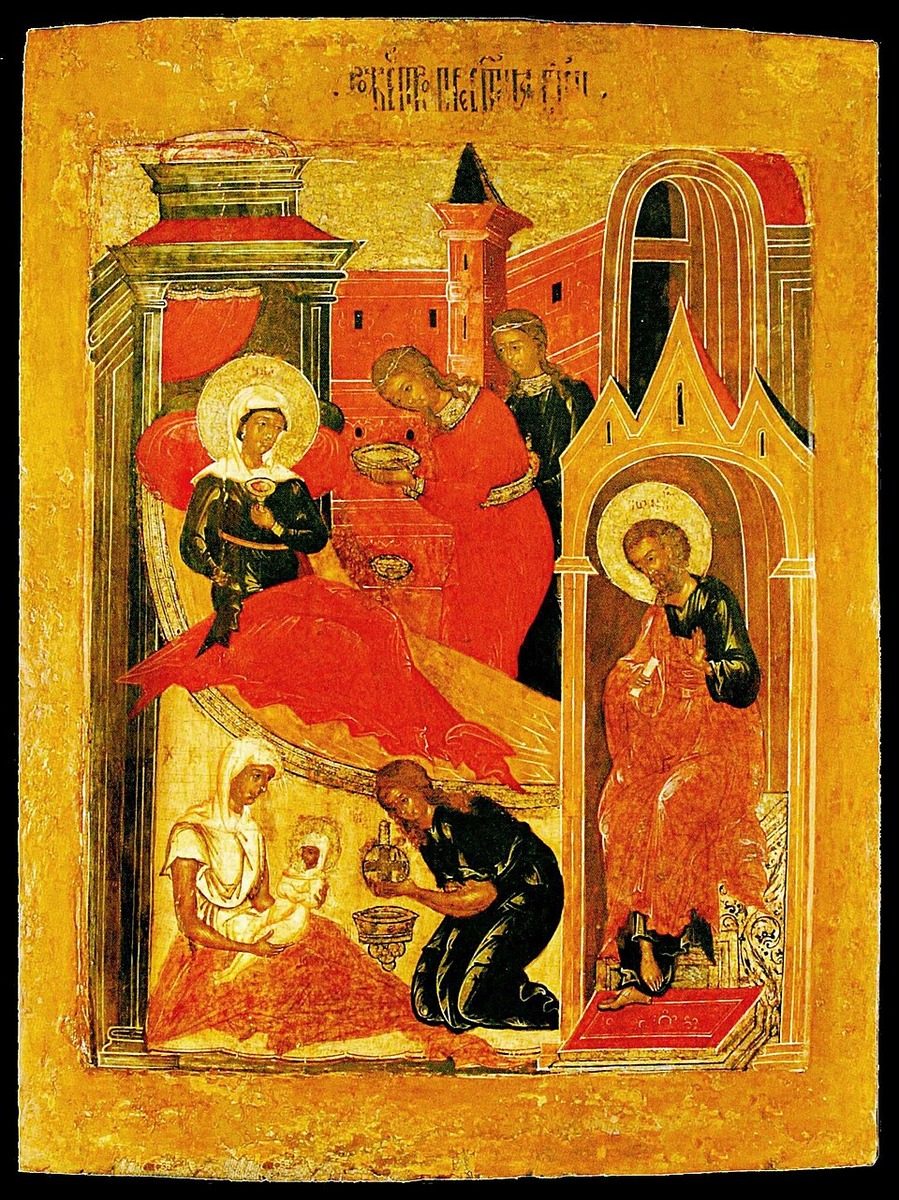
The icon of the feast, fixed in its essentials since middle Byzantine times, is a birth-chamber scene. Anna reclines on a high couch, attended by maidservants who bring her food and gifts; in the foreground midwives bathe the newborn Mary in a basin, the infant already nimbed; Joachim looks on from a doorway or an upper chamber, or sits pondering at the side. Later and fuller recensions — abundant in Russian iconography — add the tender scene of Joachim and Anna caressing the child, the annunciations to each parent, the meeting at the Golden Gate, and attendant scenes of the feast's narrative around the border. The composition deliberately parallels the Nativity of the Forerunner and, more distantly, the Nativity of Christ: three birth-scenes of the one economy.
The stored icon is a Russian icon of the mid-seventeenth century from the festal tier of the iconostasis of the church of the Beheading of John the Forerunner at Rostov the Great: beneath the architectural canopies Anna reclines on the red-draped couch while two maidservants bring her vessels; below, a nurse holds the swaddled, nimbed infant while a midwife prepares the bath; and at the right Joachim sits apart under his own canopy, pondering the wonder. The Slavonic titulus of the feast runs across the top of the panel.