
The "Paramythia" (Consolation) Icon of the Mother of God
Kept 21 January — The icon of Vatopedi that spoke to warn the monks of a pirate raid
The Paramythia — "Consolation" or "Comfort" (Greek Παραμυθία) — is a wonderworking icon of the Mother of God kept at the Monastery of Vatopedi on Mount Athos. The tradition relates that early one morning, as the abbot was handing out the keys for the gates to be opened, the Theotokos spoke aloud from her icon, warning the monks not to open the gates that day but to man the walls against a band of pirates lying in ambush; and that when the Christ Child reached up to cover her mouth, saying the monks deserved their fate, she gently took his hand aside and repeated the warning. The monastery was saved. From that hour, the tradition holds, the posture of the figures in the icon was found changed — the Mother's face turned aside from the Child's restraining hand, her expression full of mercy, the Child's grave — and so it has remained. The event is commemorated on January 21, and the icon is honoured in its own chapel at Vatopedi, where a lamp burns before it unceasingly.
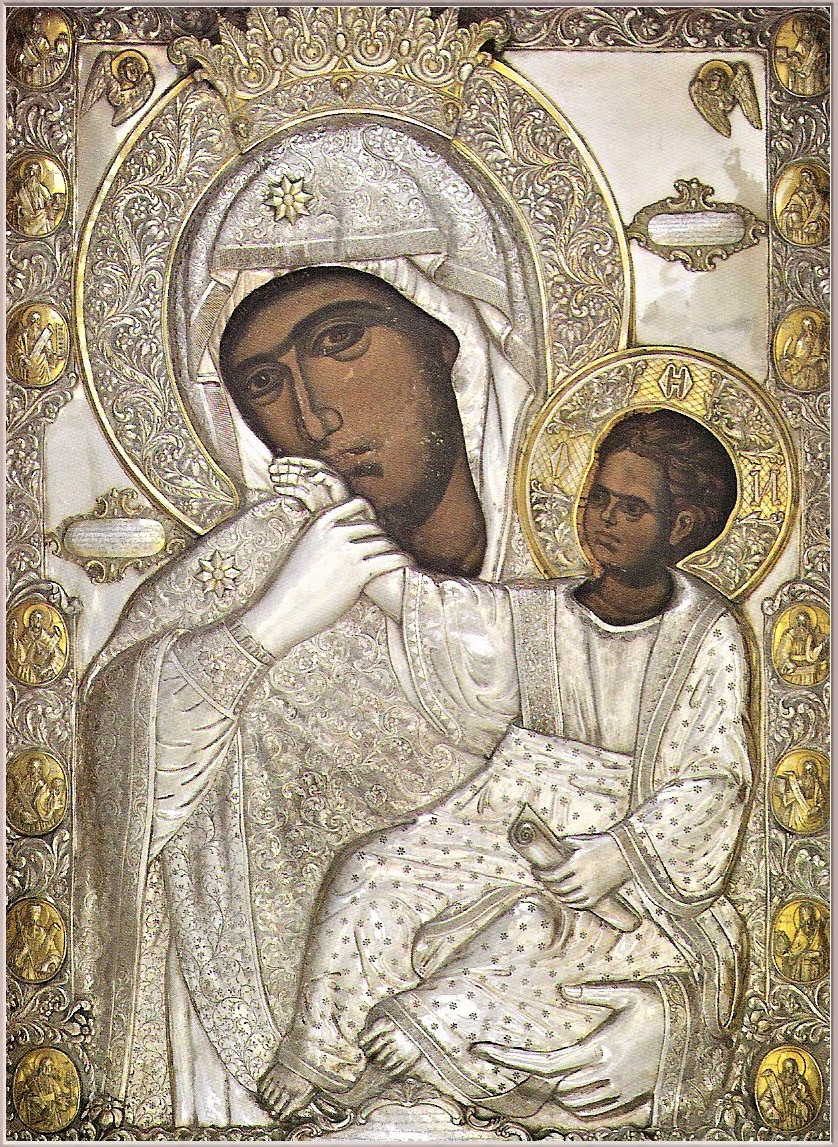

The icon that spoke
The Paramythia is a wall-icon (a fresco, later framed and adorned) of the Mother of God holding the Christ Child, of the type long treasured at Vatopedi, one of the great houses of the Holy Mountain. The story the monastery tells and the feast commemorates is set on the morning of a day the tradition fixes to January 21 (a year commonly given as 1320, in the fourteenth century, though older reckonings circulate — see below).
The night's vigil ended, the brethren were gathered, and the abbot, having dismissed the community, remained a moment before the icon of the Mother of God near the gate to entrust the keys to the gatekeeper so that, according to custom, the monastery gates might be opened at daybreak and the monks go out to their labours. As he stood there he heard a voice from the icon, the voice of the Theotokos: "Do not open the gates of the monastery today, but go up onto the walls and drive off the pirates." Astonished, the abbot lifted his eyes to the image — and saw that it had come alive: the face of the Mother of God had changed, and the Christ Child had stretched out his hand to cover her lips, turning his own face to her and saying, "No, my Mother, do not warn them; let them be chastised as they deserve, for they have grown careless in their duty." But the Mother of God, inclining her head aside to free her mouth from the Child's hand and gently taking hold of it, spoke the warning a second time.
The monks did as she said. They kept the gates shut and manned the walls, and found that a company of pirates had indeed come ashore in the night and lay hidden near the monastery, waiting for the gates to open to fall upon it. So the community was delivered; and in thanksgiving they named the icon Paramythia, "Consolation," and set apart the chapel where it hangs for its perpetual honour.
The changed image
The wonder of the Paramythia is that the icon itself is said to bear the memory of the event in its very form. Where the older type had shown the Mother and Child in the settled posture of the Hodegetria, the icon after that morning shows the Theotokos with her head inclined to one side, her face turned slightly away and full of tenderness and appeal, and the Christ Child reaching toward her mouth, his own expression grave and severe — the two frozen in the attitudes of that morning's dialogue, the Mother pleading for mercy on the monks, the Son withholding it in justice, and mercy prevailing. Pilgrims to Vatopedi are shown the icon in this altered posture to this day, in the chapel of the Paramythia, where an oil-lamp is kept ever burning before it and where the abbot's staff is by custom laid, the Mother of God being honoured as the true Abbess of the house.
The dating
The tradition of the miracle is firm; its date is not. The fourteenth century (often 1320) is the commonly received placing, and agrees with the age of the icon as it survives. Some Slavic calendars, however, carry a far older date — the year 807 — attaching the deliverance to an earlier raid; this earlier reckoning is recorded here as it stands in the sources, without being preferred to the fuller Athonite tradition. What is constant is the place (Vatopedi), the event (the icon's spoken warning and the monastery's deliverance from pirates), the name (Paramythia, Consolation), and the day (January 21).
Feast and commemoration
January 21 (church date; Old Calendar civil February 3), kept on Mount Athos and in the Greek and Slavic worlds as the feast of the Paramythia icon of Vatopedi, falling on the same day as Maximus the Confessor and Maximus the Greek. It is one of the celebrated wonderworking icons of the Holy Mountain, and its chapel at Vatopedi is a place of pilgrimage; the commemoration is Athonite and Greek in origin, taken up in Russian usage among the many Athonite icon-feasts. Vatopedi keeps several venerated icons of the Mother of God commemorated about this day — the Ktitorissa ("Founder's" icon), the Esphagmeni ("Stabbed" icon), and others — of which the Paramythia is the most widely known.
Appointed readings
Epistle — Philippians 2:5–11
5Let this mind be in you, which was also in Christ Jesus: 6Who, being in the form of God, thought it not robbery to be equal with God: 7But made himself of no reputation, and took upon him the form of a servant, and was made in the likeness of men: 8And being found in fashion as a man, he humbled himself, and became obedient unto death, even the death of the cross. 9Wherefore God also hath highly exalted him, and given him a name which is above every name: 10That at the name of Jesus every knee should bow, of things in heaven, and things in earth, and things under the earth; 11And that every tongue should confess that Jesus Christ is Lord, to the glory of God the Father.
Gospel — Luke 10:38–42; 11:27–28
38Now it came to pass, as they went, that he entered into a certain village: and a certain woman named Martha received him into her house. 39And she had a sister called Mary, which also sat at Jesus’ feet, and heard his word. 40But Martha was cumbered about much serving, and came to him, and said, Lord, dost thou not care that my sister hath left me to serve alone? bid her therefore that she help me. 41And Jesus answered and said unto her, Martha, Martha, thou art careful and troubled about many things: 42But one thing is needful: and Mary hath chosen that good part, which shall not be taken away from her. 27And it came to pass, as he spake these things, a certain woman of the company lifted up her voice, and said unto him, Blessed is the womb that bare thee, and the paps which thou hast sucked. 28But he said, Yea rather, blessed are they that hear the word of God, and keep it.
Iconography
The Paramythia shows the Mother of God at half-length holding the Christ Child, but in the distinctive altered posture the tradition ascribes to the miracle: the Theotokos inclines her head to one side, drawing back from the hand of the Child, her face turned in mercy toward the beholder; the Christ Child reaches his hand toward her lips, his face grave — the visual record of the exchange in which the Mother interceded for the monks and the Son at first withheld his mercy. The stored image is the fourteenth-century icon of the Paramythia at Vatopedi itself — the wonderworking image in its own altered form.