
Tikhvin Icon of the Mother of God
Kept 26 June — The appearance of the icon over Lake Ladoga and at Tikhvin, 1383
The Tikhvin Icon is one of the four or five most venerated icons of the Mother of God in Russia and, with the Vladimir and Kazan images, one of the national protectresses. Tradition counts it among the icons painted by the Evangelist Luke, brought from Jerusalem to Constantinople in the fifth century and set in the church of the Blachernae; the Russian account holds that in 1383, seventy years before the fall of the imperial City, it left Constantinople of itself and was seen by fishermen hovering in the air above Lake Ladoga in a great light. It showed itself in several places in the Novgorod land before settling on the bank of the Tikhvinka, where a wooden church of the Dormition was raised over it; Ivan the Terrible founded a monastery there in 1560. In the Swedish invasion of 1613–1614 the monastery was held against repeated assault, and the deliverance was ascribed to the icon; the peace of Stolbovo was sworn before a copy of it in 1617. Taken by the Germans in the Second World War, the icon travelled through Pskov, Riga and Bavaria to Chicago, where it was guarded for fifty-five years, and was returned to Tikhvin in 2004. Its feast is June 26, the day of the appearance.

The Constantinopolitan origin
The received account gives the icon an apostolic origin: one of the images of the Mother of God painted by the Evangelist Luke, sent from Jerusalem to Constantinople in the fifth century — in the reign of the Empress Pulcheria, on the usual reckoning — and enshrined in the church of the Blachernae, the imperial city's chief Marian sanctuary and the shrine of her protection. As with the other Lukan attributions, this is the Church's traditional claim about the image's lineage and type rather than a datable statement about the surviving panel; the icons of the Hodegetria family are held to descend from an apostolic prototype, and Russian and Greek tradition alike understands the claim in that sense.
Russian manuscripts of the early sixteenth century, which are the earliest witnesses to the Tikhvin story in the form it has since kept, add the theological reading of the icon's departure: the Mother of God withdrew her image from a City that was about to fall, and gave it to the Russian land. The date they give — 1383 — falls seventy years before 1453, and the account was written with that ending in view.
The appearance of 1383
The narrative of the appearance is unusually circumstantial. Fishermen on Lake Ladoga saw the icon borne through the air over the water in a radiance, and it passed from them without their being able to approach it. It appeared afterwards in a succession of places in the Novgorod land — the tradition names Smolkovo, Vymochenitsy, Kozhela and Motchenitsy on the Tikhvinka river among them — resting a while at each, so that a chapel or a church was built at every station, and then moving on. At last it came to rest on the right bank of the Tikhvinka at the place that became Tikhvin, and there it stayed.
A wooden church of the Dormition was raised over it. It burned, and was rebuilt, and burned again; the icon was each time found unharmed in the ashes, once in a juniper bush at some distance from the fire. Early in the sixteenth century the Grand Prince Vasily Ivanovich replaced the wooden church with one of stone, and in 1560 Tsar Ivan IV founded beside it the Tikhvin Dormition monastery for men, walling it with stone — a frontier fortress as much as a monastery, on the road from Novgorod to the north.
The Swedish siege, 1613–1614
In the Time of Troubles the Swedes held Novgorod, and in 1613–1614 they attacked the Tikhvin monastery repeatedly, meaning to destroy it. The monastic account preserves two things. The first is that when the brethren, despairing, resolved to abandon the house and carry the icon away with them, they could not lift it from its place — which they took for the Mother of God's promise to stay and to defend them, and they stayed. The second is that at the height of the danger the besiegers broke and fled, the tradition saying that they saw a great Muscovite army descending upon them where none was.
When peace was negotiated in the village of Stolbovo, some thirty-three miles from the monastery, a copy of the Tikhvin icon was carried to the conference and the treaty of 10 February 1617 was sworn before it. That copy was afterwards set in the Dormition Cathedral of the Moscow Kremlin, and later in the Hagia Sophia at Novgorod.
The monastery and the copies
From the seventeenth century the Tikhvin monastery was among the great Russian pilgrimage sites. The icon was covered with a riza of gold and jewels given by tsars and by ordinary petitioners, and was borne in more than twenty processions in the course of the year, to the lake, to the town, to the surrounding villages. Copies multiplied across Russia, several becoming wonderworking in their own right; the Tikhvin image was, and remains, the icon most commonly invoked in Russian usage for the healing of sick children.
The twentieth century: Riga, Chicago, and the return
The monastery was closed and the icon nationalised into a museum after the revolution, and it survived both that and what followed. In the German occupation of 1941 the icon was taken from the Tikhvin museum and carried west — to Pskov, where it was given back to the Church and openly venerated, then in 1944 to Riga, and thence into Bavaria with the retreating population. Its guardian through these years was Bishop (later Archbishop) John Garklāvs of Riga, who in 1949 brought it to the United States and enshrined it at Holy Trinity Cathedral in Chicago. He carried it on pilgrimage across North America for thirty years, and at his death on Palm Sunday 1982 its keeping passed to his adopted son, the Archpriest Sergei Garklāvs, on the condition his father had laid down: that the icon should return to Tikhvin when the monastery was restored and the Church in Russia free.
That condition was met after 1991. The return began at the ninety-ninth annual pilgrimage to Saint Tikhon's Monastery in South Canaan, Pennsylvania, on 23–26 May 2003, and after a progress through the Orthodox Church in America the icon was carried back to Russia and restored to the Tikhvin Dormition monastery in 2004, where it is enshrined today.
Feast and commemoration
June 26 (church date; Old Calendar civil July 9) is the feast of the appearance (yavlenie) of the icon in 1383. It is a Russian commemoration, kept in the Russian Church and by the Orthodox Church in America and throughout the Slavic world, with a proper service; it is not on the Greek or the Antiochian calendars. At Tikhvin itself the day is the monastery's patronal celebration and draws pilgrims from across the north-west of Russia. The day generally falls within the closing week of the Apostles' Fast, which ends on June 28; where the fast is in force, the rank of the feast relaxes it in common Russian practice. Blue vestments are worn, as at all feasts of the Mother of God in Russian usage.
Hymns
Troparion — Tone 4
Today, as a most radiant sun, thy most honourable icon hath shone forth upon us in the air, O Sovereign Lady, enlightening the world with the rays of thy mercy; which great Russia, having reverently received from on high as a divine gift, doth glorify thee, O Mother of God, the Mistress of all, and doth joyfully magnify Christ our God who was born of thee. Pray to Him, O Lady, Queen and Mother of God, that He may preserve all the cities and lands of the Christians unharmed from every assault of the enemy, and may save them that in faith bow down before His divine image and thy most pure likeness, O Virgin who knewest not wedlock.
Original translation from the Slavonic
Kontakion — Tone 8
Let us hasten, O ye people, to the Virgin Theotokos and Queen, giving thanks to Christ our God; and gazing with compunction upon her wonderworking icon, let us fall down and cry out to her: O Mother of God, who hast come from the lands of the East into the land of Russia and hast brought with thee thy grace and thy compassions, save us who flee to thee from every calamity and affliction: rejoice, O Virgin, salvation of the world.
Original translation from the Slavonic
Appointed readings
Epistle — Philippians 2:5–11
5Let this mind be in you, which was also in Christ Jesus: 6Who, being in the form of God, thought it not robbery to be equal with God: 7But made himself of no reputation, and took upon him the form of a servant, and was made in the likeness of men: 8And being found in fashion as a man, he humbled himself, and became obedient unto death, even the death of the cross. 9Wherefore God also hath highly exalted him, and given him a name which is above every name: 10That at the name of Jesus every knee should bow, of things in heaven, and things in earth, and things under the earth; 11And that every tongue should confess that Jesus Christ is Lord, to the glory of God the Father.
Gospel — Luke 10:38–42; 11:27–28
38Now it came to pass, as they went, that he entered into a certain village: and a certain woman named Martha received him into her house. 39And she had a sister called Mary, which also sat at Jesus’ feet, and heard his word. 40But Martha was cumbered about much serving, and came to him, and said, Lord, dost thou not care that my sister hath left me to serve alone? bid her therefore that she help me. 41And Jesus answered and said unto her, Martha, Martha, thou art careful and troubled about many things: 42But one thing is needful: and Mary hath chosen that good part, which shall not be taken away from her. 27And it came to pass, as he spake these things, a certain woman of the company lifted up her voice, and said unto him, Blessed is the womb that bare thee, and the paps which thou hast sucked. 28But he said, Yea rather, blessed are they that hear the word of God, and keep it.
Iconography
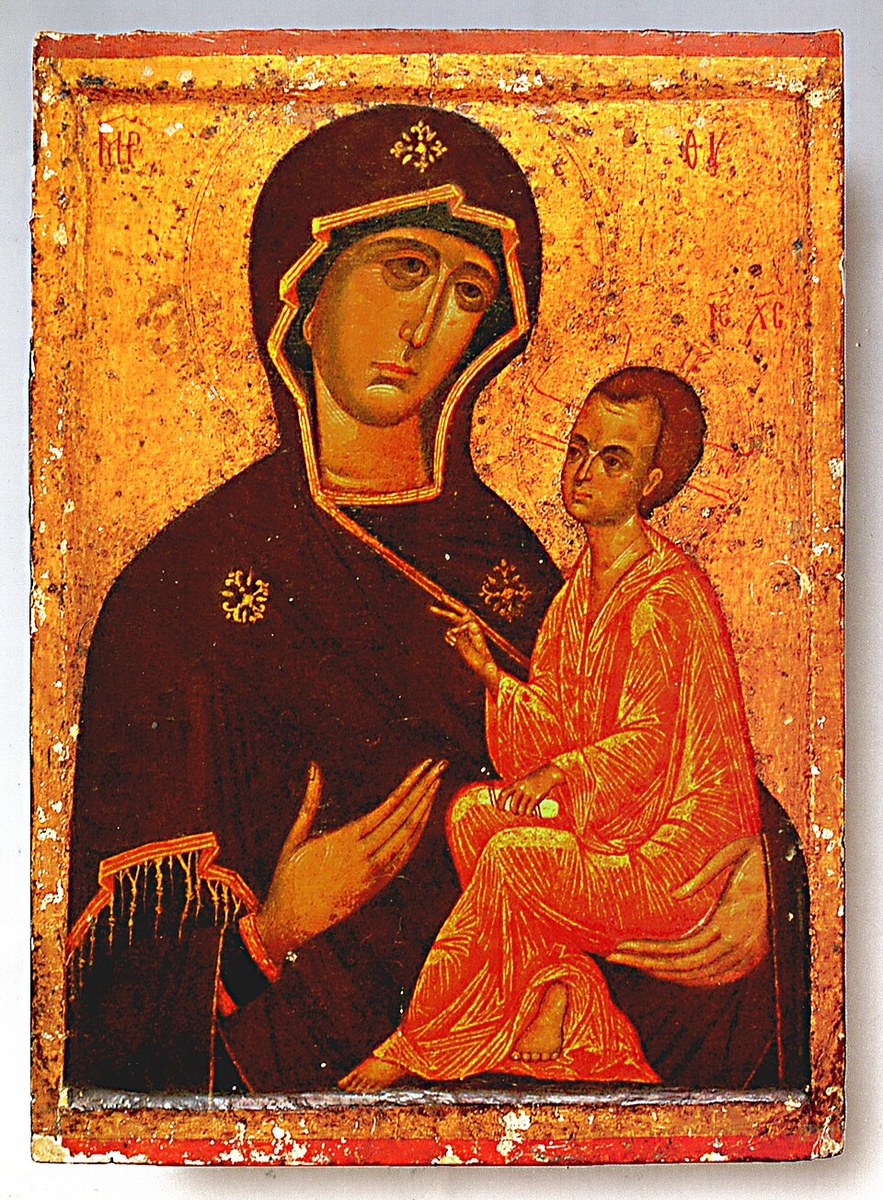
The Tikhvin icon is of the Hodegetria type — the Mother of God holding the Child on her left arm and indicating him with her right hand, "she who points the Way" — and is close in composition to the Iveron icon of the Holy Mountain. Two features identify the Tikhvin recension and are reproduced in every copy of it. The first is the Christ Child's legs: the right leg is drawn up and crossed beneath the left so that the sole of the right foot is turned outward toward the viewer, a detail found in no other Russian Hodegetria and the readiest test of the type. The second is the sharp turn of the Child's head and the raised blessing hand held high, before his shoulder rather than at his breast. The Mother's face is inclined slightly toward him, dark and severe, with the star of virginity on the maphorion at the brow and shoulder; the ground is gold and the maphorion deep red-brown.
The stored image is a panel of the Tikhvin type dated on its source page to the 15th–16th century, with the crossed leg and exposed sole clearly shown, the raised blessing hand, and the inscriptions ΜΡ ΘΥ and ΙC ΧC in the field; the gilding is heavily rubbed and the gesso losses at the margins are those of a much-handled devotional panel. It is reproduced from Wikimedia Commons under the faithful-reproduction doctrine: a flat photograph of a two-dimensional work centuries out of copyright, and so pd-old-work.