
Tolga Icon of the Mother of God
Kept 8 August — The appearance of the icon to Bishop Prochorus of Rostov on the Volga, 1314
The Tolga Icon is the great wonderworking image of the Upper Volga, and the only one whose feast records not a deliverance or a translation but a night's vision: on August 8, 1314, camped on the Volga a few versts above Yaroslavl, Bishop Prochorus of Rostov woke to see a pillar of fire on the far shore and a bridge of light stretched to it, crossed over, and found an icon of the Mother of God hanging in the air. Returning, he left his staff behind; and the staff, found next morning in the forest beside the icon, was the proof of the thing to his own retinue. A church was raised on the spot in a single day and consecrated the same evening, and the Tolga monastery grew from it — one of the oldest and, until the Revolution, one of the richest houses of the Russian north-east.

The night on the Volga, 8 August 1314
Prochorus, bishop of Rostov and Yaroslavl (called Tryphon in the schema), was making the visitation of his diocese in the summer of 1314. He had been in the upper Trans-Volga country about White Lake (Beloozero) — where the Kirillo-Belozersk monastery would later stand — and was travelling home down the Sheksna and then the Volga toward Yaroslavl. Night overtook the party some six or seven versts short of the city (the Russian accounts say six, the OCA's seven), on the bank opposite the mouth of the little river Tolga, and they camped there.
At midnight, with everyone else asleep, the bishop woke. The whole place was lit. The light came from a pillar of fire standing on the far bank, and from the camp to the pillar there stretched a bridge. Prochorus took up his staff, went out, crossed the bridge, and came to the pillar — and saw in it an icon of the Most Holy Theotokos with the Child on her arm, held up, as the Russian account is careful to specify, not resting on any tree but hanging in the air about five cubits from the ground, so high that it could not be reached from below. He prayed before it a long time with tears, and went back over the bridge to his tent; and in the amazement of the thing he left his staff on the other side.
In the morning, when the bishop was ready to go on, the staff could not be found. Then he remembered where he had left it, and told his people what had happened in the night. Servants were sent across, and found in the place he named the bishop's staff and, beside it, the icon of the Mother of God — standing now upon the ground, in the older Russian telling; lodged in the branches of a tree, in the version the modern English calendars follow.
The church built in a day
Prochorus crossed with his whole retinue, recognised the icon he had seen in the night, and prayed before it. Then the trees were cleared and the foundations of a church were laid on the spot. Word went to Yaroslavl, and the townspeople came out; and with all of them working together the church was finished by midday and consecrated the same evening, in honour of the Entry of the Theotokos into the Temple. The icon was set in it, and the bishop appointed a feast on the day of its appearance. Afterwards he founded beside the church the Tolga monastery, which took its name from the little river. Prochorus died on September 7, 1328.
The written account, and the icon's later history
The narrative above is not contemporary. The Skazanie — the tale of the icon's miraculous finding — was composed at the Tolga monastery in the sixteenth century out of local tradition, and it is from that text, and from Dimitri of Rostov's retelling of it in his Lives of the Saints under August 8, that every later account descends. Bishop Prochorus's own century has left no record of the event.
What the tradition established, however, was durable. The Tolga image became the patronal icon of the Yaroslavl land, credited with deliverances from drought, fire and pestilence, and carried in procession about the city and the countryside; the monastery grew into one of the wealthiest houses of the Russian north-east, and its Entry of the Theotokos cathedral, cedar grove and walls survive.
The icon of the apparition — the small half-figure panel that art historians call "Tolgskaya II" — was taken from the monastery in the 1920s and passed into the collection of the Yaroslavl Art Museum. In 2003 it was returned to the monastery, now a women's community, where it stands again for veneration while remaining formally part of the museum's collection.
Feast and commemoration
August 8 (church date; New Calendar civil August 8, Old Calendar civil August 21) is the feast of the appearance of 1314, and falls within the afterfeast of the Transfiguration and within the Dormition Fast (August 1–14) — so that the icon's day is kept in a fasting season, with the Transfiguration hymns still being sung. It is a Russian commemoration, carried into the OCA calendar; the Greek books do not have it.
Some calendars, the OCA's among them, also enter the Tolga icon against July 18. This repository treats August 8 as the icon's own day, the day of the apparition and of the consecration of the first church, and records July 18 as a secondary listing whose basis is not the apparition; the July 18 entry of this corpus notes the same and defers the matter here.
Hymns
Troparion — Tone 4
Today, like a beacon, thy most honoured icon shineth forth upon us, O Lady, and gladdeneth the hearts of the faithful, and calleth us to look upon the great wonder: for thou wast pleased to be borne upon a pillar of fire and to rest in the branches of a tree, and thou didst give the sign of thy coming to thy servant the bishop. Wherefore, falling down before thine image, we cry aloud to thee: O Sovereign Lady, keep this land and thy monastery in peace, and save our souls.
Original translation from the Slavonic
Kontakion — Tone 8
Thou didst come by night to the shore of the Volga and show thine image in a pillar of fire, and by morning a house was built for thee; wherefore the people of Yaroslavl and all the countryside cry out to thee with thanksgiving: Rejoice, O Lady of Tolga, our deliverance from pestilence and from every sorrow.
Original translation from the Slavonic
Appointed readings
Epistle — Philippians 2:5–11
5Let this mind be in you, which was also in Christ Jesus: 6Who, being in the form of God, thought it not robbery to be equal with God: 7But made himself of no reputation, and took upon him the form of a servant, and was made in the likeness of men: 8And being found in fashion as a man, he humbled himself, and became obedient unto death, even the death of the cross. 9Wherefore God also hath highly exalted him, and given him a name which is above every name: 10That at the name of Jesus every knee should bow, of things in heaven, and things in earth, and things under the earth; 11And that every tongue should confess that Jesus Christ is Lord, to the glory of God the Father.
Gospel — Luke 10:38–42; 11:27–28
38Now it came to pass, as they went, that he entered into a certain village: and a certain woman named Martha received him into her house. 39And she had a sister called Mary, which also sat at Jesus’ feet, and heard his word. 40But Martha was cumbered about much serving, and came to him, and said, Lord, dost thou not care that my sister hath left me to serve alone? bid her therefore that she help me. 41And Jesus answered and said unto her, Martha, Martha, thou art careful and troubled about many things: 42But one thing is needful: and Mary hath chosen that good part, which shall not be taken away from her. 27And it came to pass, as he spake these things, a certain woman of the company lifted up her voice, and said unto him, Blessed is the womb that bare thee, and the paps which thou hast sucked. 28But he said, Yea rather, blessed are they that hear the word of God, and keep it.
Iconography
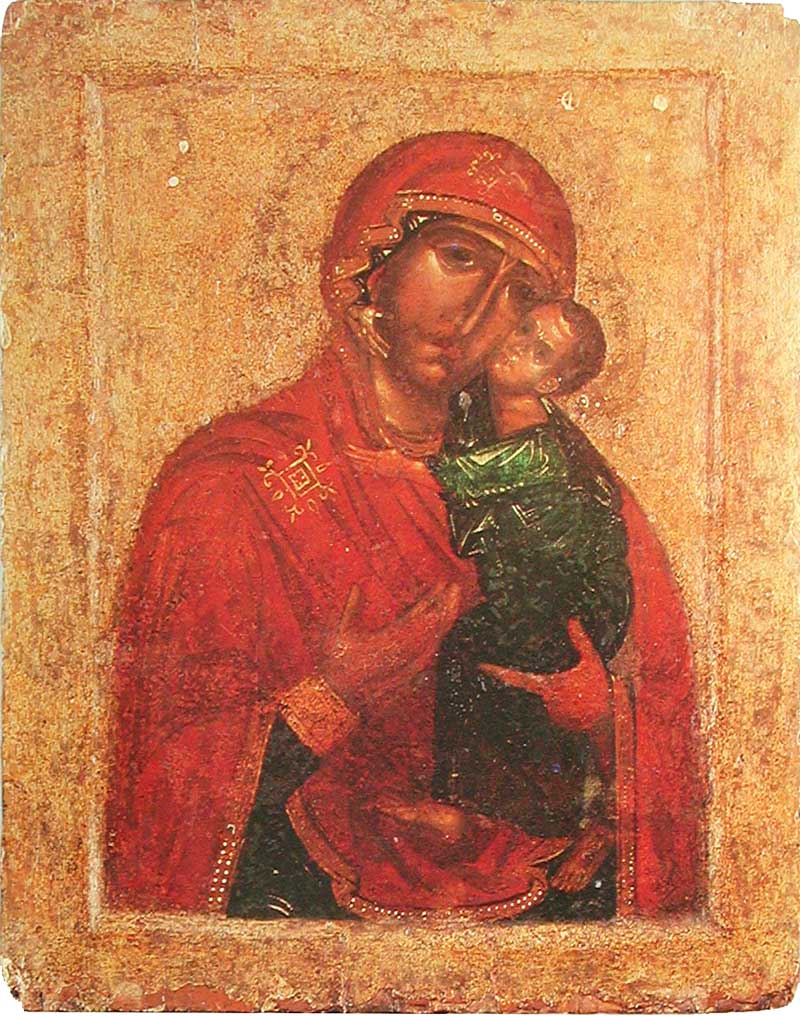
The Tolga image is an Eleousa — a Umilenie, "tenderness," in the Russian naming: the Mother of God in half-length, her head bowed to her right, the Child seated on her right arm and pressing his cheek against hers, his small feet drawn up and bare, one arm reaching about her neck. The maphorion is deep vermilion with a gold-starred border and the Child is in a green tunic under a dark mantle; the ground is a warm ochre. The gesture — the Mother receiving the Child's caress rather than presenting him — is what distinguishes the type from the Hodegetria images that dominate Russian icon-painting of the period.
Three related panels carry the name and must be kept apart:
- Tolgskaya I, the "great" or "enthroned" Tolga icon, last quarter of the 13th century, 140 × 92 cm on a lime panel, now in the Tretyakov Gallery (inv. 12875), from the Elevation of the Cross church of the Tolga monastery: the Mother of God enthroned at full length, the Child standing on her left knee with his arm about her neck and his cheek against hers, the archangels Michael and Gabriel hovering at either side of the throne. Lazarev called it one of the most emotional of all Russian icons of the thirteenth century, and judged it Yaroslavl work — against the attributions to a Pisan or a Georgian hand that have been proposed.
- Tolgskaya II, the "small" or "appeared" icon, 1314, 61 × 48 cm, from the Tolga monastery, in the Yaroslavl Art Museum (inv. И-1206) and since 2003 kept at the monastery: the half-figure Eleousa described above. This is the panel identified by the tradition with the apparition to Prochorus, and it is the image reproduced with this entry.
- Tolgskaya III, dated 1327, a further half-figure image of the family, in the State Russian Museum, St Petersburg.
Later copies multiply from the seventeenth century: a large 1655 Yaroslavl panel with border scenes of the monastery's history is in the Yaroslavl Art Museum, and eighteenth-century Old Believer panels of the Volga region set the image among prazdniki and ranks of saints. The Wikidata entity for the icon carries an attribution of the panel to Theophanes the Greek; this cannot be right for a work of the 1310s, since Theophanes was not born until about 1340, and the attribution is disregarded here.
The stored image is the Tolgskaya II panel, c. 1314, from the Yaroslavl Art Museum: the Mother in the red maphorion with the Child in green pressed to her cheek, on the scored ochre ground within its raised border, the paint surface worn to the gesso in places.