
Abercius of Hierapolis
Our Father among the Saints Abercius the Wonderworker, Equal-to-the-Apostles, Bishop of Hierapolis
Equal to the Apostles · Bishop · Wonderworker · b. early 2nd century — d. c. 167
Commemorated 22 October — Repose at Hierapolis in Phrygia
Abercius (†c. 167) was the second-century bishop of Hierapolis in Phrygia whom the Church honours as Equal-to-the-Apostles and Wonderworker for the missionary journeys, healings, and exorcisms recorded in his Life. He is unique among the saints of this era in that a genuine artefact of his own making survives: the "Abercius inscription," the verse epitaph he composed for his tomb, rediscovered in 1883 and now in the Vatican. In veiled but unmistakable language it speaks of the Fish caught by a spotless Virgin, of bread and wine, of a journey that carried him from Rome to the Euphrates in the company of Paul — one of the oldest and richest Christian inscriptions known, and an independent witness to the faith of the sub-apostolic Church that the later legendary Life only elaborates.
.jpg)
The two Hierapoleis and the historical Abercius
Phrygia held two cities of nearly the same name, and they are easily confused: the celebrated Hierapolis of the hot springs (modern Pamukkale), and the smaller Hieropolis of Phrygia Salutaris (near modern Koçhisar), of which Abercius was bishop. The Byzantine calendars and the Slavonic books style him "of Hieropolis"; English usage generally writes "Hierapolis," followed here. That a bishop named Abercius (Avircius Marcellus) held this see in the later second century is historically secure: he is very probably the "Avircius Marcellus" at whose urging an anti-Montanist writer took up his pen, quoted by Eusebius (Ecclesiastical History 5.16), which places him firmly in the Phrygia of the 170s–190s, the very region and moment in which Montanism arose.
The Life
The surviving Life of Abercius is a later hagiographic composition, valuable above all because it transmits the text of his epitaph, but elaborating around it a full legend. It presents Abercius as bishop of a city still overwhelmingly pagan, grieved at the few Christians among the throngs of idolaters. Commanded in a vision by an angel to throw down the idols, he entered the temple of Apollo by night and shattered its images; when the mob gathered to kill him, three demon-possessed youths in the crowd began to shriek, and Abercius cast the demons out before their eyes, so that the astonished people asked to be taught the faith and were baptised. From Hierapolis he went out through the surrounding towns and villages, healing the sick and preaching the Kingdom.
The Life then carries him to Rome. The emperor's household — the accounts name the daughter of Marcus Aurelius (Lucilla), or the empress Faustina — was tormented by a demon that could be expelled by no one but Abercius, who was summoned from Phrygia for the purpose. Having freed the girl, he laid on the demon the task of carrying a great pagan altar-stone from Rome back to Hierapolis, a token of the visit. Returning eastward he made a long missionary circuit through Syria, Cilicia, and Mesopotamia — the Life brings him to Nisibis and the lands of the Euphrates — everywhere confirming the faithful, refuting heretics, and working cures, before coming home to Hierapolis, where he reposed in peace at a great age. For the sweep of these labours the Church names him Equal-to-the-Apostles, and for his healings Wonderworker. The historical residue beneath the legend is exactly what the epitaph independently attests: a Phrygian bishop who had in fact travelled to Rome and to the Euphrates.
The Abercius inscription
The epitaph is the heart of the matter and deserves its own weight. Abercius composed for his own tomb a Greek verse inscription of twenty-two lines, setting it up (as the text says) in his seventy-second year. Its wording was already known from the manuscripts of the Life; then in 1883 the Scottish archaeologist William Ramsay, surveying Phrygia, found first (1882) a later grave-altar that copied its opening formulae, and in 1883, built into the public baths at Kelendres near the site of Hierapolis, two fragments of the original stone itself, carved in the later second century. Their text matched the Life, proving the epitaph genuine. The fragments were presented to Pope Leo XIII and are today in the Vatican Museums (the Museo Pio Cristiano, formerly the Lateran collection).
Its language is deliberately veiled — the "discipline of the secret" that concealed the mysteries from the uninitiated — yet transparent to a believer. Abercius calls himself "a disciple of a pure shepherd" and tells how his faith sent him travelling: to Rome, "to see a queen golden-robed and golden-sandalled" (the Church, or the imperial city as her seat), and eastward across the Euphrates, where he saw Nisibis and all the cities of Syria. Everywhere, he says, he had "Paul as a companion," and everywhere Faith led him and set before him for food "the Fish from the fountain, mighty and pure, whom a spotless Virgin caught, and gave to friends to eat for ever, having good wine and offering it mixed with bread." The imagery is unmistakably sacramental: the Fish is Christ (the acrostic ΙΧΘΥΣ — Iēsous Christos Theou Huios Sōtēr, "Jesus Christ, Son of God, Saviour"), sprung from the baptismal spring and born of the Virgin; the bread and mingled wine are the Eucharist; the fellowship stretches from Rome to Mesopotamia as one Church. He closes by asking every like-minded believer who understands to pray for him, and — in the ordinary Roman manner — forbids anyone to lay another body in his grave on pain of a fine to the imperial treasury.
For a brief period around 1895 some scholars (notably Albrecht Dieterich and Gerhard Ficker) argued that the inscription was pagan, addressed to Cybele or to the goddess of the mysteries; but the Christian reading defended by Giovanni Battista de Rossi, Louis Duchesne, and Ramsay himself carried the day and is now universal. The stone stands as one of the earliest dated witnesses to the Eucharist, to the baptismal symbol of the Fish, to the virginal birth, and to the felt unity of the Roman and Eastern Churches — "the queen of Christian inscriptions," as de Rossi called it.
Relics
After his repose miracles were reported at his tomb. His relics were later dispersed as the veneration spread: his skull is kept at the Monastery of the Most Pure Theotokos on the island of Andros, and portions of his relics are venerated on Mount Athos (the Monastery of Karakallou) and at Proussos in Evrytania and Phaneromeni on Salamis.
Feast and commemoration
October 22 (church date; Old Calendar civil November 4), kept universally in the Byzantine rite together with the Seven Youths of Ephesus. The Greek Menaion for the day (consulted live at glt.goarch.org) heads its service with "the holy and Equal-to-the-Apostles Abercius, bishop of Hierapolis the Wonderworker," and appoints proper stichera and a canon to him alongside the office of the Seven Youths.
Hymns
Troparion — Tone 4
A herald of the truth and a wondrous worker of miracles wast thou shown to be, O father of orphans and champion of the poor, a vigilant shepherd of the rational flock, terrible to the demons: guard therefore from their assaults all who cry to thee, O Abercius our father; entreat Christ God that our souls may be saved.
Original translation from the Greek
Kontakion — Tone 8
As a most great priest and a companion of the Apostles in their dwelling, the whole Church of the faithful honoureth thee, O Abercius: keep her by thy prayers, O blessed one, unconquered and untroubled by every heresy, and undefiled, O thou who art ever-memorable.
Original translation from the Greek
Appointed readings
Epistle — Hebrews 7:26–8:2
26For such an high priest became us, who is holy, harmless, undefiled, separate from sinners, and made higher than the heavens; 27Who needeth not daily, as those high priests, to offer up sacrifice, first for his own sins, and then for the people’s: for this he did once, when he offered up himself. 28For the law maketh men high priests which have infirmity; but the word of the oath, which was since the law, maketh the Son, who is consecrated for evermore. 1Now of the things which we have spoken this is the sum: We have such an high priest, who is set on the right hand of the throne of the Majesty in the heavens; 2A minister of the sanctuary, and of the true tabernacle, which the Lord pitched, and not man.
Gospel — John 10:9–16
9I am the door: by me if any man enter in, he shall be saved, and shall go in and out, and find pasture. 10The thief cometh not, but for to steal, and to kill, and to destroy: I am come that they might have life, and that they might have it more abundantly. 11I am the good shepherd: the good shepherd giveth his life for the sheep. 12But he that is an hireling, and not the shepherd, whose own the sheep are not, seeth the wolf coming, and leaveth the sheep, and fleeth: and the wolf catcheth them, and scattereth the sheep. 13The hireling fleeth, because he is an hireling, and careth not for the sheep. 14I am the good shepherd, and know my sheep, and am known of mine. 15As the Father knoweth me, even so know I the Father: and I lay down my life for the sheep. 16And other sheep I have, which are not of this fold: them also I must bring, and they shall hear my voice; and there shall be one fold, and one shepherd.
Iconography
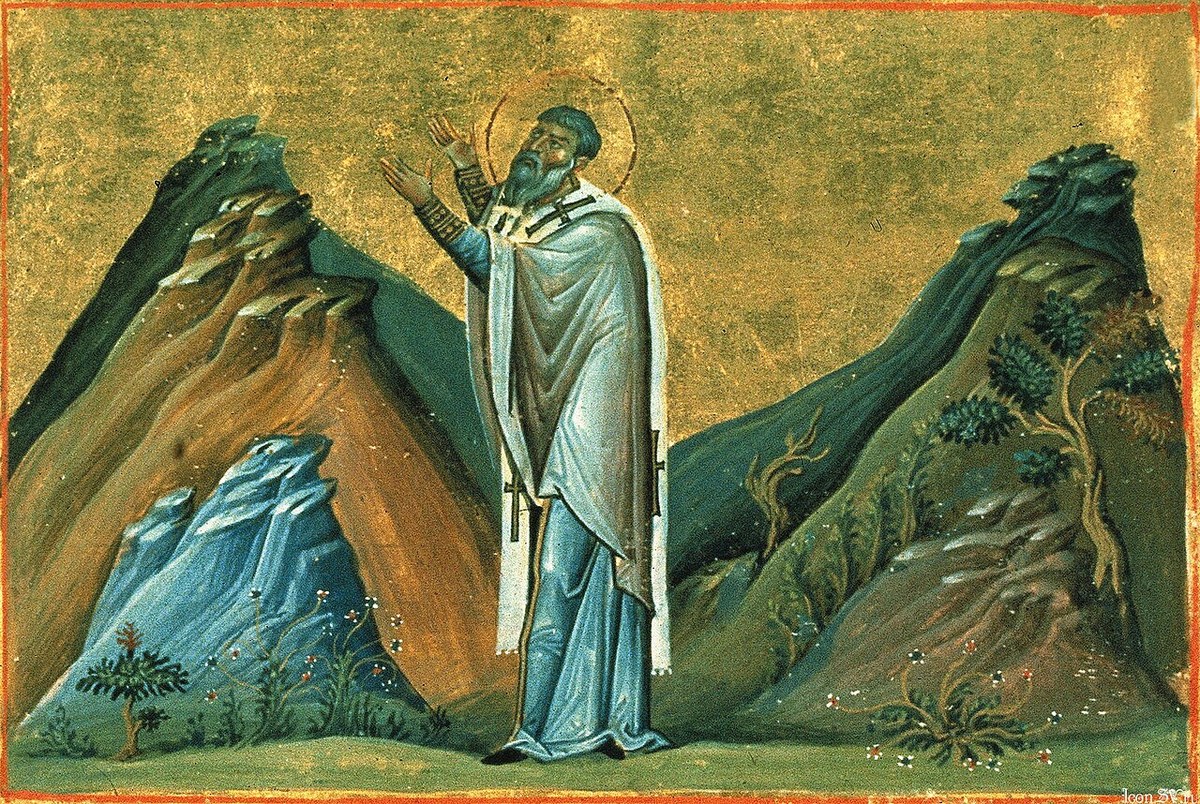
Abercius is depicted as a bishop of the early Church: an elderly hierarch with a short rounded or forked beard, in the phelonion and omophorion, blessing with his right hand and holding the Gospel book in his left. The stored image is his miniature from the Menologion of Basil II (Constantinople, c. 985, Vatican Library), one of the standard sources for the saints of the fixed year, showing the bishop full-length in hierarchical vesture. Some later Russian menaia-icons place him among the wonderworkers and, drawing on the Life, show the demon bearing the great altar-stone.
Disputed questions
- Not to be confused with the martyr Abercius who suffered with his sister Helen, commemorated on May 26 — a saint of the first century, named in the synaxarion as a son of the Apostle Alphaeus and put to death by the stings of bees. The names are identical (Greek Ἀβέρκιος, Slavonic Аверкий); the two saints have nothing else in common.