
Acindynus, Pegasius, Aphthonius, Elpidephorus and Anempodistus
The Holy Martyrs Acindynus, Pegasius, Aphthonius, Elpidephorus and Anempodistus, and the 7,000 with them, of Persia
Martyr
Commemorated 2 November
Acindynus, Pegasius, Aphthonius, Elpidephorus and Anempodistus were five martyrs of fourth-century Persia — courtiers and secret Christians at the court of King Shapur II — who confessed Christ before the king during his long persecution and were put to death around 341–345, together with a great multitude, reckoned by the tradition at seven thousand, who suffered with them. Their memory is kept together on November 2 with proper hymns that play on the meanings of their Greek names — "without danger," "flowing," "abundant," "hope-bearing," "unhindered" — turning the five into a single image of the grace that martyrdom pours out on the Church.
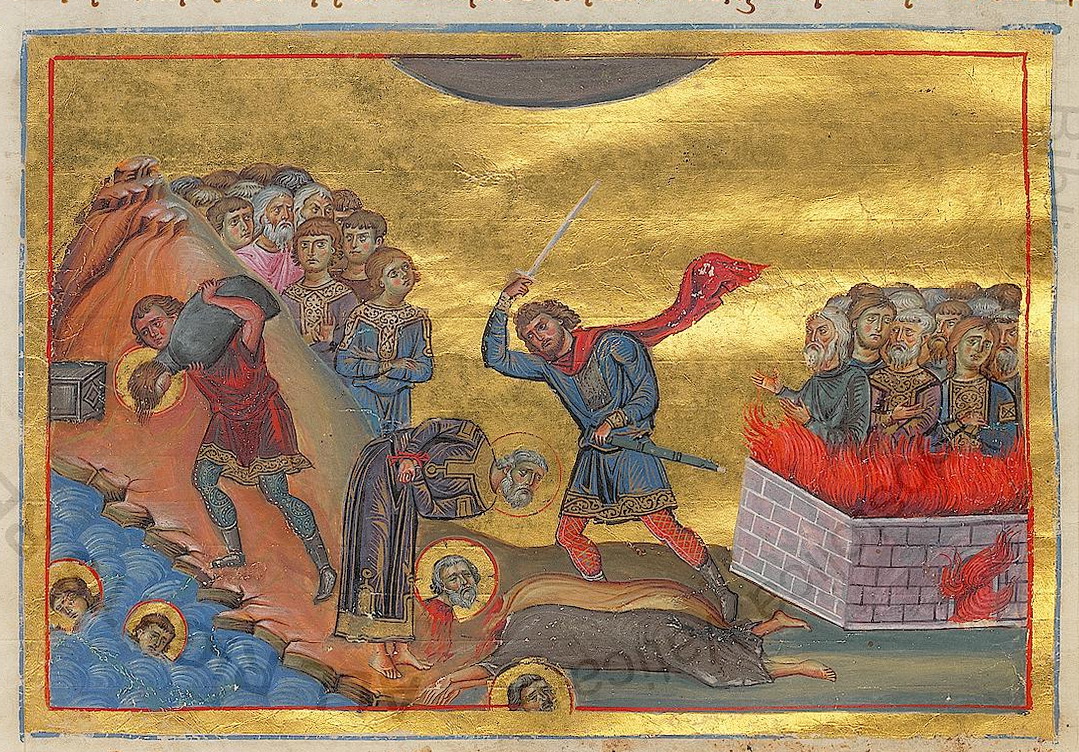
.jpg)
Origins and the persecution of Shapur II
The five belong to the great company of the Persian martyrs, whose sufferings under the Sassanid king Shapur II (309–379) made the church of Persia, in the words of the Byzantine tradition, a church of martyrs to rival the early Church under Rome. Shapur's persecution, unleashed from about 340 in the wake of his wars with the Christian Roman Empire, fell first on the clergy and then on Christians of every rank; the Syriac Acts of the Persian Martyrs preserve the names of many hundreds who died in it. The Greek passion of these five places them at the royal court itself: they are described as men of Shapur's own household — courtiers and men of the senate — who had received the faith in secret and lived as Christians while serving the king.
Martyrdom
As the account is transmitted, envious pagans of the court denounced them to Shapur. Summoned before him and questioned, they confessed their faith in the Holy Trinity without fear, and the king ordered them scourged. The passion that follows is composed in the heightened, miracle-laden manner of the Persian martyr-acts: the saints endure a succession of torments — the whip, the rack, fire — and are repeatedly delivered unharmed, so that onlookers among the king's people are moved to confess Christ and share their lot. The Greek synaxarion's verse notes that the contest of Aphthonius and of others was by fire and by the sword, marking that they did not all die in one manner or on one day.
The received narrative gives the martyrdom its shape in stages. Elpidephorus was beheaded outside the city walls, and with him — as an immense crowd followed the confessors to the place of execution, glorifying Christ — the soldiers on Shapur's order fell upon and massacred the whole procession of Christians, some seven thousand, whom the Church commemorates as suffering "with them." Acindynus, Pegasius and Anempodistus were reserved and burned on the following day; the tradition adds that the king's own mother, converted through what she had witnessed, died in the fire alongside them. When the flames had died, Christians came by night, found the bodies unconsumed, and buried them with reverence.
Feast and commemoration
November 2 (church date; Old Calendar civil November 15), kept universally in the Byzantine rite. The five martyrs carry a full proper service in the Menaion — a canon by Theophanes and proper stichera and kontakion built on the wordplay of their names — while the other Persian and allied memories of the day (the senators; Eudoxius, Agapius and their company; the women Kyriake, Domnina and Domne) are commemorated in the synaxarion without a separate service. The Slavic and Antiochian calendars keep the day identically.
Hymns
Troparion — Tone 2 (from the common of martyrs)
O victorious martyrs of the Lord, blessed is the earth that was enriched by your blood, and holy are the dwellings that received your spirits; for in the arena you triumphed over the enemy and proclaimed Christ with boldness. Entreat Him, since He is good, we pray, that He save our souls.
Original translation from the Greek
Kontakion — Tone 4
Made resplendent by the beauty of the Trinity, the five-rayed divine phalanx of the champions blunted the fierce assaults of the tyrants, pouring out upon all who with hope and longing draw near through them — abundant grace, unhindered and free of danger — to the Maker of all.
Original translation from the Greek
Sticheron
The five-shining lamp of the champions, like an axe among the trees of a thicket, after the manner of David hewed down the error of the enemy; and having confessed Christ before kings, they intercede unceasingly for our souls.
Iconography
The martyrs are shown as a group of confessors — most often in the court dress of Persian noblemen, bearded elders and younger men together, each holding the martyr's cross — set against the instruments of their death. The stored image is the miniature for November 2 in the Menologion of Basil II (Constantinople, c. 1000), depicting the saints and the multitude that suffered with them being led out and slain beyond the city.
Disputed questions
- Historicity. The passion is legendary in its detailed form — the serial miracles, the wholesale conversions at court, the round figure of seven thousand — and belongs to a hagiographic type rather than to documentary record. Its historical kernel, however, is entirely consistent with the well-attested persecution of Shapur II, under which Christians of the Persian court and nobility did in fact suffer; the Syriac martyr-acts attest the setting in sober detail.
- The names and their number. The five are transmitted with minor spelling variance (Pegasius/Pegasias, Elpidephorus/Elpidiphorus). The Greek synaxarion of the day distinguishes several allied memories that the later service gathered around the five: the senators or courtiers who suffered by the sword; the martyrs Eudoxius, Agapius "and eight others" who were perfected by fire; and the women martyrs Kyriake, Domnina and Domne, beheaded — so that the "seven thousand with them" of the title stands for a much larger company reduced, in the calendars, to these names. Per the practice of this repository the transmitted variance is recorded rather than harmonised.