
Adrian and Eubulus
The Holy Martyrs Adrian and Eubulus
Martyr · d. c. 308–309, at Caesarea
Commemorated 3 February — Martyrdom at Caesarea under the governor Firmilian
Adrian and Eubulus were two Christians of the region of Batanea who, at the height of the Diocletianic persecution, came to Caesarea to visit and comfort the confessors imprisoned there and were themselves seized. Brought before the governor Firmilian and refusing to sacrifice, they were cruelly tortured and condemned to the beasts of the amphitheatre: Adrian, after being given to a lion that did not finish him, was dispatched by the sword; Eubulus, offered his freedom if only he would sacrifice, chose death and suffered two days later — by the tradition preserved in Eusebius, the very last of the martyrs of Caesarea in that persecution. They are commemorated on February 3, and their courage in seeking out the imprisoned made them a byword for the works of mercy that the persecution could not extinguish.

The persecution at Caesarea
The martyrdom of Adrian and Eubulus is recorded by an eyewitness. Eusebius of Caesarea, in his tract On the Martyrs of Palestine — the roll of those who suffered in his own city and province during the Great Persecution of Diocletian and his successors — sets their deaths at the very close of the long ordeal, in the seventh year of the persecution (c. 309), under the governor Firmilian, whose severity fills the last chapters of that book. The two were not of the city itself but came from Batanea (the district of Manganaea, in the Hauran east of the Jordan), and they came to Caesarea for a purpose that the tradition remembers as their glory: to visit the confessors held in its prisons — to comfort those already condemned for the faith and, in the old phrase, to minister to the saints in bonds. It was an act of the works of mercy done in the teeth of the persecution, and it cost them their lives.
The martyrdoms
As they approached the city, or at its gate, Adrian and Eubulus were questioned, confessed themselves Christians, and were arrested and brought before Firmilian. Both refused to sacrifice to the gods, and both were subjected to the scourgings and the tearing of the sides that the governor's tribunal inflicted.
Adrian was condemned to the beasts. Cast to a lion in the arena, he was mauled but not killed outright, and was then dispatched by the sword — put to death, the account notes, on a day sacred to the pagan festival, his blood made part of the city's holiday. Eubulus suffered two days afterward. Brought again before the judge and offered his life and liberty if he would but sacrifice, he counted the freedom of confession dearer than the freedom of the body: he refused, and, after the beasts, was beheaded. Eusebius records — and the Church's memory has kept — that Eubulus was the last to be crowned at Caesarea in that persecution, so that the roll of the martyrs of his city closes with his name, and with it the ordeal itself soon after ended.
A note on the place
The Byzantine synaxaria and the Slavic and Greek service-calendars commonly locate Adrian and Eubulus at Caesarea in Cappadocia. The earliest and best witness, however — Eusebius, who wrote as the bishop of the city and a contemporary of the events — places them unmistakably at Caesarea in Palestine (Caesarea Maritima), the provincial capital where he himself lived and where the martyrs of his book suffered under Firmilian. The two cities of the same name were easily confused in later transmission, and the calendars' "Cappadocia" is best understood as such a confusion; the historical martyrdom belongs to the Palestinian Caesarea and to the persecution Eusebius chronicled. The disagreement is recorded here rather than silently resolved.
Feast and commemoration
Adrian and Eubulus are commemorated on February 3 (church date; Old Calendar civil February 16), on the day of the afterfeast of the Meeting. The Greek and Slavic calendars keep their memory together; the year is given as about 308–309, in the last stage of the Diocletianic persecution. This Eubulus, the martyr of Caesarea, is not to be confused with Eubulus the Apostle of the Seventy (kept February 28 with Nymphas), the companion of Paul greeted in 2 Timothy 4:21 — a wholly different person of the apostolic age who shares only the name.
Hymns
Troparion — Tone 4
Thy martyrs, O Lord, in their contest received incorruptible crowns from thee our God; for possessed of thy might, they cast down the tyrants and shattered the powerless boldness of the demons. By their prayers, O Christ our God, save thou our souls.
Original translation from the Greek
Troparion — Tone 4
Thy martyrs, O Lord, in their contest received incorruptible crowns from thee our God; for possessed of thy might, they cast down the tyrants and shattered the powerless boldness of the demons. By their prayers, O Christ our God, save thou our souls.
Original translation from the Greek
Iconography
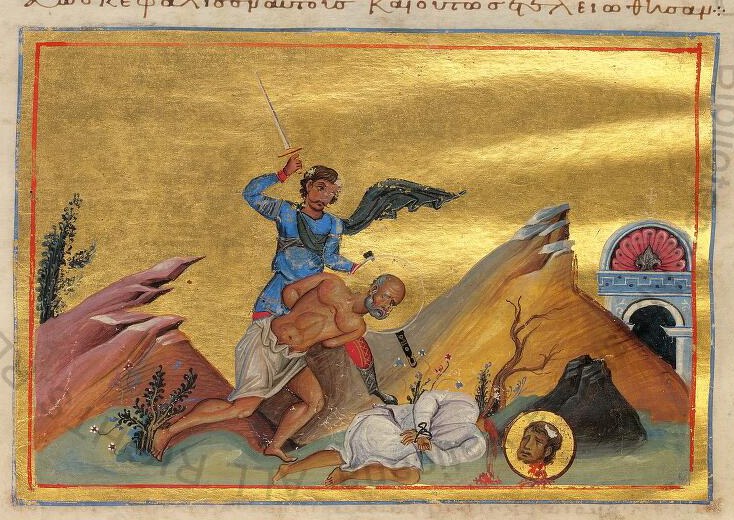
Adrian and Eubulus are shown together in the manner of paired martyrs: two young or middle-aged men in the tunic and cloak of laymen, each holding the small cross of martyrdom, standing side by side. Their narrative scene — proper to the account of their death — shows Adrian exposed to the lion in the arena and Eubulus beheaded, with the walls of Caesarea behind.
The stored image is the miniature of the Menologion of Basil II (Constantinople, 985): one martyr kneels beheaded — his haloed head upon the ground — while the sword is raised over his fellow, the walls of Caesarea's sanctuary in the hills behind; the manuscript's caption stands above the frame.