
Agapitus of Synnada
Our Father among the Saints Agapitus the Confessor and Wonderworker, Bishop of Synnada in Phrygia
Confessor · Wonderworker · Bishop · Venerable · b. late 3rd century, Cappadocia — d. mid-4th century
Commemorated 18 February
Agapitus (4th century) was a confessor and wonderworker, bishop of Synnada in Phrygia. Born in Cappadocia of devout parents in the last years of the pagan empire, he entered a monastery in his youth and became renowned for a gift of miracles — the healing of the sick and the casting-out of demons. Conscripted into the army under the emperor Licinius, he confessed Christ openly amid the persecution, was wounded but preserved unhurt, and comforted the martyrs who suffered beside him. After the victory of Constantine the Great, whose ailing servant he healed, he asked only to return to the monastic life; ordained priest and then chosen bishop of Synnada, he shepherded his flock and wrought many wonders, and reposed in peace. He is commemorated on February 18.

Origins and the monastic life
Agapitus was born in Cappadocia, of Christian parents, during the reigns of the emperors Diocletian and Maximian (284–305) — the very years of the last and fiercest persecutions. While still a young man he withdrew from the world and entered a monastery near Synnada in Phrygia, where his humility and obedience won him the love of his abbot, who saw to his instruction in letters and in the Scriptures. There, in the ascetic life, God granted him the gift of wonders: the tradition credits him with more than a hundred miracles — healings, the relief of the possessed, and, in one striking account, the destroying by prayer of a great serpent (a "dragon") that had ravaged the district, killing both men and beasts. His holiness was known throughout the region before ever he was called to the world's notice.
Confessor under Licinius
When Licinius (308–324), the persecuting rival of Constantine in the East, renewed the pressure on the Christians, Agapitus — a man of evident strength and standing — was conscripted into the army against his will. He did not conceal his faith. In the ranks he saw fellow-soldiers who were Christians tortured for Christ's name — the martyrs whom the synaxaria name with him, Victorinus, Dorotheus, Theodulus, and Agrippas — and he confessed openly with them. Wounded by a spear, he was, the account says, kept unharmed by the grace of God, and his constancy strengthened those who suffered. Thus, though he did not die, he stood as a confessor, bearing wounds and danger for the faith and not denying it.
Bishop of Synnada
The turn of the wheel came with the triumph of Constantine the Great. Hearing of Agapitus's power to heal, the emperor sent to him a gravely sick servant of his household, who was restored; and when Constantine offered a reward, the soldier-monk asked one thing only — his discharge from the army and leave to return to the monastery. It was granted at once. Back in the ascetic life, and after deeper study of the Gospel, he was ordained priest by the bishop of Synnada; and on that bishop's death the clergy and people with one voice chose Agapitus to succeed him as bishop of Synnada in Phrygia. As a hierarch he taught his flock the Orthodox faith and the way of virtue, continued to work healings and wonders — whence his title Wonderworker — and, having governed his church in peace, reposed in peace. He is kept on February 18.
Feast and commemoration
Agapitus is commemorated on February 18 (church date; Old Calendar civil March 3), the day given him in the Greek Menaion and the Slavic and OCA synaxaria alike. With him on this day the synaxaria remember the soldier-martyrs Victorinus, Dorotheus, Theodulus, and Agrippas, who suffered in the persecution he witnessed and survived (listed among the pending entries of this day). His feast falls in late winter, and, like the other commemorations of February 18, it often coincides with the pre-Lenten or Lenten season.
Hymns
Troparion — Tone 4
The truth of thy deeds revealed thee to thy flock as a rule of faith, an image of meekness, and a teacher of temperance; therefore by humility thou hast gained the things on high, and by poverty the things of wealth. O Father Agapitus, intercede with Christ God, that our souls may be saved.
Original translation from the Greek
Kontakion — Tone 2
A confessor unwavering and a wonderworker rich in grace, a shepherd taught of God and a healer of soul and body, thou didst adorn the throne of Synnada, O venerable Agapitus; entreat Christ God without ceasing on behalf of us all.
Original translation from the Greek
Iconography
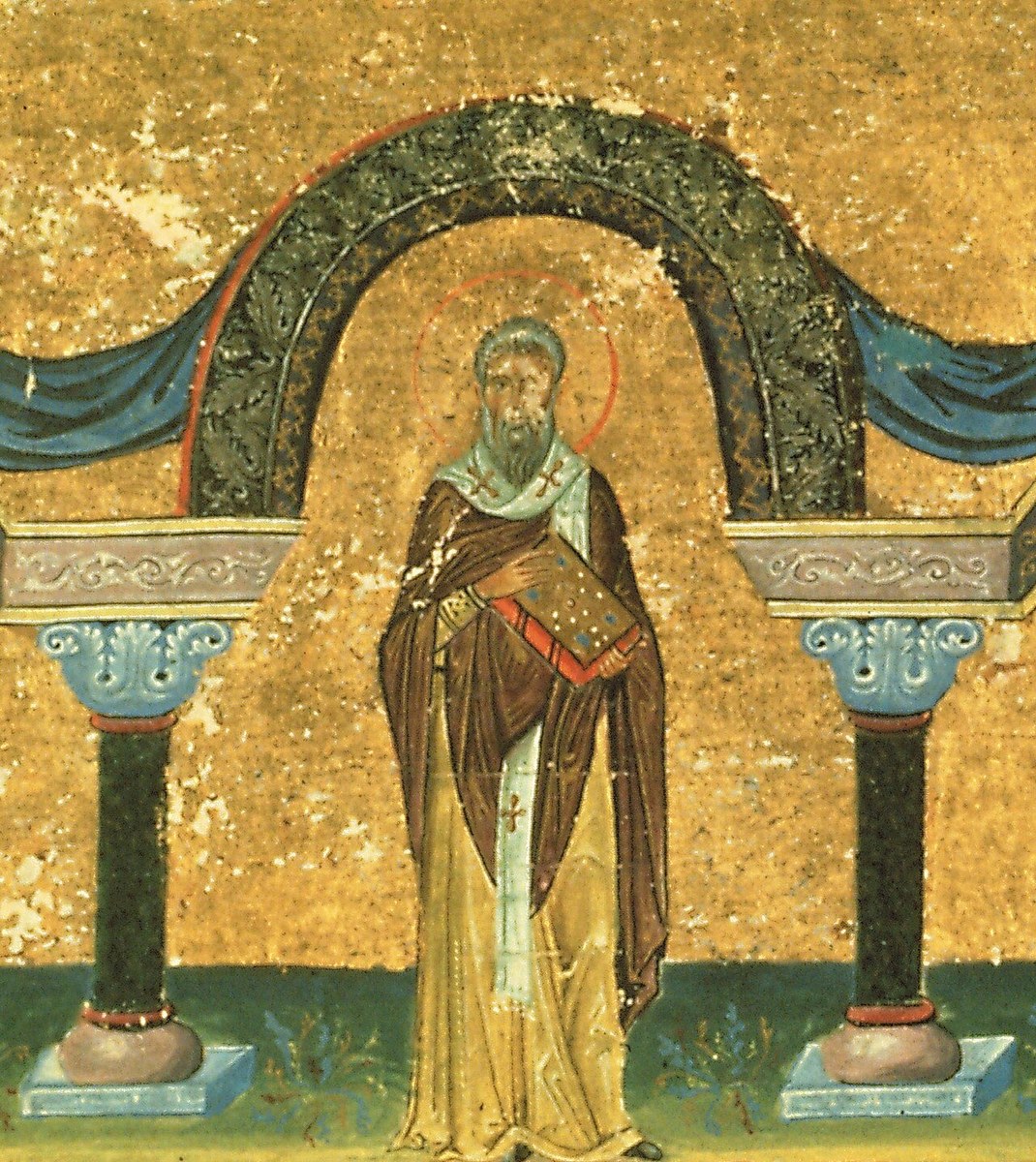
Agapitus is depicted as a bishop of the fourth century in the settled hierarch type — vested in the phelonion and the omophorion, holding the Gospel-book and blessing, a figure of middle age with a short dark or greying beard. The Menologion of Basil II gives him among the hierarchs of February. Where his life is shown in narrative, the scenes are his miracles — the healing of the sick and of Constantine's servant, and the destroying of the serpent that plagued Phrygia.
The stored image is the miniature for February 18 from the Menologion of Basil II (Constantinople, c. 985; Vatican, Vat. gr. 1613), inscribed for Agapitus the Confessor and Wonderworker, Bishop of Synnada: the saint vested as a bishop in the cross-marked omophorion, blessing (source, public domain, pd-old-work).
Disputed questions
- Synnada or Synaus. The Greek synaxaria and service-books style him variously bishop of Synnada (Σύνναδα) and of Synaus / Sinaos (Σίναος) — two towns of Phrygia often confused in the manuscripts, and the source of the garbled forms ("of Sinai," "Σινάου") found in some lists. The dominant tradition, and the Slavic and OCA lives, name him bishop of Synnada in Phrygia, followed here.
- Not to be confused with the several other saints named Agapitus / Agapetus: the Roman Pope Agapetus I (†536, kept April 17 in the East); Agapitus the deacon-martyr of Rome (kept August 6 / 18); or Agapitus of the Kiev Caves, the unmercenary physician (†1095, kept June 1). This Agapitus is the confessor-bishop of Phrygia, of February 18.