
Agathoclia
The Holy Martyr Agathoclia
Martyr
Commemorated 17 September
Agathoclia was a Christian slave in the household of a man named Nicolas, himself a Christian, and his pagan wife Paulina. For eight years her mistress tormented her for her faith — beatings, forced walking barefoot over sharp stones, a rib broken with a hammer, her tongue cut out, and starvation in confinement — and, unable to break her, finally killed her. The synaxaria transmit no place or date for her contest. She is commemorated on September 17.
.jpg)
The whole of Agathoclia's record is a single synaxarion notice, and her Life is honestly brief. She was a servant (the sources say a slave) in a divided house: her master Nicolas was a Christian, her mistress Paulina a pagan, and it was from the mistress that the persecution came — a domestic martyrdom, without governor or tribunal. For eight years Paulina tried to force her to worship the idols: she beat her savagely, drove her barefoot over sharp stones, and in one fit of rage broke her rib with a hammer-blow and cut out her tongue. When cruelty failed she tried starvation, shutting the maid away without food; the tradition relates that birds brought Agathoclia her daily bread, as the raven fed Elias. At last Paulina went in to the prisoner and murdered her. The Greek verses for the day say that she "bears fire upon her neck," suggesting that the final torment was by burning coals or hot embers poured upon her — the detail by which the epigrammatist chose to remember her: with the fire on her own neck she burned the neck of dreadful error.
No year, reign, or city is transmitted; the era of her contest is unknown, and this entry accordingly asserts none.
Veneration and later cultus
Agathoclia appears in the Greek synaxaria on September 17 and passed also into the Western martyrologies on the same day. In Spain she is venerated — as a virgin martyr, by a local tradition that elaborates well beyond the Greek notice — as the patroness of the town of Mequinenza in Aragon, whose festival is likewise kept on September 17; devotional literature (gozos) in her honour was printed there into the modern era. The relation of the Spanish patroness to the slave-martyr of the synaxarion is a matter of received identification rather than documented history.
Feast and commemoration
September 17 (church date; Old Calendar civil September 30), within the afterfeast of the Elevation of the Cross, on the OCA calendar and in the Greek synaxarion alike (both consulted live). She has no proper service; the day's office belongs to the feast and to Sophia and her daughters.
Hymns
Troparion — Tone 4 (from the common of a woman martyr)
Thy ewe-lamb Jesus crieth out with a great voice: Thee, my Bridegroom, do I love, and seeking Thee I contend, and am crucified and buried with Thee in Thy baptism; I suffer for Thy sake, that I may reign with Thee, and I die for Thee, that I may live in Thee. Receive me therefore as a spotless sacrifice, slain for Thee with love. By her intercessions, O Merciful One, save our souls.
Original translation from the Greek
Iconography
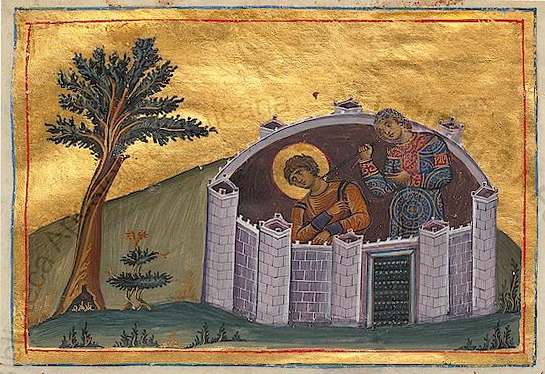
The stored image is the miniature for her commemoration in the Menologion of Basil II (c. 1000), identified by its inscription: within the round walls of her prison the haloed martyr is slain by her persecutor — the manuscript's rendering of her murder in confinement. Later icons are rare; she would be painted as a woman martyr with a cross, without distinguishing attributes.
Disputed questions
- Era and place. Nothing is transmitted. Later Western sources supply dates and settings for the Spanish cultus, but none has ancient authority; the century is left unstated here.