
Agathon of Rome
Our Father among the Saints Agathon the Wonderworker, Pope of Rome
Bishop · Wonderworker · b. c. 577, in Sicily — d. 681, at Rome
Commemorated 20 February — Commemoration in the Byzantine calendar (repose January 10, 681)
Agathon (c. 577 – 681) was Pope of Rome from 678 to 681, under whom the Sixth Ecumenical Council — Constantinople III (680–681) — condemned the heresy of Monotheletism, the teaching of a single will in Christ. A Sicilian of Greek origin, born about Palermo, he gave away his inheritance to the poor, became a monk, and served long as treasurer of the Roman church before his election. When the Emperor Constantine IV summoned a council to end the long controversy over the wills of Christ, Agathon gathered the Western bishops in synod and sent to Constantinople a celebrated dogmatic letter confessing the two natural wills and two energies of the incarnate Word, which the Council received with acclamation as the voice of Peter, and upon which it framed its definition. Renowned besides for the multitude of his miracles — whence the Greeks style him Thaumaturgus, the Wonderworker — he reposed in 681. The East keeps his memory on February 20; the West on January 10, the day of his repose.
.jpg)
Origins and monastic beginnings
Agathon was born about the year 577, a Sicilian — the tradition places his birth near Palermo — and of Greek stock, in the age when Sicily was a Greek-speaking province of the Byzantine Empire and a nursery of Greek monasticism and of Greek popes. His parents were devout Christians who gave him a good education; on their death he distributed the inheritance that came to him to the poor and embraced the monastic life, the tradition naming the monastery of Saint John (San Giovanni degli Eremiti, later so called) at Palermo. Coming in time to Rome — as many Sicilian clergy did in that century, some fleeing the first Arab raids on the island — he was received into the service of the Roman church and rose to be its treasurer (arcarius), esteemed for his administration and his charity, before he was chosen for the papacy.
Pope of Rome
On the death of Pope Donus, Agathon was elected bishop of Rome and consecrated in 678 (some Eastern reckonings 679). His short pontificate of about two and a half years fell at the decisive moment of the Monothelete controversy. For half a century the imperial court at Constantinople had promoted, first the doctrine of one energy and then of one will in Christ — Monenergism and Monotheletism — as a formula to reconcile the Chalcedonian and the non-Chalcedonian; and the great confessors of Orthodoxy, Maximus the Confessor and Pope Martin of Rome, had suffered and died under it. Now the Emperor Constantine IV (Pogonatus), seeking peace and unity, invited the Pope to send representatives to a general council at Constantinople.
The Sixth Ecumenical Council
Agathon met the summons with care and weight. He first held a synod at Rome — the tradition numbers it a gathering of some hundred and twenty-five Western bishops (Easter 680) — to establish a common confession, and then dispatched his legates to the East bearing two letters: one in his own name, and one, longer and dogmatic, in the name of the Roman synod. This Letter of Agathon to the Emperor set out, with full patristic documentation, the faith of two natural wills and two natural operations in the one Christ — a human will and a divine, distinct and unconfused, the human ever freely conforming to the divine — grounding it in the Chalcedonian confession of two natures and in the witness of the Fathers.
The Sixth Ecumenical Council (Constantinople III) opened in the domed hall of the imperial palace on 7 November 680 and sat until September 681. Agathon's letter was read in its fifth and later sessions and received with acclamation — the Fathers crying, in the phrase the tradition remembers, that Peter had spoken through Agathon — and the Council's definition of faith confessed the two wills and two energies in Christ, anathematizing Monotheletism together with its chief promoters (among them, notoriously, the former Pope Honorius, condemned by name for his silence and complicity). The Council thus set the seal of the sixth of the Ecumenical Councils on the Christ of Chalcedon: perfect God and perfect man, with all that belongs to each nature, will and operation alike, whole and entire in the one Person.
Repose and the wonders
Agathon did not live to see the Council close: he reposed on 10 January 681, while its sessions were still in progress, in extreme old age — the Western tradition, perhaps with pious exaggeration, reckons him more than a hundred years old. The multitude of miracles ascribed to him, in life and after, won him from the Greeks the title Thaumaturgus, "the Wonderworker"; the tradition tells in particular of his healing of a leper, whom he embraced and kissed, and who — so the account runs — was revealed as a messenger of God. He was venerated at once as a saint, and his memory is kept in both East and West as a champion of the Orthodox faith of the Sixth Council.
Feast and commemoration
Agathon is kept in the Byzantine calendar on February 20 (church date; Old Calendar civil March 5), in the Greek, Slavic, and Antiochian synaxaria, together with Leo of Catania and Bessarion the Great. The Roman calendar commemorates him on January 10, the day of his repose. The Menaion for February 20 carries his synaxarion notice and distich; his sung office is that of a holy hierarch.
Hymns
Troparion — Tone 4
The truth of thy deeds revealed thee to thy flock as a rule of faith, an image of meekness, and a teacher of temperance; therefore by humility thou hast gained the heights, and by poverty riches. O Father and Hierarch Agathon, intercede with Christ our God that our souls may be saved.
Original translation from the Greek
Iconography
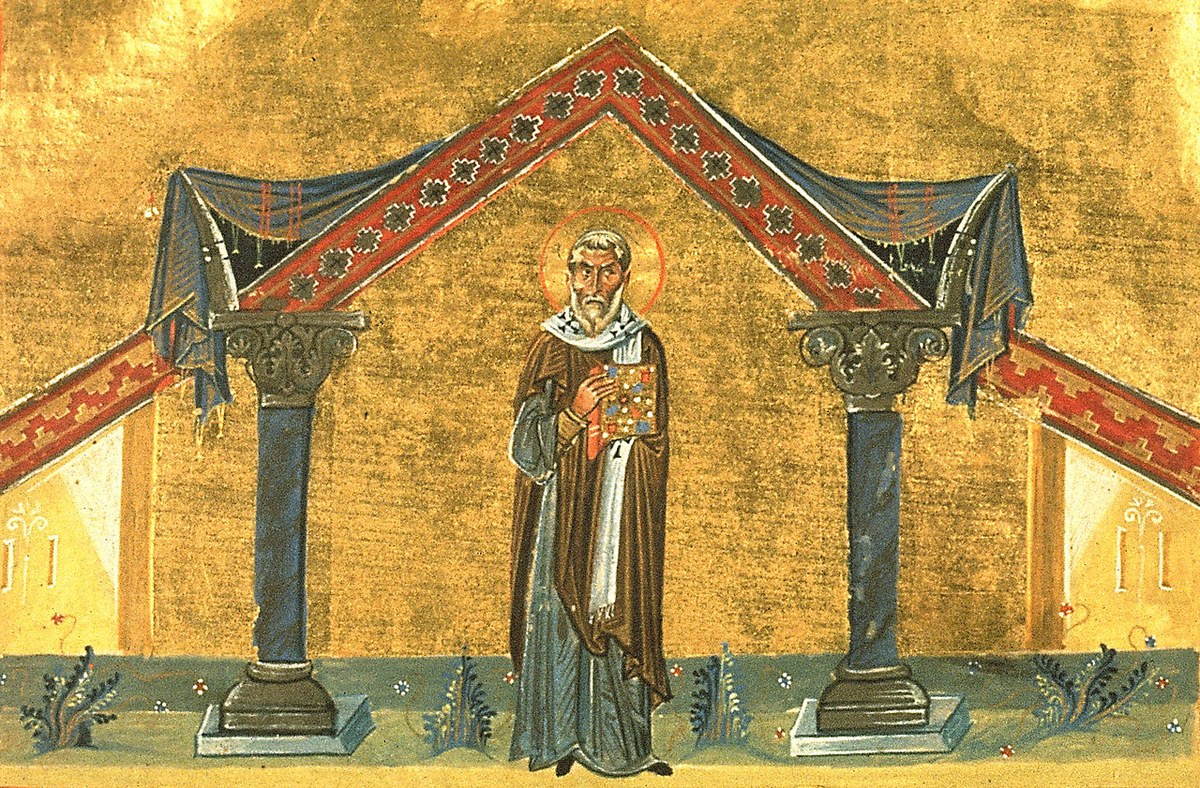
Agathon is depicted as a holy pope of Rome — vested as a hierarch in the phelonion and omophorion, blessing and bearing the Gospel, and (in the Latin tradition) sometimes with the papal insignia — an aged, white-bearded figure. The stored image is the miniature for February 20 from the Menologion of Basil II (Constantinople, c. 985): Agathon shown as a haloed bishop in the standing hierarch's posture (source, public domain, pd-old-work).
Disputed questions
- The year of election and repose. His consecration is dated 678 (June 27) in the Western records, 679 in some Eastern notices; his repose to 10 January 681, which the Slavic books sometimes render as 682. The day of the Byzantine commemoration, February 20, does not coincide with the day of his death; the East keeps him on the synaxarion day, the West on the day of repose.
- Not to be confused with Agathon, Wonderworker of the Kiev Caves (venerable of the Far Caves, commemorated the same February 20 and among the monks of the Kiev Caves on August 28), a Russian ascetic of the thirteenth–fourteenth century; nor with Agatho the Great, the Egyptian desert father of the Apophthegmata (Abba Agatho, of "the stone in the mouth"), a distinct saint of the fifth-century desert. "Pope of Rome" and "the Wonderworker" in this entry belong to Agathon of Rome alone.