
Agnes of Rome
The Holy Virgin-Martyr Agnes of Rome
Virgin · Martyr · Child Martyr · b. c. 291, at Rome — d. c. 304, at Rome
Commemorated 21 January — Martyrdom at Rome under Diocletian
Agnes of Rome (c. 291 – c. 304) is one of the most celebrated virgin-martyrs of the undivided Church, a girl of about twelve or thirteen who gave her life at Rome in the Great Persecution rather than betray her consecrated virginity or deny Christ. Born of a noble Christian family and sought in marriage by the son of the city prefect, she answered that she had already a Bridegroom, Christ, whom she would not forsake; denounced as a Christian, she was subjected to shame and threat — exposed, the tradition says, in a house of ill fame, where her hair grew to veil her and an angelic light shielded her, and where those who assailed her were struck down. Neither seduction, nor terror, nor fire could move her; she was at last slain by the sword. Venerated at once at her tomb on the Via Nomentana, over which a basilica rose, she is kept on January 21, and her name — near the Latin agnus, a lamb — made her the very emblem of innocence.

Agnes was a Roman, of a noble and wealthy family that was secretly Christian, born about the year 291. From childhood she had consecrated her virginity to Christ, resolving to have no bridegroom but the Lord. She was, all the accounts agree, remarkably beautiful, and while still a girl of about twelve or thirteen she was sought in marriage by many of the young nobility of Rome, and above all by the son of the prefect of the city (named in the tradition Sempronius). To every suit she gave the same answer: that she was already betrothed to a Bridegroom greater than they, the Son of God, to whom she had given her whole love and her whole faith, and whom she would never forsake. The rejected suitor fell sick with longing, and his father, learning the cause and learning too that Agnes was a Christian, saw his opportunity: he summoned her, and by turns coaxed and threatened her, setting before her the instruments of torture and the honours of marriage alike. The child stood unmoved, confessing Christ.
The prefect then ordered her stripped and led to a house of shame, that her virginity might be assailed where it could not be broken by law. But the tradition surrounds her exposure with wonders: her hair grew miraculously long to cover her nakedness; an angel filled the place with a blinding light and clothed her in a robe of brightness, so that none could look on her or approach her; and the prefect's son, rushing in with others to violate her, was struck dead (some say blinded), and was raised again, or healed, by the prayer of the very maiden he had wronged. Foiled and enraged — and, when the miracle was ascribed by the mob to sorcery, pressed to be rid of her — the prefect condemned her to death. The tradition tells that she was cast into the fire, but the flames parted around her and would not burn her, some accounts saying the fire turned instead upon her persecutors; and that at the last the executioner plunged a sword (or dagger) into her throat, and so the child gave up her soul, about the year 304, in the persecution of Diocletian. She is honoured as a virgin-martyr and, for her tender age, a child-martyr, whose steadfastness shamed the strong.
Relics and cultus
Agnes was buried by her family in their ground on the Via Nomentana outside Rome, and her tomb became at once a place of veneration. Within a generation of the Peace of the Church, Constantina, daughter of the emperor Constantine, raised a basilica over her grave — Sant'Agnese fuori le mura, "St Agnes outside the walls," which stands to this day and guards her relics. Her fame spread through the whole Church, East and West: Ambrose of Milan and the poet Prudentius and Augustine and Jerome all praised her, Ambrose making her in his treatise On Virgins the very pattern of Christian maidenhood, and marvelling that "a new kind of martyrdom" had been found, in one too young for punishment yet ripe for victory — "a child in years, but a mother in faith." Her name, echoing the Latin agnus, "lamb," bound her forever to the innocence of the Lamb of God, and to this day lambs are blessed on her feast at Rome, from whose wool are woven the pallia of the archbishops. Though her cultus arose and flourished in the West, Agnes belongs to the undivided Church, and the Orthodox Church in America and other Orthodox calendars keep her memory among the saints of the ancient West.
Feast and commemoration
January 21 (church date; Old Calendar civil February 3), the day of her martyrdom, kept in the Roman Church and, among the Orthodox, by the OCA and calendars that receive the ancient Western saints, together with Maximus the Confessor and the other commemorations of the day. In the West a second feast on January 28 (the octave) was long kept; the Orthodox commemoration is the January 21 day of her passion.
Hymns
Troparion — Tone 4 (common of a virgin-martyr)
Thy lamb Agnes crieth out to thee, O Jesus, with a great voice: I love thee, my Bridegroom, and in seeking thee I endure the contest; I am crucified and buried with thee in thy baptism, and I suffer for thy sake, that I may reign with thee; I die for thee, that I may live in thee. Accept me as a spotless sacrifice, offered in love to thee. By her prayers, O merciful One, save our souls.
Original translation from the Greek
Iconography
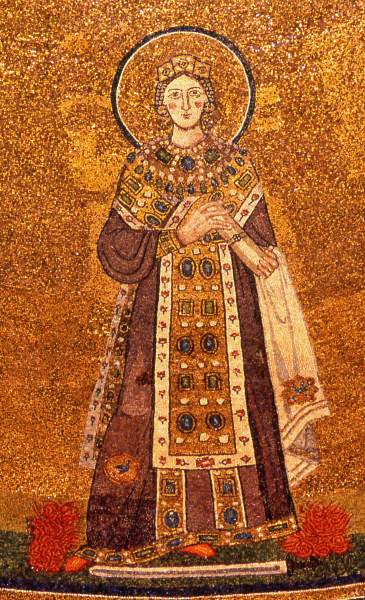
Agnes is depicted as a young girl, richly or simply robed, most often with a lamb — the attribute her name gave her — held in her arms or at her feet, and bearing the palm and crown of martyrdom; the flames of her passion and the sword appear in narrative images, and the miraculously grown hair veiling her is shown in Western cycles. The stored image is the figure of St Agnes from the apse mosaic of Sant'Agnese fuori le mura at Rome (c. 625) — the ancient basilica over her tomb — where she stands in the golden field of the apse, robed as a Byzantine empress with the sword of her martyrdom at her feet, between two popes: the oldest great image of the saint, a faithful reproduction of which is stored under the pre-1900 public-domain doctrine (§8).
Disputed questions
- The manner of her death. The two oldest strands differ: some accounts (following Prudentius) make the sword the instrument of her death, others the fire, and the received tradition combines them — the fire that would not burn her, and the sword that at last did. The fact of her martyrdom at Rome in the Great Persecution, while very young, is constant.
- A Western saint on the Byzantine day. Agnes is a saint of the ancient Roman Church, kept in the West and by the Orthodox Church in America on January 21; the Greek and most Slavic Menaia do not carry her, whose day is led by Maximus the Confessor. Her presence on the Orthodox calendar is by the reception of the saints of the undivided Church.