
Agrippina of Rome
The Holy Virgin-Martyr Agrippina of Rome
Martyr · Virgin · d. c. 253–262, at Rome
Commemorated 23 June — Martyrdom at Rome; her relics venerated at Mineo in Sicily
Agrippina was a Roman virgin of the third century who refused marriage, consecrated herself wholly to Christ, and — in the persecution the Greek acts assign to Valerian (253–259) — presented herself before the tribunal of her own accord and confessed the faith. She was beaten with rods until her bones were broken and bound in chains, from which an angel loosed her, and she died of the injuries. Three Christian women, Bassa, Paula and Agathonike, carried her body out of Rome and by sea to Sicily, where it was laid at Mineo in the interior of the island; there her tomb became one of the great healing shrines of the Sicilian Greeks, and she remains to this day the patroness of the town. She is one of the small group of Roman martyrs whose cultus was carried by relics into the Byzantine world and returned to Rome only as a memory: the Greek Menaia keep her on June 23, and the Sicilian and Italo-Greek tradition keeps her with a festivity older than the Norman conquest of the island.

A Roman virgin
Nothing certain is known of Agrippina's family beyond what her passion states — that she was Roman by birth and of a household of some standing, which is what the name implies; Agrippina is a patrician cognomen, borne in the first century by the mother and by the wife of emperors, and its appearance on a Christian girl of the mid-third century suggests a family that had kept the old Roman names.
The one thing the tradition insists on is her refusal of marriage. She would not be given to a husband, and dedicated her virginity to God — the earliest and most characteristic form of the consecrated life for women in the pre-monastic Church, lived not in a community but in the household, under the eye of the local church. The Greek acts present this refusal as the root of everything that followed: it made her conspicuous, and when the edict came she was already known as a Christian who had set herself apart.
Confession and passion
The Greek passion places her death under the emperor Valerian, whose two rescripts of 257 and 258 struck first at the clergy and the Christian gentry and then at everyone who would not sacrifice. Agrippina did not wait to be denounced. She came before the magistrate of her own accord and confessed Christ — a voluntary confession of the kind the Church honoured but never commanded — and refused the sacrifice.
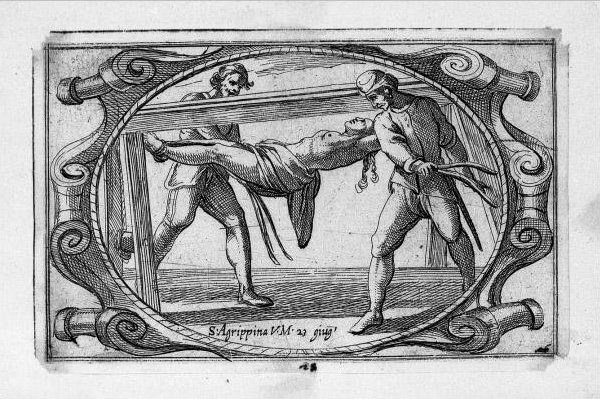
She was sentenced to be beaten with rods, and the beating was pressed until her bones were broken. The acts then relate that she was loaded with chains and shut up, and that an angel came in the night and loosed the irons from her; the detail is a commonplace of the martyr-acts and is drawn from Acts 12, but here it carries the point that the Roman power could break her body and not hold her. She did not survive the injuries: unlike most of the virgin-martyrs of the Roman cycle she was not beheaded but died of her torments, and is therefore reckoned among the martyrs by the manner of her dying rather than by a sentence of execution.
The voyage to Sicily and the shrine at Mineo
The removal of her body is the substance of her cultus. Three Christian women — Bassa, Paula and Agathonike — took the martyr's body secretly, brought it out of the city, and carried it by ship to Sicily; the acts add that the voyage was made under angelic guidance, and the Sicilian tradition fills out the detail with a landing on the southern coast and a journey inland. The relics came to rest at Mineo, the ancient Menai in the hills west of Catania, in a rock-cut crypt over which the church of Sant'Agrippina was afterwards raised.
At that tomb the sources report a continuous stream of healings. The saint was invoked in Sicily against fevers and infections, against leprosy, against the assaults of evil spirits — Mineo was a place of exorcism — and, in an island that lives under Etna and under violent summer storms, against thunder and lightning. She was also credited with turning back an Arab raiding force from the town, a memory that belongs to the ninth or tenth century and shows the shrine still functioning under Muslim rule. The Byzantine chroniclers add a translation of the relics to Constantinople in the eleventh century, an operation of the sort the Comnenian emperors undertook repeatedly, though Mineo has never conceded that its saint left the island (see Disputed questions).
Later cultus
Agrippina's feast at Mineo is among the oldest continuously kept in Sicily and is celebrated with three annual festivities rather than one, in May, in June for the feast proper, and in August. Sicilian emigration carried the cult across the Atlantic: the Mineo colony in the North End of Boston has kept her feast every summer since 1914, which makes her one of the very few third-century Roman martyrs with an unbroken living lay cultus in North America.
In the Greek and Slavic books she is a plain entry of the synaxarion — the Roman virgin who confessed and was beaten to death — and her name entered the Russian calendar with the rest of the Constantinopolitan synaxarion. She has no proper canon of her own in most recensions of the Menaion, being served with the common of a woman martyr.
Feast and commemoration
June 23 (church date; New Calendar civil June 23, Old Calendar civil July 6). Agrippina is a universal commemoration of the Byzantine calendar, carried by the Synaxarion of Constantinople and by the Greek, Slavic and Antiochian books alike, and she is the principal saint of the day in Greek usage. She is served with the office of the common of a woman martyr; where a proper canon exists it is a late supplement.
In the West her feast was also June 23 until the calendar reform of 1969 removed her from the general Roman calendar; she is kept at Mineo, in the diocese of Caltagirone, and by Sicilian communities in the diaspora. On the Old Calendar her day falls on civil July 6.
Hymns
Apolytikion — Tone 4
Thy lamb, O Jesus, cries aloud: O my Bridegroom, thee I long for, and contending I am crucified and buried with thee in thy baptism; I suffer for thy sake, that I may reign with thee; I die for thee, that I may live in thee. Receive me as a spotless offering, for I am slain in love of thee. By her prayers, O merciful one, save our souls.
Kontakion — Tone 4
Thou didst spurn an earthly bridegroom and keep thy virginity unspotted for Christ, and being broken with rods thou wast not broken in soul, O all-honoured Agrippina; wherefore thy relics, borne over the sea, pour out healing upon the faithful who cry: Rejoice, O boast of Rome and shelter of the island.
Original translation from the Greek
Iconography
Agrippina is painted in the Byzantine manner as a young woman without veil or monastic habit, in a long tunic and a mantle drawn over one shoulder, her hair bound; she holds the martyr's cross in her right hand, the left open before her breast in the gesture of prayer. Her attribute in the narrative scenes is the rod or bundle of rods with which she was beaten, and — where the fuller cycle is painted — the ship carrying her body to Sicily, with the three women aboard it. In Sicilian art she is crowned and carries the palm, and the fifteenth-century marble statue in the mother church at Mineo, which is carried in procession, shows her as a girl of the local type with the palm and a small model of the town.
The stored image is not an icon but a Roman engraving of about 1600 by Antonio Tempesta, from his suite Imagini di molte SS. vergini Romane nel martirio: the saint stretched on a frame and beaten by two soldiers, within an elaborate cartouche, and inscribed at the foot "S. Agrippina V.M. 23 giug." — Saint Agrippina, Virgin and Martyr, 23 June. It is stored because it is unambiguously identified by its own inscription, is securely pre-1900, and depicts her passion exactly as the acts describe it; but it is a Western baroque print and its idiom is not that of the Church's iconography. A Byzantine or Cretan panel of the saint remains wanted.
Disputed questions
The date. The Greek acts assign her passion to Valerian (253–259), and the Orthodox day-books give the round figure "253." The Latin martyrologies and the modern Sicilian tradition prefer 262, which would place the death after Valerian's capture by the Persians in 260 and therefore under Gallienus, whose edict of toleration ended the persecution. The Wikidata record follows a third figure, 258 — the year of Valerian's second rescript, and the likeliest of the three if the persecution setting is accepted at all. The discrepancy is not resolvable from the sources and is best stated as c. 253–262.
Historicity. Alban Butler, followed by the Bollandist tradition, judged the acts preserved in the Greek Menaia to be unreliable, and observed that there is no early Roman evidence — no entry in the Depositio martyrum, no ancient Roman church, no inscription — for a martyr of this name. What is undoubtedly ancient is the Sicilian cult at Mineo. The most economical reading is that Agrippina is a genuine martyr whose memory was preserved in Sicily rather than at Rome, and that the Roman setting of the acts was supplied later from her name and the tradition of the relics' voyage; but the acts as transmitted are hagiographic romance and should not be pressed for detail.
Where the relics are. The Byzantine tradition of an eleventh-century translation to Constantinople and the Sicilian claim of continuous possession at Mineo cannot both be wholly true. Partial translations were normal, and the likeliest reconciliation is that a portion went east while the principal relics stayed in the crypt at Mineo; the Orthodox day-books record the translation, the Sicilian church does not.
Her companions. Bassa, Paula and Agathonike are not martyrs and have no feast; they appear only as the bearers of the body. A Bassa and an Agathonike are separately commemorated elsewhere in the calendar, and the names should not be conflated.