
Ahijah the Shilonite
The Holy Prophet Ahijah the Shilonite
Prophet · d. 10th century BC
Commemorated 12 November
Ahijah the Shilonite (in Greek Achias) was a prophet of the tenth century before Christ, from the ancient sanctuary town of Shiloh, active in the reigns of Solomon and Jeroboam. He is remembered for two great oracles of the First Book of Kings: the tearing of a new garment into twelve pieces, by which he foretold the division of Solomon's kingdom and Jeroboam's rule over ten tribes; and, in his blind old age, the prophecy of the death of Jeroboam's son and the doom of his idolatrous house. The Orthodox Church numbers him among the holy prophets of the Old Covenant and commemorates him on November 12.
.jpg)
Ahijah belonged to Shiloh, the town in the hill country of Ephraim that had been the resting-place of the Ark and the central sanctuary of Israel in the days of the judges, before the rise of Jerusalem. He appears in the Scriptures at the end of Solomon's reign, when the king's foreign marriages and toleration of idolatry had provoked the divine sentence that the united monarchy would be torn apart.
The first of his recorded acts (1 Kings 11:29–39) is among the most vivid prophetic sign-actions of the Old Testament. Meeting Jeroboam son of Nebat, one of Solomon's officials, alone on the road outside the city, Ahijah took the new cloak he was wearing and tore it into twelve pieces, bidding Jeroboam take ten of them: so, he declared, God would rend ten tribes from the house of Solomon and give them to Jeroboam, leaving one tribe to David's line for the sake of the covenant and of Jerusalem. The word came to pass after Solomon's death, when the northern tribes broke from Rehoboam and made Jeroboam king of Israel.
The second oracle (1 Kings 14:1–18) came at the close of Ahijah's life, when he was old and blind. Jeroboam, now king and the author of the golden calves set up at Bethel and Dan, sent his wife in disguise with a gift to inquire of the prophet about their sick son Abijah. Ahijah, though sightless, knew her at the door by the word of the Lord, and gave a stern answer: because Jeroboam had done more evil than all before him and led Israel into idolatry, his house would be utterly cut off, and the child — in whom alone some good was found — would die as she returned home, and be the only one of that house to be mourned and buried. So it fell out. The Second Book of Chronicles (9:29) further names "the prophecy of Ahijah the Shilonite" among the written sources for the acts of Solomon, marking him as one of the recording prophets of the age.
Ahijah died at Shiloh; no account of his death survives beyond the tradition of his repose in his own town. The Church honours him for the fearlessness of his witness — announcing judgement alike upon the great Solomon and upon the king his own oracle had raised up — and reads his rending of the garment as a figure of division healed only in Christ.
Feast and commemoration
November 12 (church date; Old Calendar civil November 25). His commemoration is kept in the Byzantine synaxaria among the Old Testament prophets; as with the other prophets, the day's service borrows the common of a prophet, and the Menaion preserves for him a synaxarion distich recalling that Ahijah was, before his death, a witness against Jeroboam son of Nebat.
Hymns
Troparion — Tone 2
As we celebrate the memory of your prophet Ahijah, O Lord, through him we beseech you: save our souls.
Original translation from the Greek
Iconography
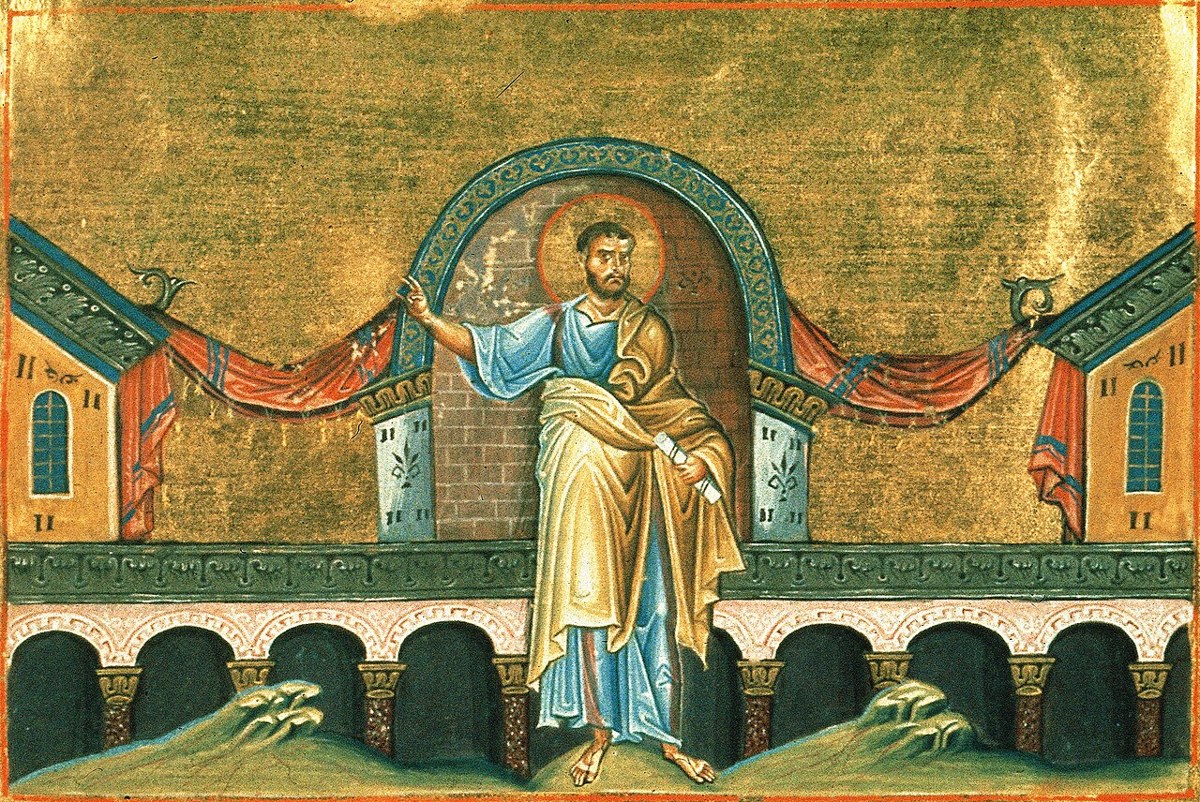
Ahijah is depicted as an Old Testament prophet: an elderly, long-bearded figure in a mantle, holding a scroll, often shown in the act of tearing a garment, the sign that identifies his prophecy. The stored image is a miniature from the Menologion of Basil II (Constantinople, c. 985), which portrays him standing with a scroll.