
Akepsimas, Joseph and Aithalas
The Holy Hieromartyrs Akepsimas the Bishop, Joseph the Presbyter and Aithalas the Deacon of Persia
Hieromartyr · Bishop · Priest · Deacon · Martyr · d. c. 378
Commemorated 3 November
Akepsimas, Joseph and Aithalas were leaders of the Church in Persia — a bishop, a priest, and a deacon — martyred under the Sassanid king Shapur II around the year 378, near the end of the forty-year persecution he waged against the Christians of his realm. Akepsimas, bishop of the city of Naeson, was arrested an old man of eighty and held three years in prison with the seventy-year-old priest Joseph and the deacon Aithalas; when all three refused to worship the sun and fire, the bishop was beheaded and the priest and deacon stoned to death. They are commemorated together on November 3.
.jpg)
Origins and ministry
The three martyrs belonged to the clergy of the Church of Persia in the middle decades of the fourth century, when Christianity had spread widely through the Sassanid empire east of the Roman frontier. Akepsimas was bishop of Naeson (the sources also render the see as Hnaita), an aged and revered hierarch whose flock loved him for the austerity of his life and his tireless pastoral labour. Joseph was a presbyter and Aithalas a deacon of the same Church. Their martyrdom falls within the great persecution unleashed by Shapur II (Sapor, r. 309–379), which from the 340s pressed the Christians of Persia for some forty years — a persecution driven in part by the crown's suspicion that Christians, now sharing the religion of the Christian Roman empire with which Persia was at war, were a disloyal element within the state, and pressed through the Zoroastrian priesthood by demands that Christians worship the sun and fire.
Martyrdom
When Shapur ordered his officers to seek out and destroy the leaders of the Christians, Akepsimas was arrested though already eighty years old, and brought to the city of Arbela before the judge Ardarkh, a pagan priest of the sun. The bishop refused to sacrifice to the Persian gods; he was cruelly beaten and cast into prison. On the following day the priest Joseph and the deacon Aithalas were seized, beaten in the same way, and imprisoned with him. For three years the three were held in close confinement, suffering hunger and thirst, until Shapur, come to a fire-temple near Arbela, had the three surviving confessors — worn out and covered with festering wounds — brought before him. Once more they refused to worship, confessing Christ; and the king condemned them. Akepsimas the bishop was beheaded. Joseph and Aithalas were led out to be stoned: the priest's execution was drawn out over hours, and a guard was set over his body to keep the Christians from taking it — but on the fourth night a violent windstorm scattered the stones, lightning killed the guard, and the body of Joseph was gone. The deacon Aithalas was taken to the village of Patrias and there stoned; Christians secretly gathered and buried his body, and it was told that a tree grew upon his grave whose fruit brought healing to the sick.
Veneration
The company passed early into the Byzantine synaxaria, and their memory was kept on November 3 across the calendar of the Great Church; the eleventh-century Menologion of Basil II carries a miniature of their torments. Their passion belongs to the wider corpus of the Acts of the Persian Martyrs, preserved chiefly in Syriac, which records scores of bishops, clergy, and laity who died in Shapur's persecution and whose commemorations fill the autumn and winter months of the Eastern calendar.
Feast and commemoration
November 3 (church date; Old Calendar civil November 16). The three are kept together as a single commemoration of hieromartyrs; the day joins them, in the Menaion, with the dedication of the Church of the Great-Martyr George at Lydda and the martyrs of Sebaste. No proper troparion is appointed to the company — the common of martyrs serves — but a proper kontakion addressing Akepsimas is given in the Menaion. The feast is kept universally in the Byzantine rite; on the Old Calendar the same church date falls on civil November 16.
Hymns
Troparion — Tone 4 (from the common of martyrs)
Thy martyrs, O Lord, in their contest received incorruptible crowns from Thee, our God; for possessing Thy strength they cast down the tyrants and shattered the feeble insolence of the demons. By their intercessions save our souls.
Original translation from the Greek
Kontakion — Tone 2
Wisely and blamelessly didst thou minister the divine Mysteries, and thou wast shown to be a sacrifice acceptable to God, O God-blessed one; for gloriously thou didst drink the cup of Christ, O holy Akepsimas, together with thy fellow-sufferers, praying without ceasing for us all.
Original translation from the Slavonic
Iconography
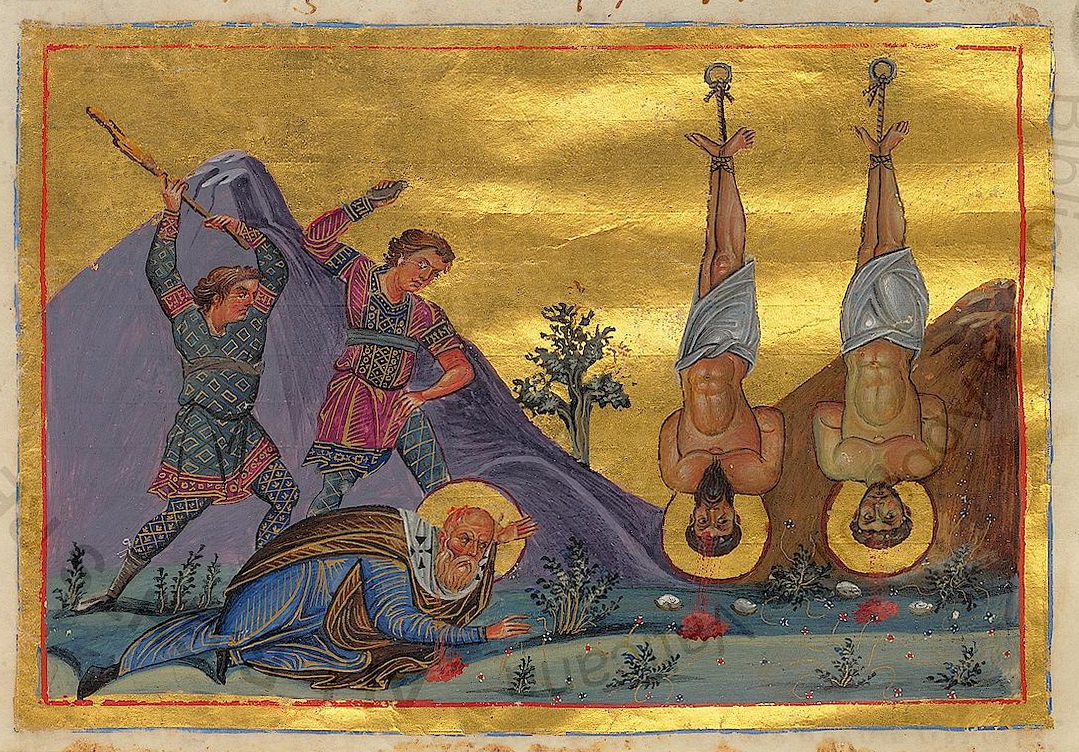
The company is depicted as three clergy-martyrs — the aged bishop Akepsimas in the omophorion, the priest Joseph, and the deacon Aithalas — bearing the martyrs' cross, or shown in their torments. The stored image is the miniature of the Menologion of Basil II (Constantinople, c. 985; Vatican, Cod. gr. 1613): it sets the aged bishop cast to the ground and beaten by two soldiers with staves, while two of his companions hang bound and inverted under further torture — the "tortures" of the passion recounted in their Acts. The miniature names all three Persian martyrs and is kept for this November 3 company; it is to be distinguished from a separate Menologion folio labelled only "Akepsimas and Aithalas" (a beheading scene of a beardless youth and one bearded martyr), which does not depict this triad.
Disputed questions
- Identity of Aithalas. The calendar also commemorates on September 1 a martyr Aithalas of Persia, likewise a deacon of the Persian Church of the later fourth century. Whether the September 1 Aithalas is a distinct martyr of the same name and country — as the received calendar, keeping both days, implies — or a doubled commemoration of the deacon of this company cannot be settled from the surviving notices. The two entries are kept distinct here, as the calendar keeps them, and the question is recorded in both. The Greek name Ἀειθαλᾶς ("ever-flourishing") renders a Persian or Syriac name transmitted in several forms.
- Two saints named Akepsimas on this day. The same November 3 also commemorates a separate [venerable] ascetic, Akepsimas the Hermit of Cyrrhus in Syria (a solitary of the fifth century, praised by Theodoret of Cyrrhus) — not to be confused with Akepsimas the bishop and martyr of this company. That hermit is not yet authored here (see the day file's Pending entries).