
Ambrose of Optina
Our Venerable Father Ambrose, Elder of Optina
Venerable · b. 1812 — d. 1891
Commemorated 27 June — Uncovering of his relics, 1998, 10 October — Repose at Shamordino, October 10, 1891 (O.S.)
Ambrose of Optina (1812–1891) is the most celebrated of the elders of the Optina hermitage and one of the best-loved saints of nineteenth-century Russia. A Tambov priest's-family son who entered Optina in 1839 after a sickbed vow, he was formed by the elders Leonid and Macarius, and from 1860 until his death was the spiritual father to whom all Russia came — peasants, merchants, bishops, and writers, Dostoevsky and Tolstoy among them. Bedridden for much of his life, he received the stream of visitors daily for three decades, answered thousands of letters, helped prepare Optina's famous patristic translations, and founded the Shamordino convent for women whom no other monastery would take. He reposed at Shamordino on October 10, 1891, and was glorified in 1988, the first of the Optina elders to be canonised.

Origins and early life
Alexander Mikhailovich Grenkov was born on November 23, 1812, in the village of Bolshaya Lipovitsa in the Tambov province, into a church family — his grandfather was a priest, his father a sexton — one of eight children, raised strictly and piously. A lively, quick-witted boy, he was sent to the Tambov theological seminary in 1830 and finished near the top of his class in 1836. About a year before graduation he fell dangerously ill and vowed that if God healed him he would become a monk; he recovered, and for several years did not keep the promise, working first as tutor in a landowner's household and then as a teacher at the Lipetsk church school.
The vow weighed on him. In 1839 he visited the hermit Hilarion of Troekurovo, a well-known ascetic of the region, who told him plainly: "Go to Optina — you are needed there." That autumn, after an evening among friends at which his wit had kept the whole company laughing, he was seized with such disgust at his own frivolity that he resolved at once: he quit his post without formalities and arrived at the Optina hermitage in October 1839.
Optina and the elders
Optina Pustyn, near Kozelsk in the Kaluga province, was then at the beginning of its great age: the tradition of eldership (starchestvo) — the daily opening of one's thoughts to a spirit-bearing guide — had been planted there by disciples of Paisius Velichkovsky, and the young novice was formed under its two great living representatives. He began under the elder Leonid (Lev, †1841), who before his death entrusted him to the elder Macarius; Alexander was tonsured in 1842 with the name Ambrose, after Ambrose of Milan, was made hierodeacon in 1843, and was ordained hieromonk in 1845.
The ordination journey to Kaluga, made in bitter cold, broke his health. From 1846 he was so ill that he was relieved of all obligations and received the Holy Mysteries as one dying; he recovered only partially, and for the rest of his life — half a century — he was never well, often unable to walk, in his last decades receiving visitors lying propped on a couch. He came to regard the illness as God's schooling: to those who complained of sickness he would answer that it is good for the monk, and he bore his own without complaint.
Under Macarius he served as cell-attendant and secretary, helping with the elder's enormous correspondence, and took part in the work that made Optina a lamp of learning as well as of prayer: the programme of patristic translation and publishing carried on with the Kireevskys and other lay scholars, including the Russian edition of the Ladder of John Climacus. Macarius, discerning what was in him, began during his own lifetime to send some of his spiritual children to Father Ambrose.
The eldership
Macarius died in 1860 without naming a successor, and within a short time — the other candidates having died or been called away to govern monasteries — Father Ambrose stood as the elder of Optina. For the next thirty years his day scarcely varied: raised at four for his rule of prayer, he dictated answers to the day's letters — dozens arrived daily — and then received visitors, with short breaks for food and rest, until late in the evening. He used to say: "The Lord has so arranged it that all my life I must talk with people. I would be glad to keep silence now, but I cannot."
His counsel was remembered for its plainness and its humour. He refused to give his own opinions, pointing questioners instead to the Fathers and explaining the hard places simply; and he clothed his teaching in homely rhymes that all Russia came to know: "Live so as not to grieve — judge no one, vex no one, and my respects to all"; "Where it is simple, there are angels by the hundred; where it is clever, there is not one." Gifts of discernment and of healing were attested of him in abundance in his lifetime — visitors found their unspoken questions answered, and cures at his prayer were widely reported — and the crowds at his hut in the skete never thinned.
Among those who came were the writers of the age. Dostoevsky visited Optina in June 1878, in grief after the death of his small son Alyosha, and spoke with the elder; the figure of the elder Zosima in The Brothers Karamazov, and the novel's picture of the monastery and its pilgrims, drew on that visit and on the Optina eldership — though Zosima is a creation, not a portrait, and Dostoevsky himself pointed to other models for the elder's teaching as well. Tolstoy visited Ambrose more than once across the years and spoke of the lightness of soul he felt in his presence; Konstantin Leontiev, who settled at Optina under the elder's direction, and Vladimir Solovyov, who accompanied Dostoevsky, complete the remarkable roll.
Shamordino
In 1884 Ambrose founded the Kazan convent at Shamordino, some twelve versts from Optina — a community of a new kind, which received the women whom the established convents (requiring dowries) would not: the poor, the sick, the blind, widows and orphaned girls. It grew within his lifetime to hundreds of sisters, with an orphanage and almshouse attached, and was his particular care and consolation. In 1890 he went to Shamordino for what was meant to be a short stay; too weak ever to return to Optina, he remained through the winter and the following year, directing both communities from his sickbed.
Repose
Ambrose died at Shamordino on October 10, 1891 (O.S.), after weeks of final illness, and was buried at Optina beside his elder Macarius, the immense funeral concourse defying the foul weather of those days. Miracles at his grave were reported at once and continuously thereafter.
Veneration and later cultus
His letters — thousands survive, to monastics and laypeople — were published by Optina in the years after his death and remain among the most read of Russian spiritual writings; through them, and through the memoirs of his visitors, the Optina eldership became the pattern of spiritual fatherhood for the whole Russian Church. Optina was closed and wrecked under the Soviets and returned to the Church in 1987; at the Local Council of June 1988, held for the millennium of the Baptism of Rus, Ambrose was glorified among the nine saints of that council — the first of the Optina elders to be canonised. The full Synaxis of the Elders of Optina, in which he stands with thirteen others, was subsequently established (its common feast is kept the day after his own), and his relics now rest in the monastery's Vvedensky cathedral, having been recovered after the monastery's restoration (the uncovering of the relics of the Optina elders in 1998 is commemorated in the Russian calendar; the precise commemorations are left to the coordinator to verify when those days are authored).
Feast and commemoration
October 10 (church date; Old Calendar civil October 23), his repose — kept by the Russian Church and the OCA; the commemoration has not passed onto the universal Greek or Antiochian calendars, and the jurisdictions field records this honestly. In the Russian calendar he is also commemorated with the Synaxis of the Elders of Optina (October 11, church date) and in the commemorations connected with the 1998 uncovering of the Optina relics; on his principal day a proper service composed for the glorification is sung.
Iconography
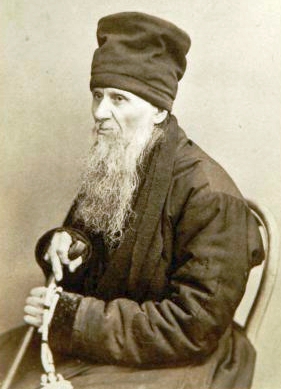
Icons of Ambrose — a modern iconography formed since 1988, guided by the photographs and portraits made in his lifetime — show a frail, grey-bearded hieroschemamonk in klobuk or schema, usually half-figure, blessing or holding a scroll with one of his sayings; he appears also in the composite icon of the Synaxis of the Optina Elders, seated at the centre of the fourteen. Those icons are the copyrighted work of living or recent iconographers and cannot be stored here. The stored image is instead a photograph of the saint from life — Commons dates it to the 1870s and tentatively attributes it to E. K. Vytropsky — published in the public domain literature (Moscow, 1893): the elder propped on his couch in skufia and cell-habit, as his visitors knew him.