
Ananias, Peter and the Seven Soldiers
The Holy Martyrs Ananias the Presbyter, Peter the Keeper of the Prison, and the Seven Soldiers with them
Hieromartyr · Priest · Martyr · d. c. 295
Commemorated 26 January — Martyrdom in Phoenicia under Diocletian
Ananias, a presbyter in the province of Phoenicia, and with him Peter, the keeper of the prison, and seven soldiers, were martyred in the persecution of Diocletian, about the year 295. Ananias, arrested for his confession of Christ and for the destruction of idols by his prayer, endured his tortures with such constancy — and, the tradition holds, with such attendant wonders — that his jailer Peter and a company of seven soldiers were themselves converted and confessed Christ. Refusing to sacrifice, all were condemned together and cast into the sea, receiving the crown of martyrdom. They are commemorated on January 26.
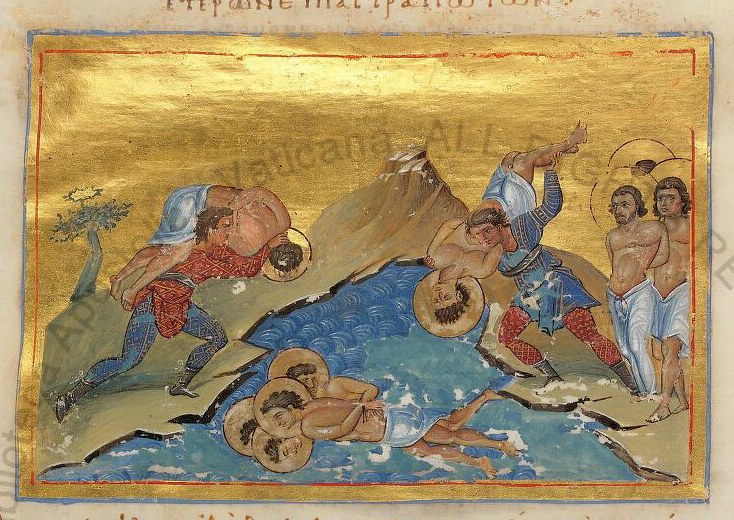

The martyrs belong to the last and fiercest of the imperial persecutions, that of Diocletian, in the province of Phoenicia on the Syrian coast. Ananias, a priest of the Church there, was denounced as a Christian and brought before the governor. Steadfast in confession, and — the synaxarion relates — the cause by his prayer of the overthrow of the pagan idols, he was subjected to a succession of torments meant to break him: he was scourged and racked, yet remained unharmed in spirit and, the account says, was strengthened and preserved by God through sufferings that should have killed him.
It was this endurance, and the signs that accompanied it, that bore fruit among his very persecutors. Peter, the keeper of the prison in which Ananias was held, and a guard of seven soldiers, seeing the martyr's constancy and the power of God at work in him, came to faith in Christ and openly declared themselves Christians. Brought before the judge and refusing, all of them, to offer sacrifice to the gods, priest and jailer and soldiers were condemned together. They were taken and drowned in the sea, about the year 295, and so passed together to the Lord — the shepherd and the flock he had won from among his own guards.
Feast and commemoration
The martyrs are commemorated together on January 26 (church date; Old Calendar civil February 8), among the saints of the day. They are honoured as a company: Ananias the priest-martyr with Peter and the seven soldiers his fellow-sufferers. No proper office survives; they are sung under the common of martyrs.
Iconography
The martyrs are depicted as a group: Ananias vested as a priest, an older bearded man; Peter and the seven soldiers as younger men, sometimes in the dress of soldiers, the company shown together or in the scene of their drowning, cast into the waves. The stored image is the miniature of the Menologion of Basil II (Constantinople, 985): the company given to the sea — the martyrs borne to the rocks and cast into the water, the haloed heads of the drowned breaking the surface — the manuscript's rendering of exactly the drowning the synaxarion records.