
Anthony, John and Eustathius of Vilnius
The Holy Martyrs Anthony, John and Eustathius of Vilnius
Martyr · d. 1347
Commemorated 14 April — Martyrdom at Vilnius under Grand Duke Olgerd
Anthony, John and Eustathius — the Three Martyrs of Vilnius — were Lithuanian courtiers, brothers or kinsmen, converted to Christ from paganism, who were hanged on an oak in Vilnius in 1347 under the Grand Duke Olgerd (Algirdas) for refusing to keep the pagan customs of their people. They are the proto-martyrs of the Lithuanian land; their incorrupt relics rest in the Monastery of the Holy Spirit in Vilnius, and they are held in especial honour throughout the Russian and the wider Orthodox Church.
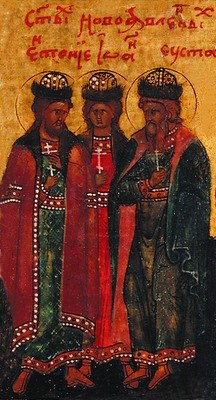

Converts at the court of Olgerd
The three were young Lithuanians of the court of the Grand Duke Olgerd of Lithuania, in the days when that grand duchy was still largely pagan though its rulers married Orthodox princesses and tolerated Christians. Their pagan names are given as Kruglets, Kumets and Nezhilo; two of them, Kruglets and Nezhilo, were kinsmen (brothers, in the received account). They came to the faith through a priest named Nestor, of the household of Olgerd's Orthodox wife, and were baptised — Kruglets taking the name John, Nezhilo the name Anthony, and the third, Kumets, later, the name Eustathius.
Confession and martyrdom
The Christian faith showed itself in their refusal of the pagan observances that the court required — they would not cut their hair in the heathen manner, nor eat forbidden foods, nor join in the rites of the fire-cult of the Lithuanians. John and Anthony were the first to be denounced; imprisoned and pressed to renounce Christ, John for a time faltered under fear and outwardly conformed, but Anthony stood firm; and when the two were again together in prison, Anthony's steadfastness recalled his brother, who repented and confessed openly. Both were hanged upon an oak — Anthony on the 14th, and John, after further imprisonment, on another day, though the Church keeps them together.
Eustathius, the youngest, a strong and beautiful youth, confessed Christ after their death; tortured with especial cruelty — his legs broken, made to stand barefoot in the frozen river, the hair and skin torn from his head — he would not yield, and was at last hanged on the same oak. All three suffered in 1347. The oak on which they died was cut down, and upon the place — the hill where they were buried — a church was built, whose altar, it is said, stood on the very spot of their martyrdom: this became the Monastery of the Holy Spirit in Vilnius, where their incorrupt relics are venerated to this day. They were glorified soon after their death, their memory carried to Constantinople, and they are counted the first martyrs of Lithuania.
Feast and commemoration
April 14 (church date; Old Calendar civil April 27). The three are the proto-martyrs of the Lithuanian land and are especially honoured in the Church of Russia and the diocese of Vilnius; a translation of their relics and other commemorations are also kept through the year.
Hymns
Troparion — Tone 1
Let us honour the three martyrs of Vilnius, Anthony, John and Eustathius, who cast down the darkness of idolatry and confessed Christ upon the tree of martyrdom; and let us cry to them: Rejoice, O firstfruits of the Lithuanian land and unshaken pillars of the faith, who intercede for our souls.
Original translation from the Slavonic
Kontakion — Tone 3
The three kinsmen, enlightened by holy baptism, trampled the ancestral idols underfoot and died upon the oak for Christ; wherefore, O Anthony, John and Eustathius, ye shine as three lights over the northern land, and pray unceasingly for us all.
Original translation from the Slavonic
Iconography
The three are painted together, standing as young martyrs in the long garments of the Lithuanian court or in martyrs' mantles, each holding the cross of witness — Anthony and John bearded youths, Eustathius the youngest and beardless — often with the oak of their martyrdom behind or above them, and the city of Vilnius below. Their relics being incorrupt and visible, later Russian icons render their faces from the shrine. The stored image is an 18th-century icon of precisely this type: the three martyrs side by side in the fur-trimmed robes of the Lithuanian court, each with the small cross, named in the Slavonic inscription across the top. The reproduction is small; a larger scan is listed among the upgrade-wanted icons.