
Antipas of Pergamum
The Holy Hieromartyr Antipas, Bishop of Pergamum
Hieromartyr · Bishop · Apostle of the Seventy · Wonderworker · d. c. 92
Commemorated 11 April — Martyrdom in the brazen bull at Pergamum
Antipas, Bishop of Pergamum, is the "faithful martyr" (ὁ μάρτυς μου ὁ πιστός) whom the risen Christ names by his own mouth in the Revelation of St John — "Antipas my faithful witness, who was slain among you, where Satan dwells" (Rev. 2:13). A disciple of the Apostle John and, by tradition, one of the Seventy, he was made bishop of the great pagan city of Pergamum in Asia Minor, and about the year 92, in the persecution under Domitian, was roasted to death inside a heated brazen bull. He is honoured as a hieromartyr and wonderworker, and is invoked especially against diseases of the teeth.
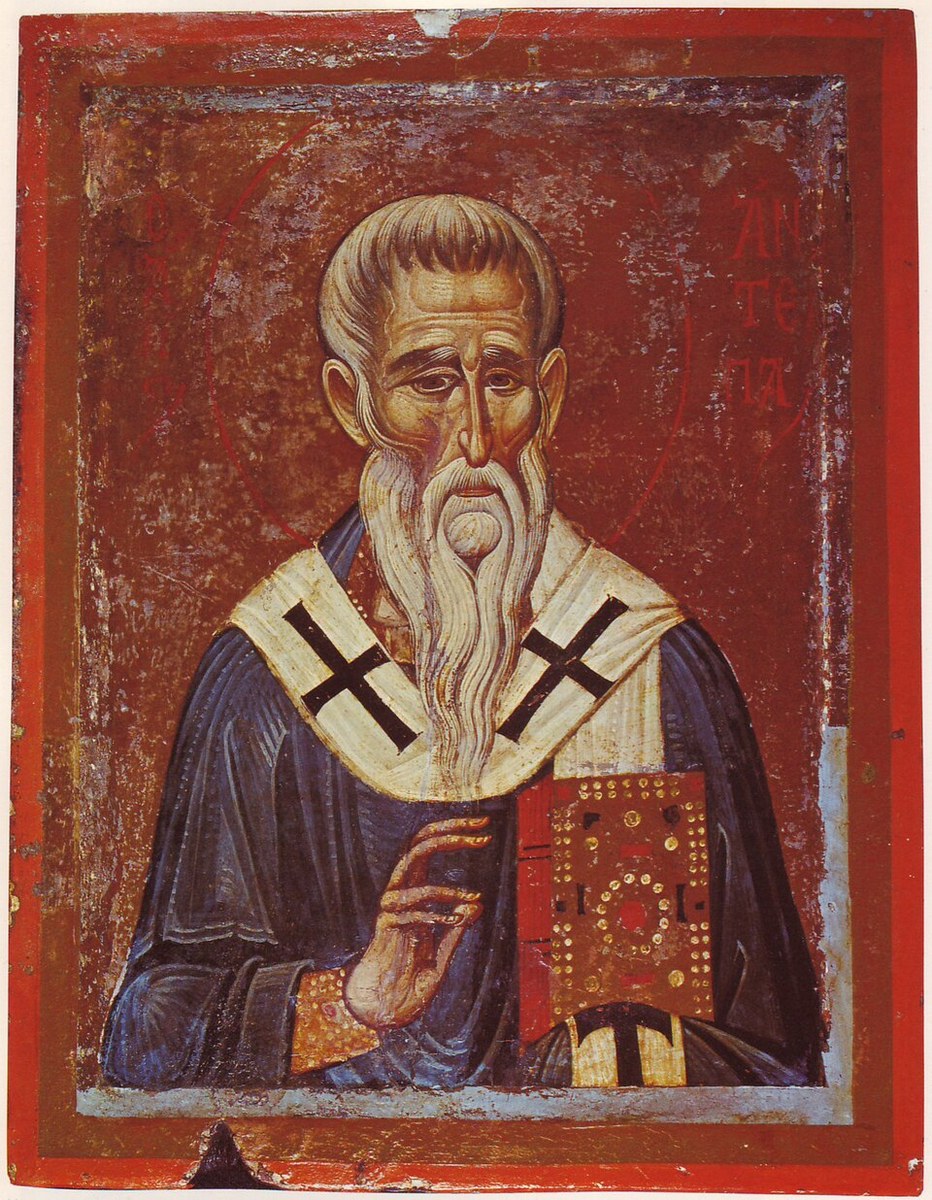

Bishop of Pergamum, disciple of John
Antipas belonged to the first generation of the Church in Asia. The tradition makes him a disciple of the Apostle and Evangelist John the Theologian, and counts him among the Seventy; he was ordained bishop of Pergamum, one of the seven churches of Asia addressed in the Apocalypse. Pergamum was among the most idolatrous cities of the province — the seat of the temples of Zeus, of Athena, and of Asclepius the healing-god, and of the imperial cult; and it is this concentration of paganism that the Lord names in the letter to the church of Pergamum, "where Satan's throne is."
There the aged Antipas shepherded his flock and cast down the power of the demons. The account relates that the idols of the city fell silent and their oracles ceased at his prayers, and that the pagan priests, no longer able to obtain the responses of their demons, complained that the "old man Antipas" had driven them out and turned the people from sacrifice.
Martyrdom in the brazen bull
Seized and brought before the governor, Antipas was commanded to sacrifice to the idols and to acknowledge that the ancient gods, being older, were greater than the new faith of Christ. He answered — the passion preserves the exchange — that the demons flee before the servants of Christ, and that he would not worship them. He confessed Christ boldly and unshaken by his great age.
He was condemned to be burned alive inside a hollow bronze bull — an instrument of the old tyrants, heated red-hot, so that the victim within was roasted. Antipas entered it giving thanks and praying for his flock and for the whole Church, and so gave up his soul, about the year 92, in the reign of Domitian. The Christians recovered his relics and buried them in Pergamum, where his tomb became a source of healings; a fragrant myrrh was said to flow from it, and cures — especially of toothache and diseases of the teeth — were wrought there, for which he is invoked to this day.
Feast and commemoration
April 11 (church date; Old Calendar civil April 24), within Great Lent. His witness is carried by every synaxarion and is anchored in Scripture itself (Rev. 2:13); he is honoured throughout the Orthodox world, and his name is proverbially invoked against toothache.
Hymns
Apolytikion — Tone 4
As a sharer in the ways and a successor to the thrones of the Apostles, O divinely-inspired one, thou didst find in contemplation the means to ascend to divine heights; rightly dividing the word of truth, thou didst struggle for the faith even unto blood, O hieromartyr Antipas: intercede with Christ God that our souls may be saved.
Kontakion — Tone 4
A worthy priest of Christ and a most honoured martyr, an unfailing fount of healings, thou dost pour out cures upon the faithful, O all-praised Antipas; wherefore we honour thy holy memory, and glorify the Lord who crowned thee.
Original translation from the Greek
Iconography
Antipas is painted as an aged bishop, white-bearded, in the phelonion and omophorion and blessing, holding the Gospel — the type of the hierarch — and as a martyr he may bear the cross; his martyrdom, the brazen bull with flames beneath it, is very often shown beside him or in the scene of his passion. He appears among the hierarch-martyrs in the menologia. The stored image is a 13th-century icon from the Monastery of St Catherine at Sinai (inscribed Ο ΑΓΙΟΣ ΑΝΤΙΠΑΣ): the hierarch bust-length in the blue mantle and crossed omophorion, blessing and holding the jewelled Gospel.