
Antony II Kauleas
Our Father among the Saints Antony the Younger (Kauleas), Patriarch of Constantinople
Patriarch · Bishop · b. c. 829, in Asia (Phrygian family) — d. February 12, 901, at Constantinople
Commemorated 12 February — Repose at Constantinople
Antony Kauleas (c. 829 – 901), called "the Younger" to distinguish him from an earlier patriarch of the name, was Patriarch of Constantinople from 893 until his death, and a peacemaker of the Church. Of a Phrygian family settled in the capital, he was drawn from childhood to the monastic life, entering a monastery at twelve and becoming in time its abbot; he even brought his own widowed father into the brotherhood. Renowned for austere prayer through the night and for great mercy to the poor, he was raised to the patriarchal throne under the emperor Leo VI the Wise, and laboured to compose the divisions left by the long strife between the followers of Photius and of Ignatius, convening a synod that restored peace to the Church. He reposed on February 12; his memory was honoured with encomia by the learned men of his own generation, and the monastery of Kauleas long kept his name.

Origins and monastic life
Antony was born about the year 829, of a well-to-do and devout family of Phrygian descent living in Constantinople. Left motherless as a boy, and early set on God, he entered a monastery in the neighbourhood of the capital at about the age of twelve, and gave himself wholly to the ascetic life — passing his nights, the tradition says, in vigil and prayer, and excelling in obedience and humility. In time he was ordained priest, against his own wish, and then made abbot of his monastery (the house afterward known by his surname, ta Kauleou, "the monastery of Kauleas"). As superior he was a father to the poor as well as to his monks, giving himself to works of mercy, and he brought his own aged and now widowed father into the monastery to end his days as a monk. His fame for holiness and for wise, gentle governance spread through the city.
Patriarch of Constantinople
On the death of the patriarch Stephen I (the young brother of the emperor) in 893, Antony was chosen — an aged monk of unblemished repute — to the throne of Constantinople, under the emperor Leo VI the Wise. His patriarchate fell in the difficult aftermath of the Photian controversy: the Church of Constantinople had been torn for a generation between the partisans of the patriarchs Photius and Ignatius, and though the schism had formally been closed, its wounds and factions remained. Antony gave himself to the work of reconciliation, and is remembered as having convened a synod (about 899) that helped to settle the lingering divisions and restore concord to the Church, so that his brief tenure is honoured as a season of peace. He continued as patriarch the charity and asceticism of his monastic years, built and adorned churches — the tradition names a church he raised over relics — and, though bowed with age and infirmity, went about the city visiting its churches and its poor. He governed the Church for some eight years and reposed in peace on February 12, 901.
Veneration
Antony was venerated at once as a saint, and his memory was celebrated in the encomia of the learned men of his time — an oration by Nicephorus the Philosopher and the praises of Arethas of Caesarea among them — witnesses that show how high his reputation for sanctity and for peacemaking stood in the generation that had known him. The monastery of Kauleas kept his name and his cultus in the capital.
Feast and commemoration
Antony is kept on February 12 (church date; Old Calendar civil February 25), the day of his repose, together with Meletius of Antioch and the other saints of the day. His commemoration passed from the Synaxarion of Constantinople into the Greek and Slavic calendars; the Menaion appoints the common office of a holy hierarch.
Iconography
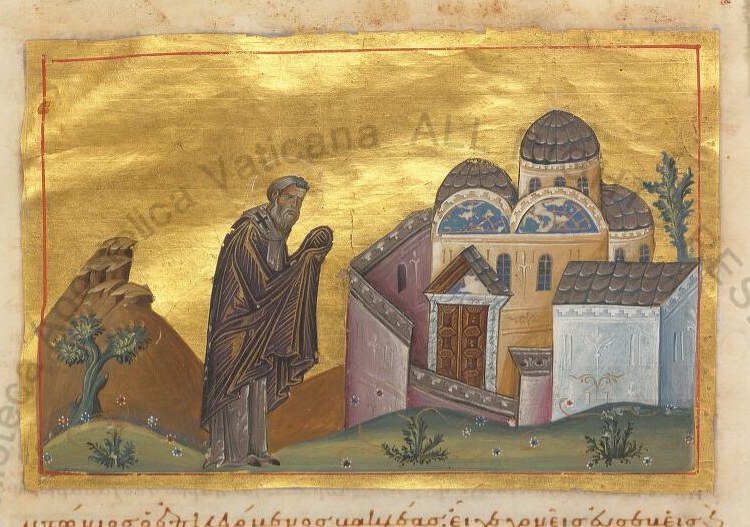
Antony is depicted as an aged Byzantine patriarch — white-bearded, vested in the polystavrion and omophorion, the sakkos of his office, blessing with his right hand and holding the Gospel — in the settled type of a hierarch of the Macedonian age. The stored image is the miniature of the Menologion of Basil II (Constantinople, 985), filed on Commons under his regnal style "Antony II of Constantinople": the patriarch-monk stands at prayer before the domed church — the manuscript's own image for his February 12 commemoration.
Disputed questions
- The year of his death. The historical record places Antony's patriarchate from 893 to his death on February 12, 901, and the century of his repose is accordingly the tenth. Some hagiographical notices (the OCA synaxarion among them) give his death as 895; the divergence is recorded here, the 901 date being that of the Byzantine sources and the standard chronologies of the patriarchate.
- Not to be confused with the earlier Antony I Kassymatas of Constantinople (an iconoclast patriarch of the ninth century, of no cultus), nor with the many other monastic saints named Antony; this Antony is the peacemaking patriarch of the turn of the tenth century, "Kauleas" or "the Younger."