
Apollinaris of Ravenna
The Holy Hieromartyr Apollinaris, Bishop of Ravenna
Hieromartyr · Bishop · b. at Antioch — d. c. 75 (traditional); late 2nd century by modern reckoning
Commemorated 23 July — Repose after his last beating at Ravenna
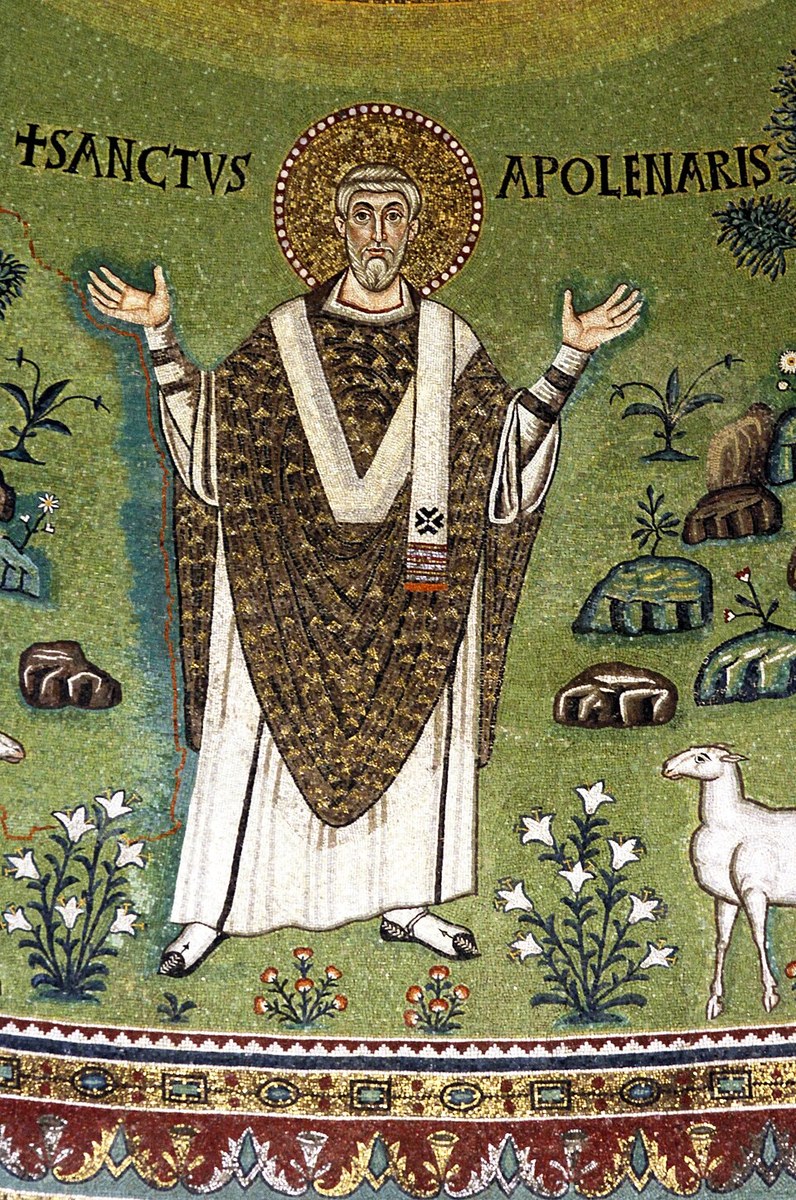
Apollinaris is the first bishop and the protomartyr of Ravenna, the Adriatic city that became the capital of the Western empire and then the seat of Byzantine rule in Italy. The tradition received by the Church makes him an Antiochene, a disciple of the Apostle Peter, whom he followed to Rome and who sent him to preach at Ravenna in the reign of Claudius; there he healed, baptised, built up a church, was five times tried, tortured, banished and recalled, and died of a last beating outside the city walls after twenty-eight years as bishop. Modern historians doubt almost every date in that account and place him a century or more later; what is not doubted is the antiquity and force of his cult, which raised over his grave the basilica of Sant'Apollinare in Classe, whose sixth-century apse still shows him standing with his hands lifted in prayer among the sheep of his flock. The East keeps him on July 23.

The Antiochene sent to Ravenna
The Passio known to the Byzantine synaxaria opens at Antioch, where Apollinaris was born — a detail the Antiochian tradition has never let fall, since it makes the first bishop of the Western imperial capital a son of the Syrian metropolis. He is said to have attached himself to the Apostle Peter, to have travelled with him from Antioch to Rome, and to have been consecrated by him and sent to Ravenna, the port city of the Adriatic, in the reign of Claudius (41–54).
He came, the account says, as a stranger with nothing, and asked lodging of a soldier named Irenaeus. In the course of their conversation he told the soldier what he had come for. Irenaeus had a blind son; Apollinaris prayed, and the boy saw. That household — soldier, wife, and child — was the first church of Ravenna, and the bishop stayed under their roof and preached to whoever would come.
Twelve years of preaching, and the first trial
The second miracle named in the passion is the healing of Thekla, wife of a tribune of the city, whom the physicians had given up. She rose from her bed whole; she and her husband both believed, and in their house Apollinaris set apart a room as a church and celebrated the Liturgy. For the growing community he ordained two presbyters, Aderetus and Calocyrus, and two deacons — the first clergy of the Ravennate church.
He preached, the passion says, for twelve years before the pagan priests laid a complaint against him before the governor Saturninus. He was tried, beaten, and left for dead; his tormentors carried him out to the seashore and threw him into the water, but he was still alive, and a Christian widow took him in and hid him for six months, in which he went on teaching in secret. He was found out when a leading citizen named Boniface, dumb, was brought to him by his wife and given back his speech.
Fire, banishment, shipwreck, return
From there the passion becomes a chain of returns. Tried a second time, he was made to stand with bare feet on burning coals and driven out of the city; he preached elsewhere in Italy and came back. Tried a third time, he was sentenced to exile, put in irons, and shipped toward Illyricum and the Danube with two soldiers as escort and three of his clergy following him of their own will. The vessel broke up; of all aboard only the bishop, his clergy and the two guards came ashore, and the two soldiers were baptised. They made their way to Moesia in Thrace, where he cleansed a leading man of leprosy, was sheltered by him, preached, was beaten by the heathen of that country, and was at last put back on a ship for Italy.
After three years away he returned to Ravenna and was received with joy. The pagans broke into the church while he was serving the Liturgy, scattered the people, and dragged him to the temple of Apollo — where, the passion says, the idol fell and broke as he was brought in. He was taken before Taurus, the new governor, whose son had been born blind and whom Apollinaris healed. Taurus would not be baptised himself, fearing the emperor, but he sent the bishop out of danger to his own estate outside the walls, where Apollinaris lived and taught unhindered for five years.
Repose
The pagan priests at last petitioned the emperor Vespasian for a sentence of death or exile against the Christian "sorcerer." The emperor's reply, as the passion gives it, is one of the more memorable lines in the dossier: the gods, he said, were strong enough to avenge their own insults if they had been insulted. The mob took the vengeance into their own hands: they seized Apollinaris as he was leaving the city and beat him so that he was barely alive when Christians found him and carried him to a settlement nearby. He lived seven days more, teaching to the end, and foretold that the persecutions would pass and the Church would confess openly what it then confessed in hiding. He blessed those present and fell asleep — by the traditional reckoning in the year 75, having been bishop of Ravenna for twenty-eight years.
Relics, basilicas, and the cult
Whatever the date, the cult is old and was central to the self-understanding of the Ravennate church. His grave lay in the cemetery of Classe, the harbour suburb, and over it was raised in the sixth century the basilica of Sant'Apollinare in Classe, consecrated in 549 — the church whose apse mosaic is the classic image of the saint. In 856, with Saracen raiders active along the Adriatic, the relics were moved inside the walls to the church now called Sant'Apollinare Nuovo, the former Arian palace-church of Theodoric, which took its present name from him. Relics are claimed also at Remagen and Düsseldorf in the Rhineland, and churches under his name are found across Italy, Gaul and Germany.
The see of Ravenna made much of him. When in the seventh century the archbishops of Ravenna were pressing for autocephaly from Rome, the descent of their first bishop directly from the Apostle Peter — bypassing any Roman intermediary — was a serviceable argument, and it is in exactly that period that the surviving Passio appears to have been composed.
Feast and commemoration
July 23 (church date; Old Calendar civil August 5) is his day throughout the Orthodox East — the Greek Menaion's synaxarion for the day names him and Vitalius, "bishops of Ravenna," together with Apollonius of Rome and the seven martyrs of Carthage, while the service of the day is sung to the hieromartyr Phocas. The Slavonic calendars and the OCA give him the day with his own life, styling him hieromartyr and bishop of Ravenna and dating his repose to about 75. Antiochian usage keeps the day with the martyrs Trophimus and Theophilus. In the Roman rite his feast stood on July 23 for centuries and is now kept on July 20; Ravenna itself keeps him as patron of the city and the archdiocese.
Hymns
Troparion — Tone 4
Sharing the manner of life of the Apostles and succeeding to their throne, thou didst find in the active life, O God-inspired one, a ladder to divine vision; therefore, rightly dividing the word of truth, thou didst contend for the faith even unto blood, O hieromartyr Apollinaris. Intercede with Christ our God that our souls may be saved.
Original translation from the Greek
Kontakion — Tone 2
Thou wast shown to be a lamp of the Church, a shepherd sent from Antioch to the shore of the Adriatic, and having opened the eyes of the blind, thou didst open the eyes of a whole city to the light; wherefore, having endured stripes and exile and the sea, thou hast received the crown, O hierarch Apollinaris, and dost pray without ceasing for us all.
Original translation from the Greek
Iconography
Apollinaris is painted as a hierarch: middle-aged, with a short grey beard, in the phelonion and omophorion of the Byzantine bishop, blessing and holding the Gospel; as a martyr-bishop he may also carry the cross. The Ravennate images, which are far older than any panel icon of him, show him in the Western vesture of his own church and give him two characteristic settings.
The first — and the image stored with this entry — is the apse mosaic of Sant'Apollinare in Classe, of about 549. The saint stands frontally in the green paradise of the apse, in white alb and the dark chasuble with the pallium of his office, his hands raised wide in the ancient orant posture of prayer, inscribed + SANCTVS APOLENARIS; on either side of him twelve sheep, the flock of Ravenna, come out of the flowers and rocks toward him, beneath the great jewelled cross of the Transfiguration. Nothing in Christian art states a bishop's office more plainly: he prays, and the flock comes.
The second is in Sant'Apollinare Nuovo, where he appears in the long sixth-century procession of martyrs on the nave wall — a white-robed figure, inscribed SCS APOLLINARIS, carrying the golden crown of martyrdom in veiled hands toward the enthroned Christ. In Western painting of later centuries he is given a mitre and crozier, and the scene of his beating outside the walls is sometimes shown.
Disputed questions
- The date. The tradition of the passion — consecration by Peter under Claudius, repose under Vespasian in 75 — is followed by the Byzantine synaxaria, by the Slavonic menologia and by the OCA, and this entry reports it as the received account. It cannot be sustained historically. The episcopal list of Ravenna, worked back from Severus, who sat at the Council of Sardica in 343, leaves no room for a first bishop in the 50s; the usual modern estimate places Apollinaris in the late second century, with his death perhaps under Septimius Severus. Between the two positions the corpus records the disagreement rather than resolving it: century: 1 follows the calendars, and this note states the historians' case.
- Who wrote the Passio. The surviving passion is generally assigned to the seventh century and, on internal grounds, to the circle — possibly the hand — of Archbishop Maurus of Ravenna (642–671), in the years when Ravenna was arguing its independence of Rome. That context explains both the Petrine consecration and the fivefold pattern of trial, exile and return, which reads as edifying construction rather than record.
- Martyr or confessor. The earliest Ravennate witness, a sermon of Peter Chrysologus (bishop c. 433–450) preached on his feast, honours Apollinaris as a bishop who suffered and calls him the church's own martyr while being noticeably careful about the manner of his death: he did not die by the sword. The liturgical tradition has always styled him hieromartyr, and the passion's ending — death of a beating, seven days after — is consistent with that. The Latin calendars kept him on July 23 until the reform of 1969, when he was moved to July 20; the Orthodox calendars have not moved.
- Confusion of name. He is not to be confused with Apollinaris of Laodicea, the fourth-century heresiarch whose teaching on the one nature of the incarnate Word was condemned at the Second Ecumenical Council, nor with the martyrs Apollinaris and Apollonius of other days; the identity of names has caused muddle in Western lists.