
Ariadne of Phrygia
The Holy Martyr Ariadne of Phrygia
Martyr · d. 2nd century
Commemorated 18 September — Martyrdom in Phrygia
Ariadne (2nd century) was a Christian slave in the household of Tertullus, a leading citizen of a Phrygian city the sources call Promissia — most plausibly Prymnessus. When her master held a sacrificial feast to the pagan gods on his son's birthday, Ariadne alone refused to take part; she was beaten, torn with iron hooks, and starved in prison, and when at last she was released and fled the city, her master's men pursued her. The tradition relates that at her prayer a cleft opened in the mountain rock and received her, and there she gave up her soul to God. She is commemorated on September 18.

Ariadne's story is that of the slave whose conscience could not be bought with her body. She served in the household of Tertullus, a man of the first rank (πρωτεύων) in the Phrygian city transmitted as Promissia, in the reign of the emperor Hadrian (117–138). The synaxarists note the paradox her memory preserves: legally a slave, she was freer and wiser than the noble women around her, who were themselves enslaved — to vanity and to "every defilement of flesh and spirit."
The occasion of her confession was a domestic festival. On the birthday of his son, Tertullus offered sacrifice to the pagan gods, and the whole household was expected to join the celebration and the sacrificial meal. Ariadne refused: a Christian could keep no feast at an idol's table. For this she was beaten, hung up, and her body raked with sharp iron hooks; then she was thrown into prison, where she was starved for a long time in the hope that hunger would bring her to sacrifice. She would not be moved, and — a rare turn in the martyrologies — her tormentors, unable to break her, finally let her go.
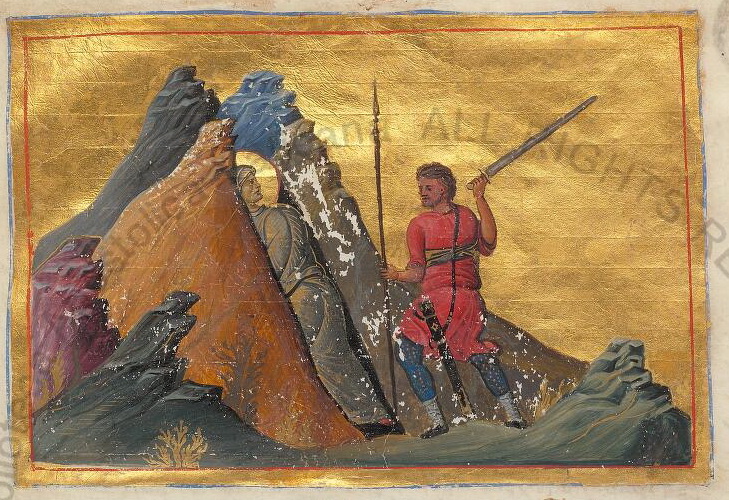
Ariadne left the city to escape further compulsion, but Tertullus repented of releasing her and sent men after her. Seeing herself pursued, she fled toward the mountains, praying as she ran that God would deliver her out of her enemies' hands. What follows is the scene the tradition made her own: the rock split open before her, the fugitive passed into the cleft, and the mountain received her; within it she surrendered her soul to God. Her pursuers found no one to seize.
Feast and commemoration
September 18 (church date; Old Calendar civil October 1), within the afterfeast of the Elevation of the Cross. The commemoration is universal in the Byzantine rite; the Russian calendar styles her "Ariadne of Promissia (of Phrygia)." She has no proper service; her memory is kept with the synaxarion notice, under the festal propers of the Cross and the service of Eumenes of Gortyna, the day's chief saint.
Hymns
Troparion — Tone 4 (from the common of a woman martyr)
Thy ewe-lamb Ariadne crieth to thee with a great voice, O Jesus: Thee, my Bridegroom, do I love, and seeking thee I endure the contest; I am crucified and buried with thee in thy baptism, and I suffer for thy sake, that I may reign with thee; I die for thee, that I may live in thee. Receive me as a spotless sacrifice, slain for thee with love. By her prayers, since thou art merciful, save our souls.
Original translation from the Greek
Iconography
Ariadne appears in the narrative iconography of the menologia rather than in panel icons: a young woman in tunic and maphorion shown at the moment of her deliverance, passing into the cleft of the mountain while an armed pursuer closes on her. The stored image is the miniature from the Menologion of Basil II (Vatican, c. 1000): the haloed martyr disappears into the opening rock at the left while a soldier in red, sword raised and spear in hand, strides after her across the mountainside — the whole legend in a single frame.
Disputed questions
- The manner of her end. The rock that opens and closes over the fleeing martyr is a frankly legendary motif — it echoes the apocryphal ends of Thecla, whom the rock likewise received. It should be read as the hagiographic tradition's image of a deliverance that was also a death: God took her before her enemies could. The sober kernel — that she died in flight from her pursuers — is preserved in the variant the OCA records, that she fell from a cliff and was killed. Fuller recensions of her Acts add that her pursuers were destroyed at the spot; the shorter synaxarion notices omit this. The entry records the legend as legend, without asserting the miracle as history or discarding the martyr behind it.
- The city. "Promissia" (Промиссия) as the Slavic tradition prints it is otherwise unknown; the name is generally taken as a corruption of Prymnessus (Πρύμνησσος) in Phrygia Salutaris, near modern Afyon in Turkey. Her Greek Acts are counted by hagiographic scholarship among the older, more sober martyr texts, which lends the underlying story more weight than its legendary ending alone would suggest.
- The emperor. The Slavic tradition and the synaxaria place her under Hadrian (117–138). The OCA prints "Hadrian (117–161)" — a span that silently runs into the reign of Antoninus Pius (138–161), under whom some accounts of Phrygian martyrdoms are set. The second century is certain; the reign is not.