
Autonomus of Italy
The Holy Hieromartyr Autonomus, Bishop in Italy
Hieromartyr · Bishop · d. c. 313
Commemorated 12 September — Martyrdom at Soreoi in Bithynia; falls on the leavetaking of the Nativity of the Theotokos
Autonomus (†c. 313) was a bishop in Italy who, when the great persecution broke out under Diocletian, crossed to Bithynia and made the village of Soreoi, near the gulf of Nicomedia, the base of a wide-ranging mission. He evangelised there and in Lycaonia and Isauria, raised a church of the Archangel Michael, and ordained his host and convert Cornelius to serve it. When his converts demolished a pagan sanctuary nearby, the pagans took revenge during the Divine Liturgy: Autonomus was cut down — the Greek verses say stoned — at the very altar, and the deaconess Maria buried his body, later found incorrupt. He is commemorated on September 12.

Origins and flight to Bithynia
Of Autonomus's origins the tradition preserves only that he was a bishop in Italy — no see is named — at the end of the third century. When the persecution of Diocletian was unleashed, he followed the Lord's counsel to flee from city to city (Matthew 10:23), left Italy, and settled in Bithynia in Asia Minor, at a place called Soreoi (Soreos), where he was received into the house of a man named Cornelius. The move was no retreat into hiding: the Life presents it as a deliberate transfer of his apostolic labour from a province where he was known to a mission field where he was not.
Mission at Soreoi and beyond
At Soreoi Autonomus preached with such effect that a large local church grew up around him, and he built for it a temple dedicated to the Archangel Michael. He ordained Cornelius deacon for the new community, and later raised him to the priesthood. From this base he carried the Gospel into the neighbouring regions of Lycaonia and Isauria. When the persecutors sought his arrest — the accounts say the order came from Diocletian himself — he withdrew for a time to Claudiopolis on the Black Sea coast; on his return to Soreoi he had Cornelius consecrated bishop for the flock, and himself travelled again, into the province of Asia, before returning to preach in the district of Limnae, near Soreoi.
Martyrdom
At Limnae the zeal of the newly converted overran itself: a company of them demolished a pagan sanctuary. The pagans of the place bided their time and took their revenge at the point calculated to wound most deeply. While Autonomus stood at the altar of the church of the Archangel Michael celebrating the Divine Liturgy, they burst in armed and fell upon him, killing him at the altar itself, so that, as the accounts say, the sanctuary was reddened with his blood and the bloodless sacrifice was mingled with the martyr's own. The verses of the Greek synaxarion make the manner of death explicit — he was stoned — and turn the scene into its enduring image: "Thy priest Autonomus was laid an offering upon Thine own table, O Word, dying by the stones." The deaconess Maria drew his body from under the heap of stones and gave it burial. The traditional year of his death is 313.
Relics and later cultus
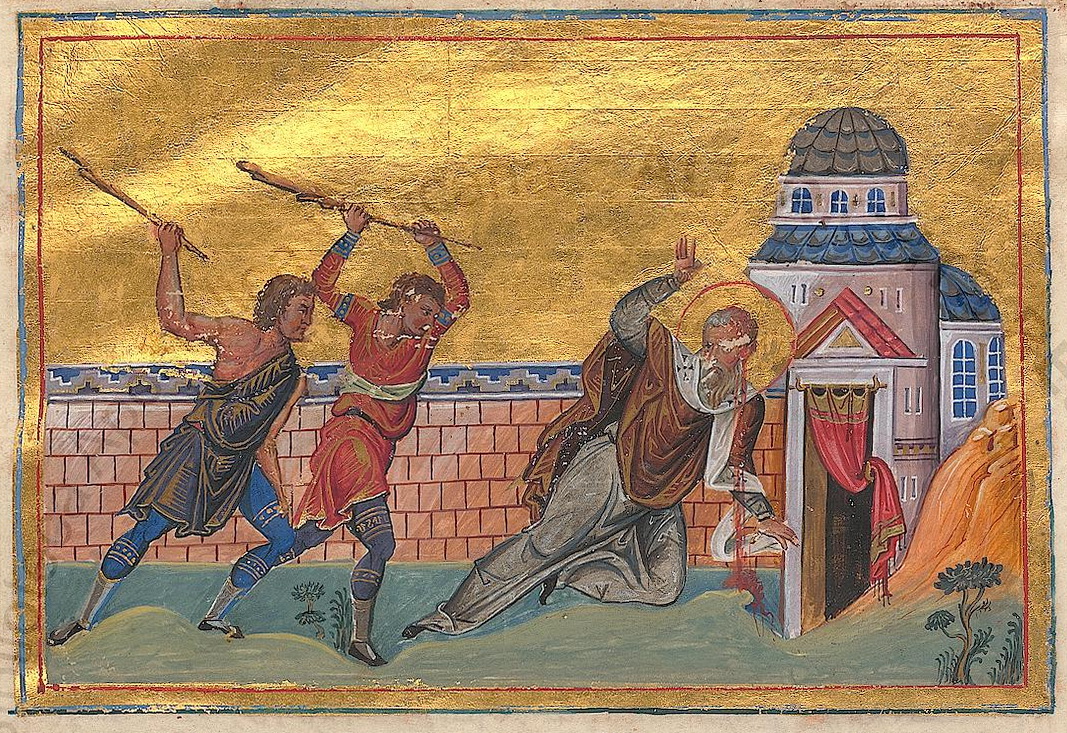
Under Constantine the Great a church was raised over the martyr's tomb. About the year 430 a priest, not realising that the martyr's body lay beneath the old church, dismantled it and rebuilt on another site; some sixty years later the relics of Autonomus were rediscovered incorrupt, and a church was then built in the hieromartyr's own name over the spot. The Byzantine tradition kept his memory thereafter on September 12, and the Menologion of Basil II (c. 985) devotes a miniature to his death before the doors of his church.
Feast and commemoration
September 12 (church date; Old Calendar civil September 25), the leavetaking of the Nativity of the Theotokos. Because the day is the apodosis of the feast, the festal service of the Nativity dominates the Menaion for the day, and the service of the hieromartyr is sung with it or transferred to Compline; the Greek synaxarion nevertheless lists his contest first among the day's commemorations. The feast is kept universally in the Byzantine rite.
Hymns
Troparion — Tone 4
As a sharer of the ways of the Apostles and a successor to their throne, thou didst find thy deeds, O God-inspired one, an ascent to divine vision; wherefore, rightly dividing the word of truth, thou didst suffer for the faith even unto blood: Hieromartyr Autonomus, intercede with Christ God that our souls may be saved.
Original translation from the Greek
Kontakion — Tone 2
Blamelessly and with wisdom didst thou minister the divine Mysteries, and thou wast made an acceptable sacrifice, O divinely blessed one: for thou didst drink the Cup of Christ, O glorious Autonomus, lamp of the whole world, praying unceasingly for us all.
Original translation from the Greek
Iconography
The Menologion of Basil II (c. 985) depicts the martyrdom: the aged, white-bearded bishop, haloed and in episcopal dress, sinks bleeding before the open doors of his domed church while two executioners strike him down with raised clubs — the miniature's compression of the stoning and beating at the altar. Later Russian minology icons show him simply as a vested hierarch with the Gospel book, among the saints of September; a nineteenth-century example by Osip Chirikov survives in the State Museum of the History of Religion.
Disputed questions
- Date of death. The hagiographic frame is the persecution "of Diocletian" (284–305), but the transmitted year of the martyrdom is 313, by which time Diocletian had abdicated. The two are compatible if the death is placed in the final phase of the great persecution, which continued in the eastern provinces under Maximinus Daia until 313; the sources themselves do not resolve the point, and the Wikidata record likewise gives 313.
- The Italian see. No source names the city in Italy of which Autonomus was bishop; the style "Bishop in Italy" (so the OCA) is therefore more exact than "of Italy," though the latter is the common calendar shorthand.