
Babylas of Antioch
The Holy Hieromartyr Babylas, Bishop of Antioch the Great, and with him the Three Holy Youths and Christodoula their Mother
Hieromartyr · Bishop · Child Martyr · d. c. 253
Commemorated 4 September — Martyrdom at Antioch with the three youths
Babylas was bishop of Antioch from about 237 until his death in the Decian persecution, c. 253. Celebrated in antiquity for barring an emperor stained with murder from the doors of the church, he confessed Christ under Decius, was loaded with chains — which he asked to have buried with him — and died a martyr together with three boys he had raised in the faith. A century later his relics were carried to the suburb of Daphne to silence the oracle of Apollo there — the first attested translation of relics in Christian history — and their removal on the order of Julian the Apostate, followed at once by the burning of Apollo's temple, made Babylas the emblem of the martyrs' victory over paganism, immortalised in John Chrysostom's writings.
.jpg)
Origins and episcopate
Nothing certain is recorded of Babylas's origins. He became bishop of Antioch the Great — the see later reckoned him its twelfth bishop — in succession to Zebinus, about the year 237, in the reign of Gordian III, and governed the church of Antioch through the turbulent 240s. Antioch in his day was the third city of the Roman world and the capital of the East, repeatedly visited by emperors on campaign against Persia; the bishop of such a city stood, more than almost any other churchman, in the emperor's path. Eusebius of Caesarea, the earliest witness, names him among the notable bishops of the age and records his death in the persecution of Decius.
The confrontation with the emperor
The deed for which antiquity remembered Babylas is his refusal to admit a reigning emperor to the assembly of the Church. John Chrysostom, preaching at Antioch over a century later, tells the story at length: the emperor had received, as pledge of a treaty, the young son of a barbarian king, and had the boy treacherously murdered; when he afterwards presumed to enter the church, Babylas met him at the doors and turned him back as a murderer unfit for the holy assembly until he should repent, fearing the emperor's power not at all. Chrysostom pointedly declines to name the emperor, saying the deed, not the man, deserves memory.
The traditions diverge over who this emperor was. Eusebius relates — without naming Babylas — that Philip the Arab (244–249), reputedly a Christian, was refused entry to the paschal vigil by the bishop until he had taken his place among the penitents, and later writers identified that bishop with Babylas; Philip's murder of the young Gordian III, whose regime he supplanted, has been connected with the boy-hostage of Chrysostom's account. The Greek synaxaria, however, set the confrontation under "Numerian," an emperor of a generation later (283–284), and make him the direct author of the saint's martyrdom; the Slavic and OCA accounts place both confrontation and martyrdom under Decius (249–251). See Disputed questions below.
Confession, chains, and martyrdom
What is historically firmest is the end. When Decius, upon becoming emperor, loosed the first empire-wide persecution (249/250), Babylas openly confessed Christ. Eusebius records that he died in prison, in his bonds, "after his confession" — a witness written within living memory. The hagiographic tradition amplifies the trial: commanded to worship the idols to atone for his affront to the imperial dignity, Babylas answered that one who rises against God deserves no reverence from men; paraded through the city in heavy chains, he called the chains more honourable than the emperor's diadem, and death for the immortal King more precious than any earthly life.
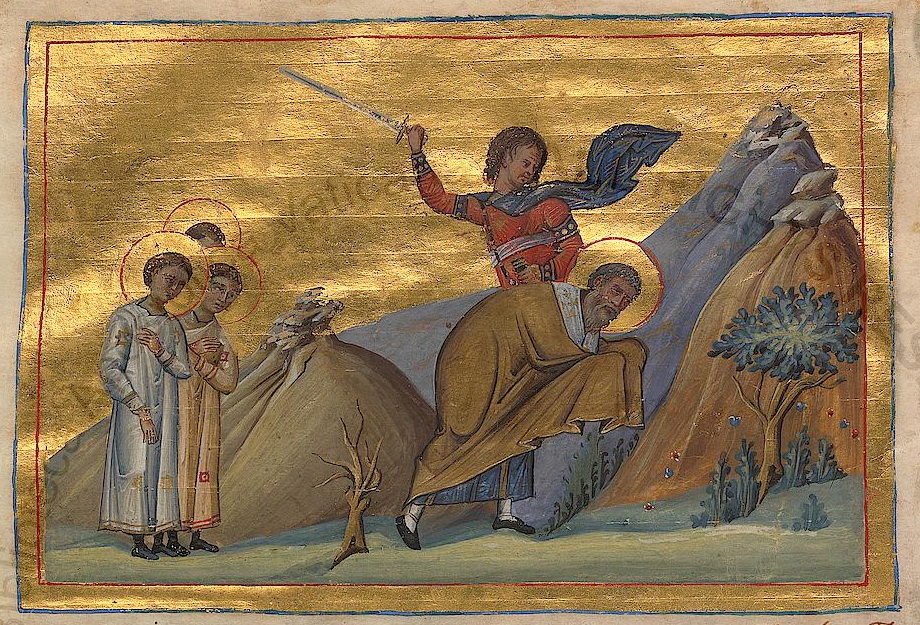
With him stood three young brothers, his pupils, whom the Slavic tradition names Urban, Prilidian, and Epolonius, with Christodoula their mother. Asked who the children were, the bishop answered that they were his spiritual children, raised by him in piety — "small in body, but great and perfect Christians; test them and see." Neither flattery nor threats moved the boys or their mother; the enraged ruler had each beaten with blows numbered to his age — twelve, ten, and seven — and, when a lie that the children had apostatised failed to shake the bishop, condemned them all. The Synaxarion of Constantinople says Babylas and the three youths were perfected by the sword; its verses for the day play on the priest who once offered Christ in the Liturgy being now himself offered to Christ by the sword. Babylas asked that his chains be buried with him, as the trophies of his contest; his burial with the chains is attested already by Eusebius's generation and repeated by Chrysostom.
His death is conventionally placed c. 253 (the traditional date; the Decian persecution itself began in 250 — see Disputed questions).
Relics and translations
The afterlife of Babylas's relics is among the most consequential in Christian history, for his was the first recorded translation of a martyr's relics — the beginning of a practice that reshaped Christian devotion.
About 351, the Caesar Gallus, half-brother of the future emperor Julian and a Christian, had the body of Babylas solemnly transferred from its grave in Antioch to Daphne, the luxurious grove-suburb five miles out, notorious for its pleasures and famous for its temple and oracle of Apollo. A martyrium was built for the saint hard by the temple. The intent, as Chrysostom expounds it, was medicinal: to sober the dissolute suburb by the martyr's presence. From that time, the tradition unanimously reports, the celebrated oracle fell silent.
In 362 Julian the Apostate, at Antioch preparing his Persian war, sought an oracle from Apollo at Daphne. The god, the Christians said — and Julian's own frustration confirmed — gave no answer, until at last the oracle complained of "bodies" polluting the vicinity; the sole "body" removed on Julian's order was that of Babylas. The emperor commanded the Christians to take the coffin away, and they turned the forced removal into a triumph: a vast procession carried the relics back to Antioch singing the psalm "Confounded be all they that worship carved images, that make their boast of idols" (Psalm 96/97:7), a defiance for which Julian instituted reprisals. Within days — on the night of 22 October 362 — the temple of Apollo at Daphne burned, its colossal cult statue destroyed. Julian, blaming the Christians (the pagans variously blamed a philosopher's votive candles or lightning; the cause was never established), closed the Great Church of Antioch in retaliation. The pagan rhetor Libanius composed a lament (his Monody on the temple), and the episode is recorded by Ammianus Marcellinus and by the church historians Socrates, Sozomen, and Theodoret alike — a rare event attested from both sides of the fourth-century religious divide.
Under Valens, bishop Meletius of Antioch built a great cross-shaped martyrium for Babylas across the Orontes, translating the relics once more; Meletius himself, dying at Constantinople in 381 while presiding over the Second Ecumenical Council, was buried beside the martyr at his own wish. The church — excavated in the 1930s at Antioch-Kaoussie and dated by its floor inscriptions to 387 — is among the earliest identified martyria of the Christian East, and the sarcophagus emplacements at its crossing have been associated with Babylas and Meletius.
Veneration and later cultus
Babylas became and remained the pre-eminent martyr of Antioch, the city's second patron after Ignatius the God-bearer. His cult spread west early: he is in the Roman Martyrology (January 24, with the three youths), and medieval relic-claims for him appear in Italy and beyond. In the Byzantine rite his feast has stood on September 4 since at least the tenth century (so the Menologion of Basil II and the Synaxarion of Constantinople), and the day's Menaion office is shared with the Prophet Moses. For the church of Antioch — and so for the Antiochian Archdiocese today — he is one of the great hierarch-martyrs of the see itself, the bishop who showed that the sanctuary is closed to unrepented power.
Hymnographic and literary legacy
Babylas occasioned one of the masterpieces of early Christian polemic: John Chrysostom's treatise On Babylas, against Julian and the pagans (c. 378–379), which narrates the confrontation at the church doors, the silencing of the oracle, the removal of the relics, and the fire at Daphne as one continuous demonstration that the martyrs' power outlives them; Chrysostom also preached a separate homily on the saint's feast at Antioch. These texts are the principal literary monuments of the first relic-translation and among the earliest theological reflections on the veneration of relics. On the pagan side, Julian's own Misopogon alludes bitterly to his Antiochene humiliations, and Libanius's Monody mourns the burnt temple. The canon of the saint in the Menaion (Tone 6) carries a note unusual in its candour: ascribed by some manuscripts to Theophanes and by others to John the Monk, "but the pen seems to be of neither."
Feast and commemoration
September 4 (church date; Old Calendar civil September 17), a universal commemoration of the Byzantine rite, kept jointly with the Prophet and God-seer Moses, with whom the saint shares the day's Menaion office. The Synaxarion of Constantinople heads the day with Babylas "bishop of Antioch the Great, and the three holy children with him, perfected by the sword." The Roman Martyrology keeps him on January 24. The OCA calendar styles the feast "Hieromartyr Babylas, Bishop of Antioch, and those with him"; the Greek and Antiochian calendars likewise lead the day with Babylas.
Hymns
Troparion — Tone 4
Becoming a partaker of the ways of the Apostles and a successor of their thrones, thou didst find thy deeds, O God-inspired one, a passage to divine vision; wherefore, rightly dividing the word of truth, thou didst also suffer for the faith even unto blood, O Hieromartyr Babylas: intercede with Christ God that our souls may be saved.
Original translation from the Greek
Kontakion — Tone 8
The Church, made radiant today, doth glorify thee, O glorious one, as a herald of piety and a firm support of them that contend; but as thou hast boldness before God, entreat Christ that they who hymn thee may be kept in perfect peace, O martyr of many struggles.
Original translation from the Greek
Iconography
Babylas is depicted as an elderly hierarch — white-haired and bearded, in episcopal vestments with the omophorion — most often in narrative menologion scenes of his martyrdom, accompanied by the three youths; his chains are an occasional attribute recalling his burial with them. The stored image is the miniature for September 4 from the Menologion of Basil II (Constantinople, c. 985; Vatican Library, Vat. gr. 1613): the aged bishop bends beneath the executioner's raised sword against a gold ground, while the three haloed youths stand together at the left awaiting their own martyrdom.
Disputed questions
- Which emperor did Babylas bar from the church? Chrysostom deliberately withholds the name. Eusebius tells the same story of Philip the Arab and an unnamed bishop; later tradition merged the two, making Philip the barred emperor. The Greek synaxaria instead name Numerian — chronologically impossible for a bishop who died under Decius, and generally taken as a late confusion. The OCA and Slavic lives transfer the whole drama to Decius himself. The entry above records all three streams; the Philip identification is the one most scholars find plausible behind Chrysostom's reticence.
- Manner and date of death. Eusebius (Hist. eccl. VI.39) says Babylas died in prison, in chains, under Decius — i.e. 250/251; the synaxarion tradition says he and the three youths were beheaded, and the traditional date of c. 253 (after Decius's death) reflects that stream. Both are recorded here; the conventional feast-date reckoning "†253" is retained in the entry's record with "c."
- The three youths. The Greek synaxarion knows them simply as "the three holy children with him"; the names Urban, Prilidian, and Epolonius, and their mother Christodoula, come from the Slavic hagiographic tradition (so also the OCA life). The names are given here as transmitted, not as historically certain.
- Not to be confused with Babylas "the teacher" of Nicomedia, martyred with his eighty-four child-pupils, commemorated the same day (September 4) — a distinct martyr whose company the synaxarion lists separately; nor with the ascetic and missionary Babylas of Sicily and his disciples Timothy and Agapius, third-century martyrs beheaded in Sicily and kept on January 24 — another distinct saint of this name and century.