
Barlaam of Khutyn
Our Venerable Father Barlaam, Abbot and Wonderworker of Khutyn
Venerable · Wonderworker · d. 1192
Commemorated 6 November — Repose at Khutyn
Barlaam of Khutyn (died 1192) was the founder of the Monastery of the Transfiguration at Khutyn on the river Volkhov and one of the most beloved wonderworkers of the Russian North. A nobleman's son of Novgorod, he became a monk in his youth, withdrew to a lonely and ill-reputed hill outside the city, and there gathered a brotherhood by the example of his ceaseless prayer, severe fasting, and hard manual labour. Endowed with clairvoyance and a wide fame for miracles — chief among them a summer frost he foretold to save the harvest — he reposed on November 6, 1192. He is venerated as a heavenly protector of Great Novgorod, and his relics rest in the monastery he founded.
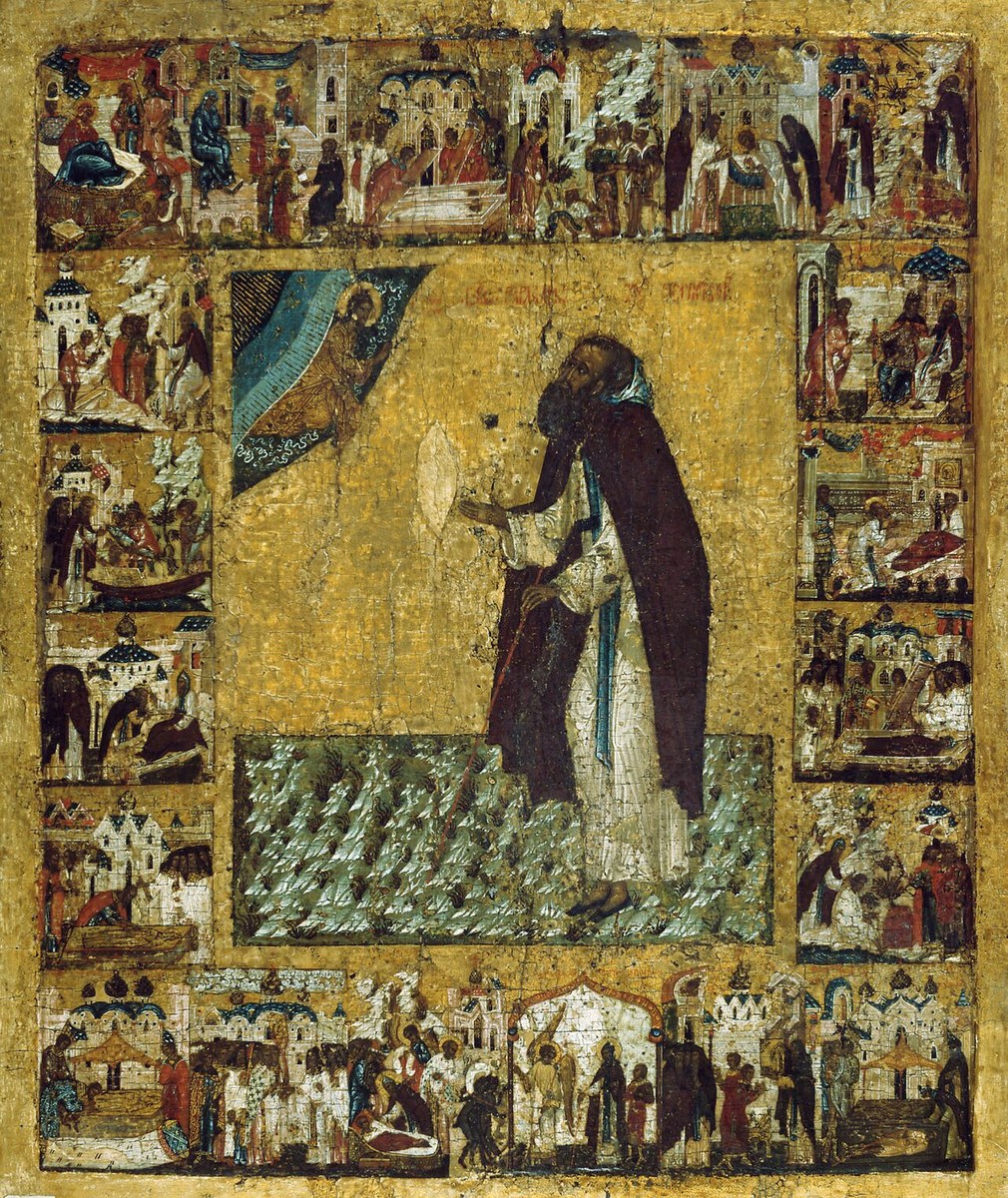

Origins and monastic beginning
Barlaam was born in Novgorod, the son of a well-born citizen, and given in baptism the name Alexis. He passed his childhood in the city, and while still a young man renounced the world, retiring to the nearby Monastery of St Nicholas at Lisichya Gorka ("Fox Hill"), where he received the monastic tonsure and the name Barlaam.
The hermitage and monastery of Khutyn
Seeking a stricter solitude, Barlaam withdrew about ten versts from Novgorod to a wooded rise above the Volkhov called Khutyn — a name popularly taken to mean an evil or haunted place, shunned by the people. There he built himself a cell and took up a hard eremitical life: unceasing prayer, a very strict fast, and unremitting labour with his own hands, felling and splitting timber and tilling the ground, holding to the apostolic rule that "if anyone will not work, neither let him eat" (2 Thessalonians 3:10). His holiness drew Novgorodians to share his struggles, and to those who came he gave plain counsel: to flee all injustice, envy, and slander, to shun anger and usury and false oaths and carnal appetite, and to keep meekness and patient love as "the beginning and the root of all good." A church of the Transfiguration of the Lord was raised, and a coenobitic monastery grew around it — the Khutyn Saviour-Transfiguration Monastery, which he governed as its first abbot.
Miracles and repose
The Lord granted Barlaam the gifts of wonderworking and of foresight for the help of his neighbours; the tradition preserves his prophecies to the archbishop and princes of Novgorod and, most famously, a fall of frost and snow in the height of summer which he foretold and which destroyed the pests threatening the crops, so that a season of apparent ruin became one of plenty — the miracle his kontakion sets against Elijah's calling down of fire. As his end drew near there came from Constantinople the hieromonk Anthony, his old friend and contemporary, into whose hands Barlaam committed the monastery, saying that though he departed in body he would remain with the brethren in spirit. Having given his last counsel — to hold fast the Orthodox faith and to abide in humility — he fell asleep in the Lord on November 6, 1192.
Relics and veneration
Barlaam was buried in his monastery, where his relics became a source of healings and his memory a mainstay of Novgorodian devotion; grand princes and tsars of Moscow numbered him among their patrons and made pilgrimage to Khutyn. His veneration spread through the Russian Church, and he is commemorated among the Saints of Novgorod. In Slavonic liturgical practice he is named at the Proskomedia among the venerable God-bearing fathers who shone forth in asceticism.
Feast and commemoration
November 6 (church date; Old Calendar civil November 19), the day of his repose and his principal feast. The Church keeps his memory three times in the year: on this day; on the first Friday of the Apostles' (Ss Peter and Paul) Fast, marking the later glorification of his relics; and on the third Sunday after Pentecost, in the Synaxis of the Saints of Novgorod. His feast is proper to the Russian Church and the jurisdictions descended from it.
Hymns
Troparion — Tone 3
Wearing down thy body upon the earth by sleeping on the ground, by fasting and by vigil, O venerable one, thou didst put to death every mind of the flesh; and thou wast shown to be an unstinting stream of healings to those who come to thee in faith, O Barlaam our father. Entreat Christ God for the salvation of our souls.
Original translation from the Slavonic
Kontakion — Tone 8
Like a second Elijah, O father, thou didst bring down from heaven — he indeed brought down fire and astonished the king, but thou didst gladden thy people and dispose them to keep festival; for great Novgorod boasts greatly of thee, holding thy relics within itself. Keep it unshaken from its enemies, that we may cry to thee: Rejoice, O Barlaam, our God-bearing father.
Original translation from the Slavonic
Iconography
Barlaam is shown as an aged monk with a long, tapering grey beard, in the monastic mantle and often the schema, holding a scroll and blessing or gesturing toward his monastery, which is sometimes depicted behind him; hagiographic icons surround the central figure with scenes of his miracles. The stored image is a sixteenth-century Novgorodian icon of the saint.