
Barypsabas of Dalmatia
The Holy Martyr Barypsabas
Martyr · d. 2nd century (?)
Commemorated 10 September
Barypsabas (dated by the received account to the 2nd century) was a hermit venerated as the guardian of a most unusual relic: a gourd-vessel said to hold blood from the side of the Saviour — or, in the interpretation of Nikodemos the Hagiorite, blood that had flowed from a pierced icon of Christ — through which many healings were worked. Entrusted with the vessel in a succession running from a righteous eyewitness of the Crucifixion through two hermits, Barypsabas was attacked at night by men who coveted the relic's miracles for gain, and was beaten to death; the treasure they sought escaped them, having passed to his disciple. His martyrdom is pictured in the Menologion of Basil II.
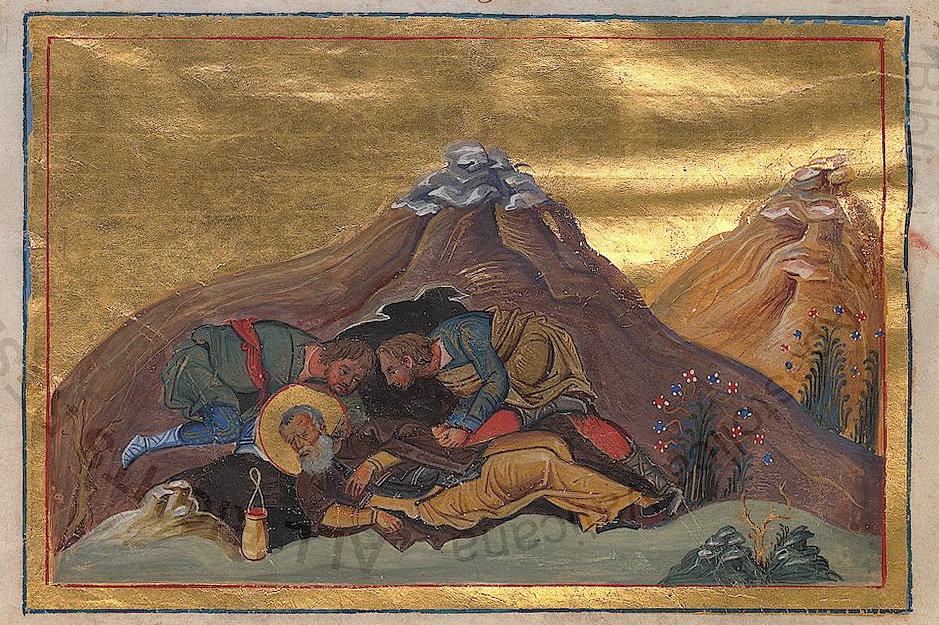
.jpg)
The story attached to Barypsabas is a relic-legend as much as a Life. A righteous man named Jacob, present — the account says — at the Crucifixion of the Lord, gathered into a vessel made from a gourd some of the blood and water that flowed from His pierced side, and concealed the holy thing by filling the vessel with oil. From its contents healings and wonders came in abundance. At Jacob's death the vessel passed to two hermits, and from the survivor of them to the hermit Barypsabas, who carried it in his wanderings in the East, working cures among the sick wherever he passed.
Report of the miracles bred greed: certain men, hearing that the hermit's vessel was the source of the healings, resolved to seize it and turn it to profit. They fell on Barypsabas by night and killed him, beating him to death with clubs — the synaxarion verses say that "for the divine blood of the Master he poured out his own blood, crushed by wood" — but found in the vessel they took nothing but oil: the holy relic itself, the account concludes, had already been given by the saint to his disciple, and its guardianship continued.
Feast and commemoration
September 10 (church date; Old Calendar civil September 23), within the afterfeast of the Nativity of the Theotokos. The Greek Menaion commemorates him in the synaxarion notice with its distich; the Slavic books transmit a proper kontakion. The commemoration is kept across the Byzantine-rite calendars.
Hymns
Troparion — Tone 4 (from the common of a martyr)
Thy martyr Barypsabas, O Lord, in his contest received an incorruptible crown from Thee, our God; for possessing Thy strength he cast down the tyrants and shattered the feeble insolence of the demons. By his intercessions save our souls.
Original translation from the Greek
Iconography
Barypsabas is painted as an aged hermit — bareheaded, grey-bearded, in a monastic mantle. The stored image is the miniature of the Menologion of Basil II (c. 1000): the haloed old man lies slain among the mountains as two assailants bend over him with their weapons, and beside him stands the small vessel — the gourd-flask of the legend — that occasioned his death.
Disputed questions
- What the vessel held. The older form of the legend makes the contents blood and water from the side of Christ, gathered at the Crucifixion. Nikodemos the Hagiorite, retailing the memory in the Synaxaristes, judged rather that the blood was that which flowed from an icon of Christ pierced by unbelievers — the famous miracle "in Berytus" (Beirut), whose relic-blood was later translated to Constantinople under John Tzimiskes in the tenth century. The two explanations coexist in the sources.
- Place and date. The Slavic calendars style him "of Dalmatia"; the Greek notices give no country, and one strand of the tradition sets his wanderings in the East, in Persian territory. The date is equally loose: the OCA's account places his martyrdom in the second century, but a guardian in third succession from an eyewitness of the Crucifixion suits the first century better, and no source fixes a year. The entry keeps the conventional second-century dating with this caution.
- The record. The anonymous Life is catalogued in the Acta Sanctorum (BHG 238), and the Menologion of Basil II (c. 1000) carries both the notice and the miniature of his death — the earliest secure witnesses to his cultus.