
Bassian of Constantinople
Our Venerable Father Bassian of Constantinople
Venerable · d. later 5th century
Commemorated 10 October — Repose in peace
Bassian of Constantinople (fifth century) was a Syrian-born ascetic who settled in the imperial capital in the days of the emperor Marcian (450–457) and founded there the monastery that long bore his name, governing as igumen a community the tradition numbers at three hundred monks. His house is remembered above all as the refuge of Matrona of Perge, who lived there disguised as the eunuch-monk Babylas until her sanctity was discovered. Famed for his virtues and miracles, Bassian reached old age and reposed in peace; the Greek, Slavic, and OCA calendars keep his memory on October 10.
.jpg)
From Syria to the capital
The synaxaria transmit only the outline of Bassian's life. Born in eastern Syria, he embraced the ascetic life and came to Constantinople in the middle of the fifth century, when Marcian — the emperor of the Council of Chalcedon — reigned. His virtue drew disciples, and the community that gathered about him became a regular monastery with Bassian as igumen; the tradition gives it three hundred brethren. A monastery "of Bassian" (τοῦ Βασιανοῦ) remained a known house of the capital in the Byzantine sources long after the founder's death, which is the surest anchor of his historical memory.
Matrona
The fullest early witness to Bassian comes not from a Life of his own but from that of his most famous disciple: Matrona of Perge (commemorated November 9), who, fleeing her marriage to give herself to God, entered Bassian's monastery dressed as a man and lived among the brethren as the eunuch-monk Babylas. When her identity was revealed — the accounts relate that it was made known to Bassian from God — the igumen did not punish the deception but provided for her monastic future, and she went on to found her own convent and to be numbered among the great women ascetics of the City. The episode presupposes exactly what the synaxaria say of Bassian: a large community, a discerning and merciful superior, and a reputation for holiness that made his house a magnet for the earnest.
Repose
Bassian governed his monastery to old age, famed — so the notices say — for his virtuous life and many miracles, and fell asleep in peace. No year is transmitted; the reign of Marcian fixes his floruit, and his repose is placed in the later fifth century. The synaxarion's distich for the day plays on his name and the Greek for "step" (βάσις): leaving the life below, Bassian goes up rejoicing to the ascent above.
Feast and commemoration
October 10 (church date; Old Calendar civil October 23), among the commemorations in the train of the martyrs Eulampius and Eulampia. The received Greek Menaion carries him in the synaxarion of the day with his distich (verified live); the Slavic books and the OCA list him likewise. He has no proper service, and the commons of a venerable are used where a fuller commemoration is required.
Hymns
Troparion — Tone 8
In thee, O father, that which was made according to the image of God was preserved exactly; for taking up the cross, thou didst follow Christ, and by thy deeds thou hast taught us to disdain the flesh, for it passeth away, but to care for the soul, which is a thing immortal: wherefore thy spirit, O venerable Bassian, rejoiceth with the angels.
Original translation from the Greek
Iconography
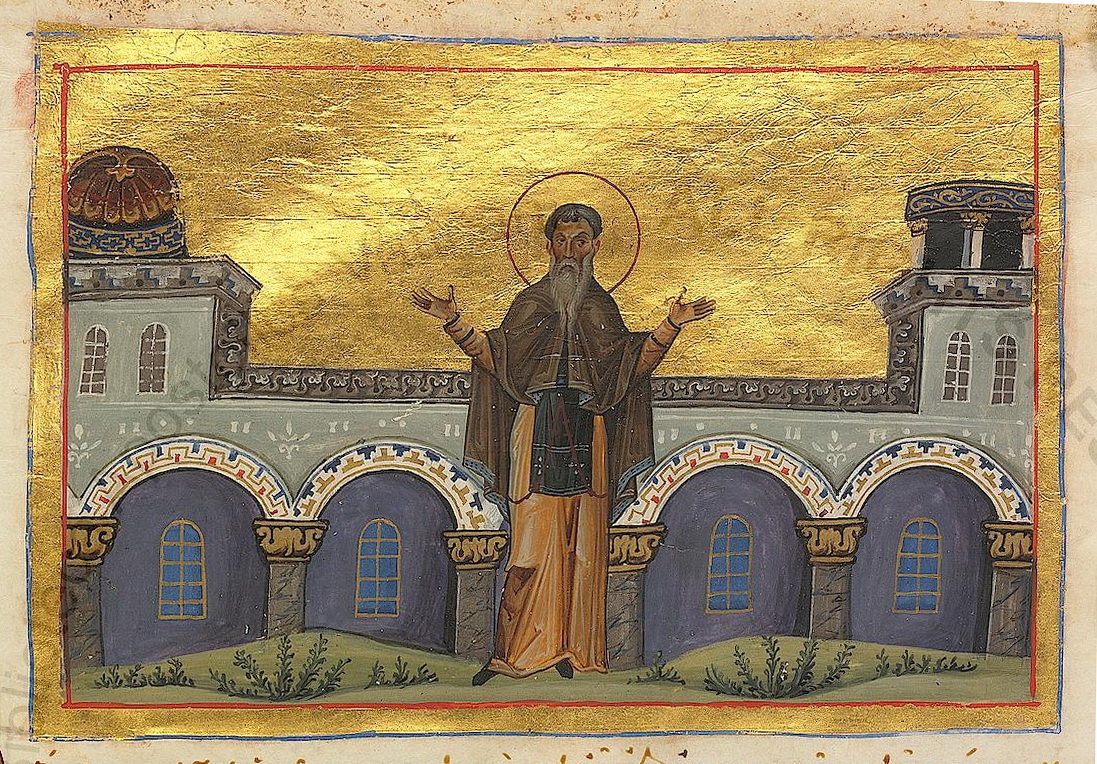
Bassian is painted as a venerable: an aged igumen in monastic habit, bearded, in prayer or blessing. The stored image is the miniature of the Menologion of Basil II (Constantinople, c. 985; Vat. gr. 1613, p. 104 — the page facing the martyrdom of Eulampius and Eulampia), showing the venerable standing in prayer before a building of his monastery.
Disputed questions
- The name. The Russian calendar glosses him "Vassian (Basil)," preserving a tradition that treats the name as a form of Basil; the Greek notices know him simply as Basianos. No transmitted fact hangs on the gloss.
- Not to be confused with the later Russian ascetics named Vassian (Bassian) who fill the Slavic calendars — among them Bassian of Tiksna (†1624, September 12) — nor with Bassian, bishop of Lodi in Italy, the correspondent of Ambrose of Milan.