
Blaise of Sebaste
The Holy Hieromartyr Blaise, Bishop of Sebaste
Hieromartyr · Bishop · b. mid-3rd century, at Sebaste in Armenia — d. c. 316, at Sebaste in Armenia
Commemorated 11 February — Martyrdom at Sebaste under Licinius
Blaise of Sebaste (Βλάσιος; † c. 316) was bishop of Sebaste in Armenia and one of the most beloved hieromartyrs of both East and West. A physician of body and soul before his episcopate, he withdrew during the persecution of Licinius to a cave on Mount Argeus, where the wild beasts of the mountain came to him for his blessing and healing, and would not leave him. Hunters sent to gather beasts for the arena found him instead and led him to the governor Agricolaus. On the road and in prison he worked the wonders for which he is universally invoked — he restored a poor widow's pig snatched by a wolf, and delivered a boy who was choking to death on a fishbone, whence his patronage of the throat and of livestock, and the Western "blessing of throats." Tortured, his flesh torn with iron wool-combs, cast into a lake and drawn out unharmed, he was at last beheaded together with two children and seven women. He is kept on February 11 in the East (February 3 in the West). He is to be distinguished carefully from Blaise of Caesarea the Herdsman, the Cappadocian cowherd-martyr of February 3, with whom, sharing both his name and an association with animals, he is constantly confused.
.jpg)
Physician and bishop of Sebaste
Blaise was a native and, in time, the bishop of Sebaste (Sebasteia, the modern Sivas) in Lesser Armenia, the same Armenian city whose frozen lake would receive the Forty Martyrs of Sebaste a few years after his death. The tradition remembers him first as a physician — one who healed the bodies of men, and, discerning that the health of the soul is the greater medicine, was raised by the people and clergy of the city to its episcopal throne, that he might be a healer of souls as he had been of bodies. As bishop he governed the church of Sebaste in the last age of the persecutions, a shepherd famed for the gentleness and holiness of his life, at a time when the peace granted by Constantine in the West had not yet reached the dominions of his eastern colleague and rival.
The cave on Mount Argeus and the beasts
When the persecution of the emperor Licinius — who from about 320 turned against the Christians of the East in violation of the Edict of Milan — fell upon Sebaste, the aged bishop, at the urging of his flock and (the tradition says) by a warning from God, withdrew from the city into the wilderness of Mount Argeus (Aргаίος), taking refuge in a cave. There the most cherished of his legends unfolds: the wild beasts of the mountain came down to him, not to harm but to be blessed. They gathered at the mouth of his cave, waited while he prayed, and would not depart until he had laid his hand upon them; the sick and wounded among them he healed, and they attended him as a gentle flock attends its keeper. This image — the holy bishop amid the tamed beasts of the mountain — has bound Blaise to the animal creation ever since, and made him throughout the Christian world a protector of flocks and herds, invoked by shepherds and farmers for the health of their beasts.
The arrest, and the wonders on the road
The peace of the cave was broken when the governor Agricolaus sent hunters into the mountains to trap wild animals for the spectacles of the arena. Coming upon the multitude of beasts gathered about the cave, the hunters discovered the bishop at prayer within, and — recognising the Christian hierarch the persecution sought — arrested him and brought him down toward the city.
To the journey the tradition attaches the two miracles that have carried Blaise's name into the devotion of the whole Church. As he was led along, a poor widow's only pig was seized and carried off by a wolf; the woman cried out to the saint, and Blaise commanded the wolf to give back what it had taken, and the beast returned the pig to its owner unhurt. (The widow, when the saint was later in prison, brought him in gratitude the flesh of that same pig, and candles to light his darkness — the root of the custom of bringing candles to be blessed at his feast.) Then a mother whose child was choking to death on a fishbone lodged in his throat brought the boy to Blaise; the bishop prayed and laid his hand upon the child's throat, and the bone came free, and the boy was saved. From this wonder above all Blaise became the patron of the throat and of its diseases, invoked against sore throats, choking, and afflictions of the neck across East and West — the origin of the Western rite of the "blessing of throats," in which two candles, crossed at the neck of the faithful, are held while the priest invokes Saint Blaise's intercession for deliverance from every ailment of the throat.
Martyrdom
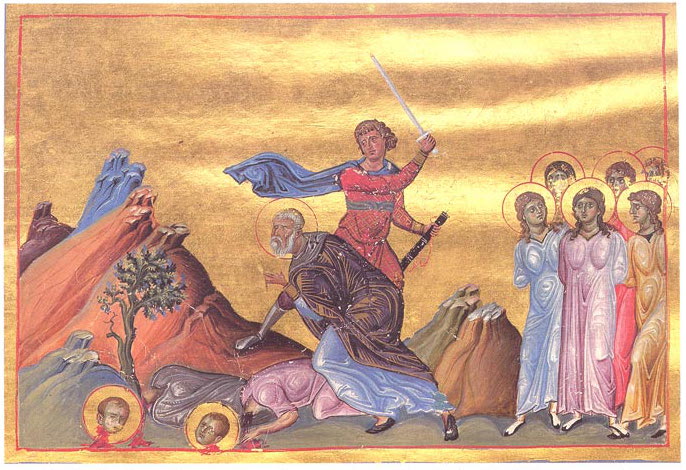
Brought before Agricolaus, Blaise confessed Christ and refused to sacrifice to the idols. He was beaten with staves and cast into prison, and — the account continues — was subjected to a torture that has become his emblem: his flesh was raked and torn with iron combs, the toothed wool-combs (carding combs) used in the working of wool, so that his body was rent as wool is carded. For this manner of his passion Blaise became in the West the patron of wool-combers and of the woollen trade, and the iron comb is his sign in Western art. The tortures failing to move him, he was cast into a lake to drown; but he walked upon the water, or stood upon it unharmed, and, inviting his persecutors to prove their gods by doing likewise, saw those who tried it drown. Drawn again to the shore, the bishop was at the last beheaded. With him, the tradition holds, suffered seven women — who had gathered the drops of his blood and were seized, tortured, and beheaded confessing Christ — and two young children who would not be parted from him. His martyrdom is placed in the reign of Licinius, about the year 316 (the year is given variously; the Slavic calendars note c. 316).
Relics and later cultus
Blaise was venerated at Sebaste from the time of his death, and his fame spread early and widely through both halves of the Christian world. Portions of his relics were carried westward; the tradition holds that in the eighth century relics of the saint, borne by sea toward Rome, were driven ashore by storm at Maratea in southern Italy, which keeps him as its patron; and above all the city of Dubrovnik (Ragusa) on the Dalmatian coast has honoured him since 972 as its heavenly protector — Sveti Vlaho, whose image stands upon the city's walls and gates and whose feast (kept there on February 3) is the great civic festival of the republic. In the medieval West Blaise was numbered among the Fourteen Holy Helpers, the auxiliary saints invoked against particular ills, his own province being the diseases of the throat; and the blessing of throats on his feast remains a living custom of the Western Church. In the East he is one of the widely loved hieromartyrs of February, his memory set close to that of the Forty Martyrs of his own city.
Not to be confused — the two Blaises
The calendar keeps two martyrs named Blaise (Vlasios) within nine days of each other, and the tradition itself testifies that they are constantly conflated:
- Blaise, Bishop of Sebaste — this saint: the physician-hierarch and hieromartyr of Armenia, healer of men and beasts, invoked for the throat and for flocks, martyred under Licinius (c. 316), kept February 11 (February 3 in the West), one of the most popular saints of both East and West.
- Blaise of Caesarea, the Herdsman — a Cappadocian cowherd, a layman, martyred in the third century and attended (the tradition says) by the beasts of his own herd, kept February 3.
The two share the name Vlasios, an association with animals (the bishop's healing and patronage of beasts; the herdsman's faithful cattle), and torture by iron; and the slighter acta of the herdsman have often been drawn into the orbit of the bishop's famous legend. They are nonetheless two distinct martyrs of two distinct days. The office of February 11 belongs to the bishop of Sebaste; the February 3 commemoration is the herdsman's.
Feast and commemoration
Blaise of Sebaste is commemorated in the East on February 11 (church date; Old Calendar civil February 24); the Greek, Antiochian, and Slavic calendars agree on the day, styling him hieromartyr and bishop of Sebaste and commemorating with him the two children and the seven women who suffered in his company. The Western Church keeps him on February 3, the day on which the blessing of throats is administered, and it is on the western date that Dubrovnik and Maratea hold his civic feasts. The eastern office is that of a hieromartyr, sung with the apolytikion common to a hierarch-and-martyr and the proper kontakion of the saint.
Hymns
Troparion — Tone 4
Sharer in the ways of the Apostles and successor to their thrones, O God-inspired one, thou didst find in the practice of virtue an ascent to divine contemplation; wherefore, rightly dividing the word of truth, thou didst contend for the faith even unto blood, O Hieromartyr Blaise. Intercede with Christ our God that our souls may be saved.
Original translation from the Greek
Kontakion — Tone 2
O divine branch, unfading flower, fruitful vine-shoot of the Vineyard that is Christ: fill with thine own gladness, O God-bearing Blaise, all who keep thy memory in faith, interceding without ceasing on behalf of us all.
Original translation from the Greek
Iconography
Blaise is depicted in the settled type of the martyr-bishop: an aged hierarch, grey-haired and bearded, vested in the phelonion or polystavrion with the omophorion, holding the Gospel-book and raising his hand in blessing. Two attributes distinguish him. In the Eastern tradition his most characteristic setting is the cave amid the beasts — the bishop enthroned or standing while the wild animals of the mountain gather at his feet or bow their heads for his blessing — the visual form of his legend and of his patronage of the animal creation. In the Western tradition his emblem is the iron wool-comb of his martyrdom, and he is often shown with two crossed candles held to a suppliant's throat, the sign of the blessing of throats. His narrative scenes show the healing of the choking boy, the restoring of the widow's pig, the carding of his flesh with iron combs, and his beheading.
The stored image is the miniature for his feast from the Menologion of Basil II (Constantinople, c. 985; Vatican, Vat. gr. 1613): the martyrdom of Blaise, the bishop set upon by his executioners (source, public domain, pd-old-work).