
Bogolep of Chorny Yar
Our Venerable Father Bogolep, the Child Schemamonk of Chorny Yar on the Volga
Venerable · b. 1660, at Moscow, baptised Boris — d. 1 August 1667 (some accounts 1654), at Chorny Yar on the Volga, aged seven
Commemorated 29 July — Commemoration of the child schemamonk
Bogolep (1660–1667) was a seven-year-old boy of the Ushakov family, baptised Boris, whose father was sent as governor to Chorny Yar — "Black Ravine" — a small fort on the lower Volga some two hundred and fifty versts above Astrakhan. From infancy he kept the fasts of his own accord, refusing the breast on Wednesdays and Fridays; struck by plague at two and left lame, and afterwards disfigured by sores, he saw a wandering monk in the street and would not be quieted until he had been given the monastic habit. He was tonsured into the great schema with the name Bogolep ("comely unto God"), was briefly restored to health, took a fever three days later, and died. He is one of the very few child ascetics in the Orthodox calendar, and the only Russian saint whose relics were carried away by a river: in 1851 the Volga cut the bank at Chorny Yar and took the grave, which the people of the place received as God's will. He is invoked for children, and against fire and lightning.

The child at Chorny Yar
He was born at Moscow in 1660, the son of the nobleman Iakov Lukich Ushakov and his wife Katherine, and was baptised Boris, after the passion-bearer. While he was still an infant his father was appointed voevoda — military governor — of Chorny Yar, a stockaded frontier post on the left bank of the Volga, about two hundred and fifty versts upstream from Astrakhan, on the edge of the steppe and within reach of the nomads. The family went there, and there the child spent his whole short life.
The account of his infancy is unusual and is transmitted with a specificity that suggests family memory rather than convention: he would not take milk on Wednesdays and Fridays, and cried until the fast-day passed; he could not be kept from the church, and had to be carried to every service, at which he was quiet; and if a beggar came he would give away whatever he had.
Illness, and the asking for the habit
In 1662 the plague — the great pestilence of those years on the Volga — came to Chorny Yar. The child took it and lived, but was left lame in one leg; and afterwards a further affliction covered his face and body with scabs and sores. He was two years old.
The turn of the story came in the street. Passing with his nurse, he saw a wandering monk in the black habit and the koukoulion of the schema, and was seized with such longing for the dress that he would not be comforted: he begged his parents for the monastic garb, and, the account says, gave them no peace until they consented. Whatever the parents made of it, the request was granted: the boy was tonsured into the great schema — the highest monastic degree, ordinarily reserved to the aged and the dying — with the name Bogolep, which in Slavonic means "seemly unto God," "God-comely."
He recovered. The sores dried and the fever left him, and for a short time he was well. On the third day after the tonsure a new fever took him, and he died — by the account, on 1 August 1667, in his seventh year. He was buried beside the wooden church of the Resurrection of Christ at Chorny Yar.
Veneration, and the river
The veneration began at once and locally, as such things do, and remained unofficial for two generations. The people of Chorny Yar and of the Astrakhan country came to the grave; the townsmen credited his intercession with the deliverance of the fort in raids and fires; and about 1731–1732 the community had a written Life compiled from the recollections still living, which is the source of nearly everything known about him. Icons of the child in the schema began to circulate through the Astrakhan diocese and down the Volga.
The end of the grave is the strangest part of the story and the part best attested. In 1851 the Volga, which shifts its channel continually along that reach, cut into the bank at Chorny Yar and carried away the ground in which the relics lay. The relics went into the river and were never recovered. The people of the place did not treat this as a loss but as a decision: it was God's will that the child's body should not be handled, and the veneration continued at the site without them. Those who ask his prayers ask them, by long local custom, for children, and against lightning and fire.
Feast and commemoration
July 29 (church date; New Calendar civil July 29, Old Calendar civil August 11) — a Russian commemoration, kept also by the OCA and locally in the Astrakhan diocese; the Greek and Antiochian calendars do not list him. He is named again on July 24 in some Russian usage. There is no proper service in the general Menaion; the Astrakhan local service is modern.
Hymns
Troparion — Tone 4
A child in years, thou wast found perfect in desire: for while others sought health, thou didst seek the habit of the monks, and having received it thou didst straightway depart to Christ. O Bogolep, comely unto God, entreat Him for the children of the faithful, and preserve us from fire and from sudden death.
Original translation from the Slavonic
Iconography
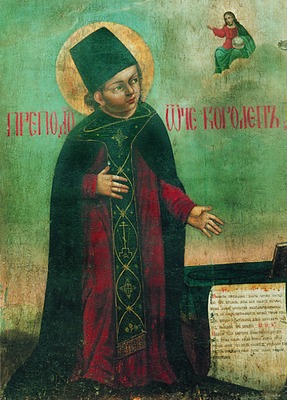
Bogolep is one of the most immediately recognisable of Russian saints, because his type is a contradiction held in a single figure: he is painted as a small boy — a child's face, a child's proportions — dressed in the full monastic schema of an adult, the dark analavos with its crosses and the pointed koukoulion on his head, and nimbed. He stands, usually in three-quarter view, with one hand at his breast and the other extended; Christ blesses from a cloud in the upper corner; and beside or beneath him is set a scroll or tablet bearing the account of his life, which is a peculiarity of his icons and reflects the fact that his veneration grew up around a written Life read aloud to those who came.
The stored image is a nineteenth-century icon from the Church of the Kazan Icon of the Mother of God at Astrakhan, inscribed ПРЕПОДОБНЫЙ ОТРОКЪ БОГОЛЕПЪ — "the Venerable Child Bogolep": the boy in the green koukoulion and the crimson and dark-green schema, on a green ground, with the Saviour blessing from the upper right and the inscribed tablet at the lower right. It is a characteristic example of the Astrakhan provincial workshops that spread his veneration down the Volga.
Disputed questions
- The year of his death. The OCA life, following the eighteenth-century Russian Life, gives birth in 1660 and repose on 1 August 1667, at seven years old. A parallel Russian tradition — reflected in some menologia and noted in this collection's July 24 entry — puts the repose in 1654. The 1660/1667 reckoning is followed here as the better attested; the variant is recorded.
- The day of commemoration. He reposed on 1 August, which in the fixed calendar is occupied by the Procession of the Cross and the Maccabees; his commemoration is accordingly kept on July 29, and some Russian calendars also list him on July 24, with the passion-bearers Boris and Gleb — his baptismal patron being Boris.
- His classification. The Russian books style him pravedny, "righteous," as they often do with children and laypeople, while he was in fact tonsured into the great schema and is therefore classed here as venerable. He is not a martyr, and should not be listed among the child-martyrs.
- Glorification. His veneration is of the local, popularly-established kind; the Astrakhan diocese confirmed it formally in modern times.