
Callistratus and his Forty-nine Companions
The Holy Martyr Callistratus and the Forty-nine Martyrs with him
Martyr · d. c. 304
Commemorated 27 September — Martyrdom with his forty-nine fellow soldiers
Callistratus (†c. 304) is the chief martyr of September 27: a Roman soldier of Carthaginian and Christian descent whose secret night prayers betrayed him to his commander in the Diocletianic persecution. Sewn into a sack and cast into the sea, he was delivered when the sack tore open on a rock and, the passio relates, was borne to land by dolphins — a wonder that converted forty-nine soldiers of his cohort. Imprisoned and tortured with them, he catechised his converts until all fifty were cut down by the sword at night. The company is commemorated together, and a church later rose over the place of their suffering, as Callistratus had foretold.
.jpg)
A Christian inheritance
The passio gives Callistratus a remarkable pedigree: his family's Christianity reached back to the generation of the Crucifixion itself. An ancestor named Neochorus (Neokoros), a soldier of Carthaginian origin, had served in Palestine under the emperor Tiberius in the forces commanded by Pontius Pilate, witnessed the Passion and heard the preaching of the apostles, and returned home a believer. The faith was handed down in the family, and Callistratus was raised a Christian by his father. Like his forebears he became a soldier, and in a pagan cohort was conspicuous for his good conduct and gentleness — and for the prayers he kept by night while the camp slept.
Betrayal and first tortures
A soldier sleeping near him heard Callistratus invoking the name of Jesus Christ and denounced him to the commander — unnamed in the Slavic account the OCA follows; the fuller Greek tradition calls him Persentinus. Summoned and ordered to sacrifice to the idols, Callistratus refused outright. He was beaten, and then dragged, covered with wounds, over sharp stones; neither torment moved him.
The sack and the dolphins
The commander then had him sewn into a leather sack and thrown into the sea. The sack struck a sharp rock and tore open, and Callistratus came to land unharmed — carried, the passio says, by dolphins. Forty-nine soldiers who watched the wonder believed in Christ on the spot. The commander imprisoned Callistratus together with the new believers, all of them first subjected to severe floggings. In prison Callistratus preached the word of God to his fellow soldiers and prepared them for martyrdom.
The second wonder and the end
Brought before the commander again, the company confessed Christ firmly. They were bound hand and foot and thrown into the deep water of a lake or cistern; their bonds broke, and the martyrs stood in the water with shining faces, rejoicing — the passio presents the immersion as the baptism of the converts, coinciding with their confession. Crowns appeared above their heads, a voice was heard bidding Callistratus and his company take courage, the earth shook, and a nearby idol fell and was shattered. At this a further hundred and thirty-five soldiers believed. The commander, fearing mutiny if he tried so many, returned Callistratus and his forty-nine to prison, where they prayed and gave thanks; by his order they were cut to pieces with swords in the night. The hundred and thirty-five who survived buried the relics, and a church was later built on the place of the martyrs' sufferings, as Callistratus had foretold to his companions.
Veneration and later cultus
The commemoration of Callistratus and his company on September 27 is universal in the Byzantine rite and is the principal commemoration of the day: the Synaxarion of Constantinople carries it, the Menologion of Basil II gives it the day's miniature, and the received Greek Menaion appoints the day's full sanctoral service to the martyrs — proper stichera, kontakion and oikos, and a canon by Joseph the Hymnographer. A monastery "of Callistratus" (τοῦ Καλλιστράτου) attested in Constantinople carried the martyr's name, a witness to an established cultus in the capital. The Menaion's stichera and canon single out by name one companion, the martyr Gymnasius — beheaded by the sword, and invoked as a healer "of them that run to thy temple in faith" — and the Russian calendar likewise pairs "Callistratus and Gymnasius of Byzantium." No other names of the forty-nine are transmitted in the received tradition.
Feast and commemoration
September 27 (church date; Old Calendar civil October 10), kept universally in the Byzantine rite as the day's principal commemoration. The OCA, the Moscow Patriarchate calendar (which adds Gymnasius by name), and the Greek Menaion (verified live) all carry the company on this day; the same commemorations of the day include the apostles Mark, Aristarchus and Zenas and the martyr Epicharis, whose services yield to the martyrs'.
Hymns
Troparion — Tone 4
Thy martyrs, O Lord, in their contest received incorruptible crowns from thee, our God; for possessing thy strength they cast down the tyrants and shattered the powerless insolence of the demons. By their intercessions, O Christ God, save our souls.
Original translation from the Greek
Kontakion — Tone 4
Like a great star hast thou shone upon the world, spreading abroad to all the rays of thy contests and of thy wonders, for them that cry: Rejoice, O Callistratus, glory of the martyrs.
Original translation from the Greek
Iconography
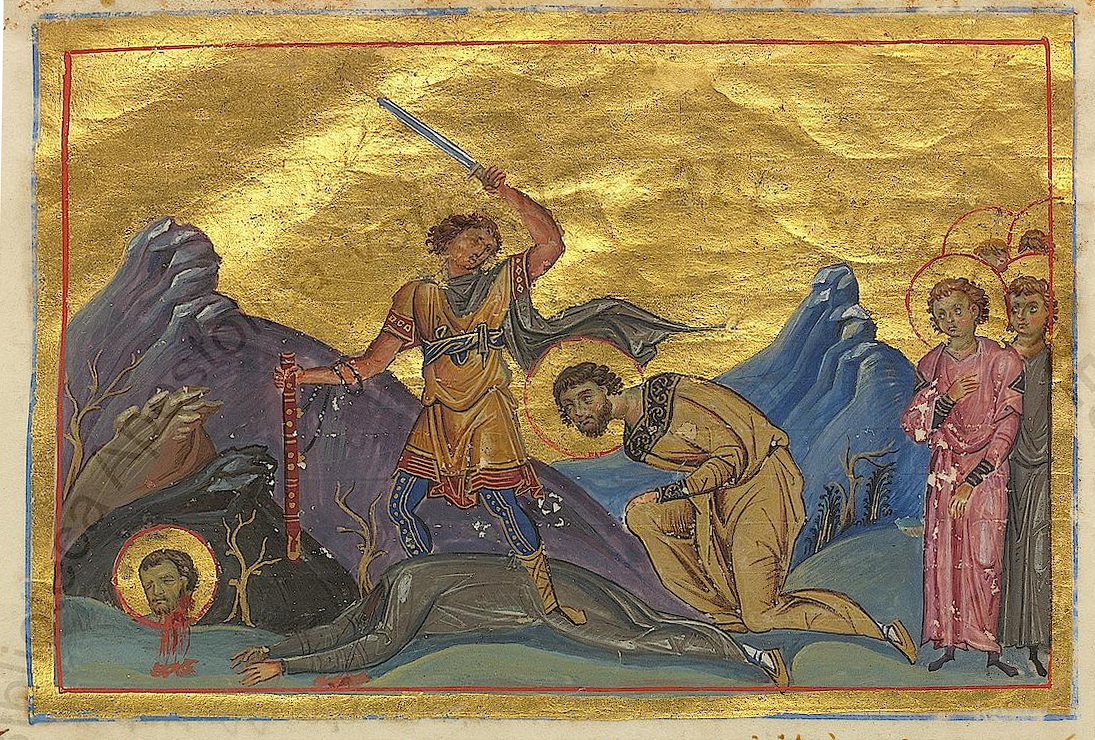
Callistratus is painted as a young soldier-martyr with the cross of martyrdom, alone or at the head of his company; narrative images show the sack cast into the sea or the final beheading. The stored image is the day's miniature from the Menologion of Basil II (Constantinople, c. 985; Vat. gr. 1613), showing the execution of the company by the sword.
Disputed questions
- Place of the martyrdom. The passio makes Carthage the family's origin, not necessarily the scene of the martyrdom. The Russian calendar styles Callistratus and Gymnasius "of Byzantium," and the Constantinopolitan monastery of Callistratus supports a tradition locating the passion at Byzantium; other retellings set it at Rome, where his cohort served; and some modern summaries (including the Wikimedia description of the Menologion miniature) say the company "suffered at Carthage." The sources disagree, and this entry asserts no city.
- Year. The passio fixes only the Diocletianic setting; c. 304, at the height of the great persecution, is the year conventionally given.
- The company's names. Only Gymnasius is named among the forty-nine, and only in the liturgical tradition (Menaion stichera and canon; the Russian calendar), not in the OCA's prose account.