
Catherine of Alexandria
The Holy Great-martyr Catherine of Alexandria the All-wise
Great Martyr · Virgin · d. c. 305
Commemorated 24 November — Martyrdom at Alexandria (Greek usage keeps November 25)
Catherine of Alexandria (†c. 305) is among the most celebrated of the virgin-martyrs, a noblewoman of Alexandria of rare learning and beauty who, converted to Christ through a vision of the Theotokos, confronted the emperor during a pagan festival and was set to dispute with fifty of the empire's foremost philosophers, whom she confounded and converted, so that they went to the fire confessing Christ. Imprisoned, she drew the empress Augusta, the general Porphyrius and two hundred soldiers to the faith; when the spiked wheel prepared for her was shattered by an angel, she was beheaded. Her relics, tradition says, were borne by angels to Mount Sinai, where the great monastery that bears her name preserves them. She is invoked by students, philosophers and women in childbirth, and her cult, immense in both East and West, is kept on November 24 (Greek usage November 25).

Origins and early life
The passio presents Catherine (Greek Αἰκατερίνη, "the ever-pure") as the daughter of Konstos (Constus), a governor of Alexandria, born to wealth and rank in the greatest city of Hellenistic learning. Gifted with exceptional beauty and a still more exceptional mind, she was schooled — the tradition insists — in the whole round of pagan wisdom: the poets and philosophers, the physicians Hippocrates and Galen, rhetoric, dialectic and the several tongues of the empire. Sought in marriage by the noblest families, she refused every suitor, telling her parents that she would wed only one who surpassed her in birth, wealth, beauty and wisdom.
Her mother, a secret Christian, brought her to her own spiritual father, an ascetic living in a cave outside the city. Hearing the girl's demand, the elder answered that he knew of a bridegroom who infinitely surpassed her in every excellence: "his countenance is brighter than the sun, his wisdom governs all creation, his riches are given to all the nations and are never diminished, and his tenderness has no equal." He gave her an icon of the Mother of God holding the divine Child and bade her pray to the Virgin to see her Son. Catherine prayed through the night and beheld the Theotokos with the Child; but the Child turned his face away, calling the maiden ugly, foolish and unbelieving, one whom he could not look upon until she forsook her impiety. Stricken, she returned to the elder, who instructed her in the faith of Christ and baptized her. In a second vision the Lord now looked upon her with love and gave her a ring in token of her betrothal — the "mystical marriage" of Catherine, of which the tradition says the ring remained upon her hand.
Martyrdom
It was during a great pagan festival at Alexandria, at which the emperor himself presided and Christians were being dragged to sacrifice or death, that Catherine came forward. Confessing the one true God and exposing the emptiness of the idols, she so struck the emperor with her beauty and her arguments that, unable to answer her himself, he summoned fifty of the most learned philosophers and rhetoricians of the empire to refute her. The contest went wholly the other way: by the wisdom given her — she called on the martyr-tongue of the apostles and the folly of the cross that shames the wise — she overthrew their reasonings, and the philosophers confessed Christ. Enraged, the emperor had them burned; Catherine signed them with the cross, and they went into the fire as into baptism, their bodies (the tradition adds) found unharmed.
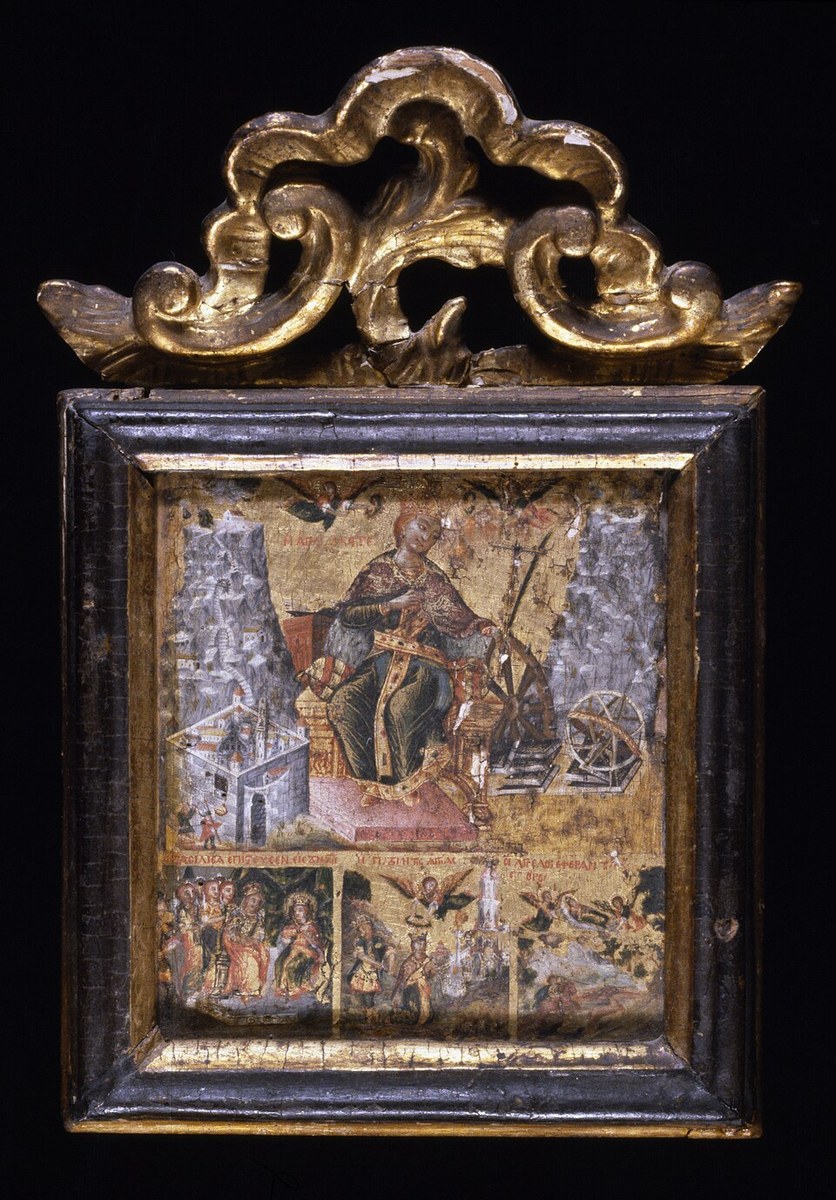
Failing with promises of wealth and rank, the emperor had her scourged and thrown into prison. There the empress Augusta, drawn by report of her, came by night with the general Porphyrius and a company of soldiers; Catherine expounded the faith to them and they too believed. She was fed in prison, the passio says, by a dove, and comforted by a vision of Christ. Brought out again, she was threatened with a new engine of death: four wheels set with iron spikes, turning against each other to tear her apart. At her prayer an angel shattered the machine, the flying fragments killing many of the bystanders — whence the "Catherine wheel" that became her emblem. Seeing the wonder, the empress Augusta openly confessed Christ and was put to death (her breasts torn off, then beheaded), and with her Porphyrius and two hundred soldiers, all beheaded.
The emperor made a last attempt, offering Catherine marriage and a share of the throne; she answered that she was already the bride of Christ, and was condemned to the sword. Praying at the block for all who should remember her, she was beheaded — and from the wound, the tradition relates, there flowed milk in place of blood. The year is given as about 305 (some accounts 307).
Relics and translations
By the received tradition angels bore the martyr's body across the wilderness to the summit of the great mountain of Sinai, the mount of the Law-giving. There, in the sixth century, her venerable head and left hand were made known by revelation to the monks of the fortress-monastery that the emperor Justinian had built at the foot of the mountain about the Burning Bush; her relics were translated with honour into its church. From that time the ancient monastery of the Transfiguration came to be called the Monastery of Saint Catherine, one of the oldest continuously inhabited Christian monasteries on earth, its possession of the great-martyr's relics drawing pilgrims from all the Christian world. Fragments of the relics were carried west during the Middle Ages — above all to Rouen — and multiplied her shrines across Europe; the monks of Sinai still anoint pilgrims at her reliquary and give them a ring in memory of her mystical betrothal.
Veneration and later cultus
Few saints of the East were so honoured in the West. In the Latin Middle Ages Catherine was reckoned among the Fourteen Holy Helpers and named one of the counsellors ("voices") heard by Joan of Arc; she is the patroness of students, philosophers, theologians, apologists, preachers, notaries, wheelwrights and of young unmarried women, and is invoked against a hard death and, from her own hard contest, for aid in difficult childbirth. Universities and colleges, guilds and countless churches took her name; her disputation made her the type of Christian wisdom confounding the wisdom of the world. In the East her feast carries a full proper service, and at Sinai she is the abiding patroness of the holy mountain.
Miracles and traditions
The passio is woven of wonders: the vision of the icon and the aversion of the Christ-child; the mystical marriage and the ring; the dove that fed her and the light that healed her wounds in prison; the angel who broke the wheel; the milk that flowed at her beheading; and the angelic translation of her body to Sinai. The conversion of the fifty philosophers — learned pagans overcome not by force but by a maiden's argument — is the heart of her cultus and the reason she is invoked over every Christian confronting the wisdom of the age.
Feast and commemoration
Catherine is commemorated on November 24 (church date; Old Calendar civil December 7), within the afterfeast of the Entry of the Theotokos and the day before its leavetaking. In the Greek books, however, her principal feast is kept on November 25, where her full service stands together with that of the hieromartyr Clement of Rome; the Slavic and Antiochian usage, followed here, keeps her on November 24, and the OCA notes the Greek November 25 expressly. The divergence is ancient — the two neighbouring commemorations of Catherine and Clement were transposed between the Constantinopolitan and later Greek calendars — and both dates are recorded. Her cult is universal; the Roman Martyrology likewise keeps her on November 25.
Hymns
Troparion — Tone 5
Let us praise the all-lauded bride of Christ, the divine Catherine, guardian of Sinai and our defence and help; for by the power of the Spirit she brilliantly silenced the eloquence of the ungodly, and now, crowned as a martyr, she asks great mercy for us all.
Original translation from the Greek
Kontakion — Tone 2
Raise up now, O lovers of the martyrs, a sacred and godly choir, singing the praise of the all-revered Catherine; for in the arena she proclaimed Christ and trampled upon the serpent, stopping the mouths of the orators' knowledge.
Original translation from the Greek
Magnification
We magnify thee, O holy great-martyr Catherine, and we honour thy precious sufferings, which thou didst endure for Christ.
Original translation from the Slavonic
Iconography
Catherine is shown as a royal virgin-martyr in rich, jewelled robes and often a crown, holding the martyr's cross and, as her distinctive attributes, a scroll or book (her learning) and the spiked wheel of her passion; a sword or palm may accompany them, and Western images add the ring of the mystical marriage. Byzantine and post-Byzantine icons frequently surround her with scenes of her life — the disputation, the wheel, the beheading, the angelic translation to Sinai. The stored image is an eighteenth-century Greek icon (Walters Art Museum) showing the great-martyr crowned and enthroned with three scenes from her passion, identified by its museum catalogue as Catherine of Alexandria.
Disputed questions
- The persecuting emperor. The passio names the tyrant variously; the Greek texts most often call him Maxentius (Μαξέντιος), other witnesses Maximinus Daza (Maximinus II) — the two are frequently confused in the tradition — and the OCA notice styles him Maximian. Historians treat the identification as unresolved; the reign in question is the last persecution, about 305–313.
- Historicity. No contemporary Acta survive; the passio is transmitted in Greek recensions from the sixth to ninth centuries and enlarged in the medieval West. Modern scholarship regards much of the narrative — the disputation, the mystical marriage, the Sinai translation — as hagiographic elaboration, while the ancient and continuous cult and the relics at Sinai are received by the Church. Some have proposed a historical connection with the learned pagan philosopher Hypatia of Alexandria (†415), a Christianised counter-figure; this is a scholarly hypothesis, not a datum of the tradition.
- The mystical marriage and the surviving ring are proper to the developed tradition and became, in Western art, her chief subject.