
Charitina of Amisus
The Holy Martyr Charitina of Amisus
Martyr · Virgin · d. 304
Commemorated 5 October — Martyrdom at Amisus under Diocletian
Charitina of Amisus (†304) was a young virgin-martyr of Pontus on the Black Sea coast: an orphan brought up as his own daughter by the Christian Claudius, in whose household she served. Denounced during the persecution of Diocletian as a Christian who won others to the faith, she confessed Christ before the count Dometius and endured a long catalogue of tortures — her head shorn and burned, her flesh pierced with heated spits, her nails and teeth torn out, herself cast into the sea with a stone about her neck — and, threatened at the last with dishonour, gave up her soul in prayer. The Greek and Slavic calendars alike keep her memory on October 5, of which day she is the principal saint.
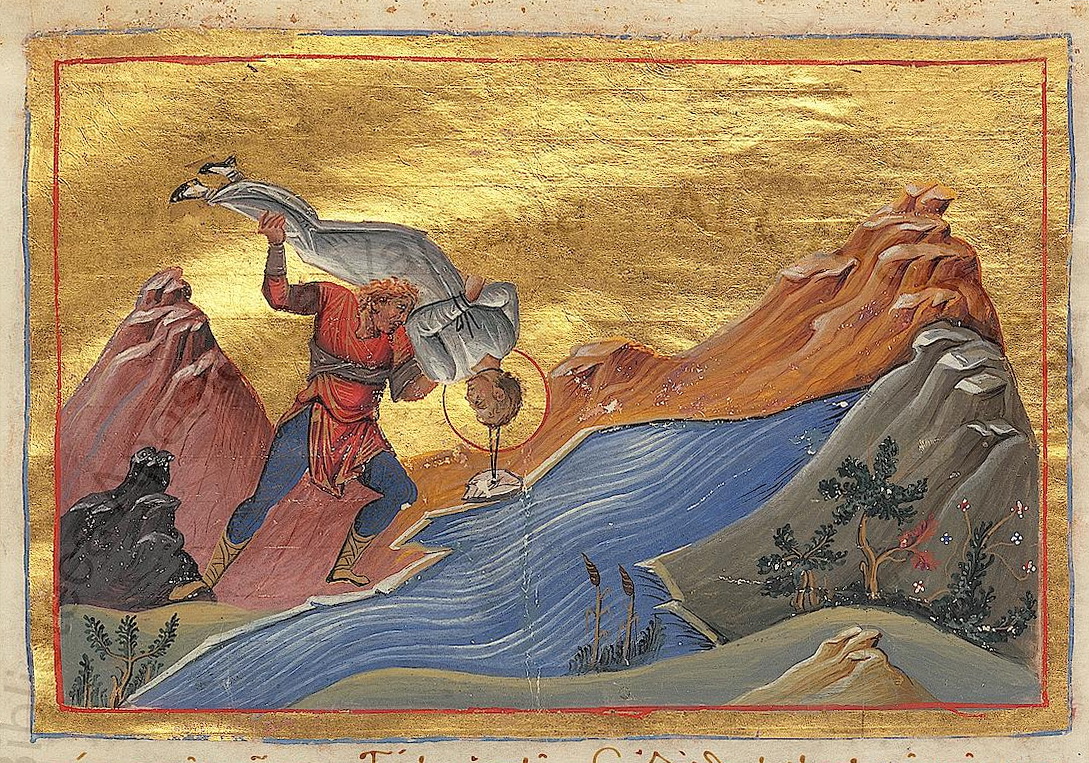
.jpg)
Origins and early life
Charitina came from Amisus (Amisos, the modern Samsun), the old Greek trading city on the Pontic coast of Asia Minor, and her martyrdom is placed in the year 304, at the height of the Great Persecution of Diocletian (284–305). Orphaned young, she was taken into the household of a Christian of rank named Claudius (the Greek synaxaria call him the senator Claudianus, and describe her as his slave), who raised the girl as his own daughter. The tradition remembers her as lovely, sensible and gentle — meek, obedient and sparing of speech — and, though not yet baptized, a Christian in heart and in deed: she studied the divine law day and night, vowed her virginity to Christ as His bride, and drew many of those around her from error to the faith.
Her name, from charis, means "graced" or "little grace," and the hymnography of her feast plays throughout on the fit between her name and her calling — "named for joy and grace," it says, she went rejoicing into the bridal chamber of heaven.
Martyrdom
Her success in winning converts was her undoing before the law. She was denounced to Dometius (in other witnesses Dometianus or Domitian), a count holding authority under Diocletian in the region, who wrote to Claudius ordering that the girl be delivered up for questioning. Claudius, foreseeing the outcome, put on sackcloth and mourned her as one already dead; Charitina comforted him, asking him rather to rejoice that she was to be offered as an acceptable sacrifice to God, and he asked in return that she remember him before the heavenly King when she stood among the martyrs.
At the tribunal she was asked whether she was truly a Christian and whether she deceived others into her "impious" faith. She answered that a Christian she was, but that the deception ran the other way: she led people out of error toward the truth, bringing them to her Christ. The judge then set upon her the sequence of torments the synaxaria record: her head was shorn, but the hair grew back at once, fuller than before; burning coals were heaped on her head and vinegar poured over the burns; her sides were scorched with lighted torches, and heated spits or rods were driven through her breasts. She was thrown into the sea with a stone tied about her neck — greeting the waters, the tradition says, as her baptism — but the stone slipped loose and sank, and she came to shore unharmed. Bound then to a wheel turning over a bed of coals, she was preserved when an angel stayed the wheel. Her fingernails and toenails were torn out and her teeth broken.
Baffled by her endurance, the judge at last handed her over to a band of dissolute men to be violated. Fearing that dishonour alone, Charitina prayed that God would receive her soul before her virginal body could be defiled, and, as she prayed, she died. The verses of the Constantinople synaxarion fix the point precisely: what she had asked in prayer — the release of the flesh — in prayer she received.
The body was sewn into a sack weighted with stones and thrown into the sea, but it was carried to land — after three days, in the account the OCA transmits — and Claudius, who had sought her, recovered and buried her with honour. The Vespers stichera of her feast put a cry of wonder into the mouth of the foster-father as he gathers her body from the sea: how the torments of her martyrdom had made the name of grace she bore come true.
Relics and veneration
Fragments of her relics are preserved at the Monastery of Kykkos on Cyprus and at the Monastery of Jerusalem (Hierousalēm) in Boeotia in Greece. Her commemoration on October 5 is ancient and universal: she holds the day's entry in the Synaxarion of Constantinople with proper verses, the Menologion of Basil II (c. 985) devotes its October 5 miniature to her drowning, and the Menaion gives her a full proper service — three prosomoia stichera at Vespers and a canon by Joseph the Hymnographer — while the Slavic books carry her troparion and kontakion. She is styled in the hymns a much-suffering virgin-martyr (παρθενομάρτυς πολύαθλε).
Feast and commemoration
October 5 (church date; Old Calendar civil October 18), her only feast, kept universally. She is the principal saint of the day in the Greek books, which give her the proper service of the Menaion; the Russian calendar keeps her first on the day ahead of the Synaxis of the Hierarchs of Moscow, with which her service is combined in Russian practice. The OCA transmits her life and proper hymns in English translation.
Hymns
Troparion — Tone 4
Thy lamb Charitina crieth to Thee with a great voice, O Jesus: Thee, my Bridegroom, do I love, and seeking Thee I suffer, and am crucified and buried with Thee in Thy baptism; I suffer for Thy sake, that I may reign with Thee, and die for Thee, that I may also live in Thee. Accept me then as a spotless sacrifice, slain for Thee with love. By her intercessions save our souls, for Thou art merciful.
Original translation from the Greek
Kontakion — Tone 2
With steadfast mind, O Charitina, thou didst make thy soul firm in faith and didst openly put to shame the enemy who warred against thee; thou standest now before Christ, O all-blessed one, clothed in the purple dyed from thy blood, and rejoicest with the angels for ever: pray for us, O passion-bearer.
Original translation from the Slavonic
Iconography
The oldest surviving image is the October 5 miniature of the Menologion of Basil II (c. 985, Vatican Library), which shows the moment of her casting into the sea: the executioner in a red tunic swings the small, haloed, white-clad figure of the saint headfirst toward the water between rocky shores, under a gold sky. Later icons show her as a young woman in a martyr's mantle, bearing the cross of martyrdom. The stored image is the Menologion miniature.
Disputed questions
- The persecutor's name. The witnesses divide between Dometius (OCA, "one of Diocletian's governors"), Dometianus/Domitian the count (Greek synaxaria; the older English literature calls him "Domitian the comes"), and the account above records the variance rather than resolving it.
- Her station. The Greek synaxarion makes her the slave (δούλη) of the senator Claudianus; the Slavic-OCA tradition softens this to a servant whom Claudius "brought up as his own daughter." The two are compatible — a house-born or orphaned slave girl raised with fatherly affection — and both are recorded.
- Manner of death. The dominant account (Greek and Slavic alike) has her die in prayer, forestalling her violation, after surviving the sea; the Menologion of Basil II nevertheless chose the casting into the sea as the image of her martyrdom, and summary calendars sometimes state simply that she was drowned. The synaxarion verses support death in prayer.
- The Charitine of September 4. The Greek synaxaria also list a martyr Charitine on September 4 (with Petronius, Zarbelus/Sarbelus, Thathuil and Bebaia), and saint.gr notes that the same distich is applied to both — a sign of possible duplication of one martyr in the manuscript synaxaria. The question is left open; the September 4 group is a pending entry (see 4 September), and the identity should be weighed when it is authored.
- Not to be confused with Chariton the Confessor of Palestine (September 28), whose name shares the same root, nor with Charitina, Princess of Lithuania, abbess at Novgorod (†1281), who is commemorated on this same October 5 in the Russian calendar.