
Concordius of Spoleto
The Holy Martyr Concordius, Presbyter, of Spoleto
Martyr · Priest · d. c. 175
Commemorated 4 June — Beheading in prison near Spoleto
Concordius was the son of a Roman presbyter named Gordian, raised in the faith and made subdeacon by the bishop of Rome; with his father's leave he went to live in retirement near Rome with a kinsman named Eutychius, in prayer and almsgiving. His reputation reached Torquatus, the magistrate of the district, who summoned him, offered him a pagan priesthood and, when Concordius answered by preaching Christ to him, had him beaten and imprisoned. A bishop named Anthimus obtained his release and ordained him presbyter; but Torquatus summoned him again, asked him what he thought of his life, and heard the answer "for me, life is Christ." Chained to the wall of a prison by the neck and hands, he refused after three days to sacrifice, spat upon the image of Zeus brought to him, and was beheaded about the year 175. His relics rest near Spoleto in Umbria, and he is commemorated on June 4.
_-_%D0%B8%D0%BA%D0%BE%D0%BD%D0%B0_10042_%D0%9A%D0%BE%D0%BD%D0%BA%D0%BE%D1%80%D0%B4%D0%B8%D0%B9.png)
Son of a presbyter
Concordius belongs to the Christian clergy of second-century Rome, and the passion is unusual in beginning with a family: his father Gordian was a presbyter of the city, and it was Gordian who raised him in piety and in the faith of Christ. On the strength of that upbringing the bishop of Rome — the passion names Pius, whose episcopate is dated c. 140–155 — appointed him subdeacon. Father and son lived together in fasting and prayer, and gave alms liberally to the needy: the domestic detail is the passion's way of establishing that his sanctity was formed before it was tested.
Retirement, and the summons of Torquatus
With his father's permission Concordius left the city and settled not far from Rome with a kinsman named Eutychius, spending his days in prayer and in works of mercy. The report of that life reached Torquatus, the official set over the district the passion calls Tussa — the Tuscan or Umbrian country north of Rome, in the neighbourhood of Spoleto.
Torquatus summoned him and urged him to renounce Christ, adding the inducement that he would make him a priest of the pagan gods — an offer that presumes he already knew Concordius to be a cleric. Concordius answered by reversing the exhortation: he urged Torquatus to turn to the true God, Jesus Christ. He was beaten for it and thrown into prison.
Anthimus, and the presbyterate
A bishop named Anthimus, who was a friend of Torquatus, asked that the prisoner be handed over to him, and Torquatus consented. Concordius lived for a time with Anthimus and was ordained presbyter by him. The episode is the strangest and the most convincing in the passion — a Christian bishop on personal terms with the magistrate who has just flogged one of his clergy is exactly the kind of local arrangement the pre-Decian Church actually lived by.
The second interrogation and the martyrdom
Torquatus summoned him again and asked him what he now thought of his own life. The reply the passion preserves is Pauline: "For me, life is Christ" (cf. Phil. 1:21). He was bound and shut up in prison a second time, chained to the wall by the neck and by the hands — a detail that fixes the manner of his confinement and, in the iconography, his emblem.
Three days later Torquatus sent an officer with soldiers and with an image of Zeus, with orders that the prisoner sacrifice or die. Concordius cried out "Glory to thee, Lord Jesus Christ," and spat upon the idol. For this he was beheaded in the prison, about the year 175.
His body was taken by the faithful, and his relics rest in Italy not far from Spoleto, where his cultus has been continuous; he is one of the martyrs of the Umbrian church, and churches and place-names of the region — San Concordio — carry his name.
Feast and commemoration
June 4 (church date; New Calendar civil June 4, Old Calendar civil June 17) in the Byzantine calendars, kept with Saint Metrophanes of Constantinople; the same day is his in the Western martyrologies, so that he is one of the pre-schism Latin martyrs whose date is not disputed between the traditions. He is commemorated at the simple rank with the common of a martyr in the Byzantine rite. At Spoleto and in Umbria his memory is local and long-standing, attached to the shrine of his relics.
Hymns
Apolytikion — Tone 4 (common of a martyr)
Thy martyr Concordius, O Lord, in his contest received an incorruptible crown from thee our God; for having thy strength, he cast down the tyrants and broke the feeble insolence of the demons. By his intercessions save our souls.
Iconography
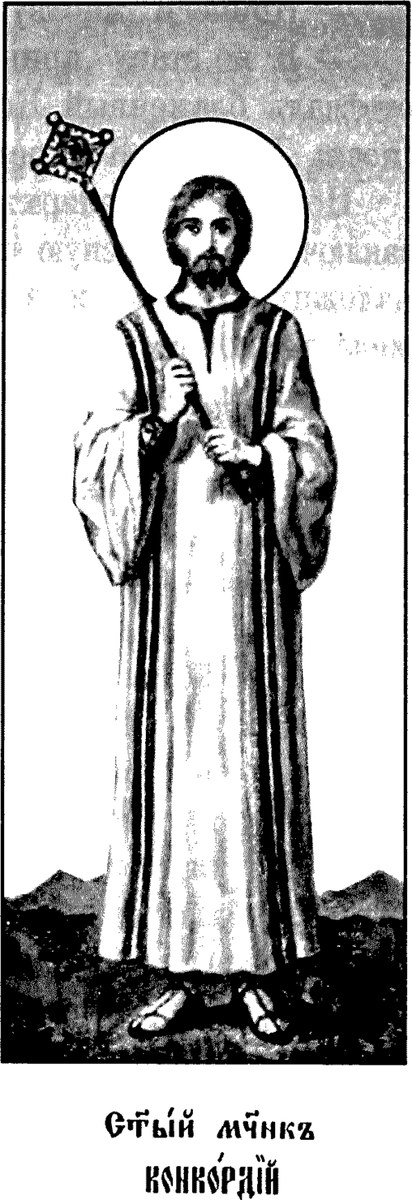
Concordius is painted as a young or youthful-middle-aged martyr — beardless, or with a short dark beard — in the long belted tunic and mantle of a layman-martyr, holding the cross of the martyrs in his right hand; where his clerical order is to be marked he may be given the narrow orarion of a subdeacon, or the presbyter's phelonion in Italian and later Russian versions which follow his ordination rather than the calendar's classification. His distinguishing attributes, where the scene of his passion is shown, are the chain at the neck and wrists by which he was fastened to the prison wall, and the fallen idol of Zeus which he spat upon; the beheading in prison may be shown in a small compartment.
The stored image is the plate of Saint Concordius from the illustrated pre-1911 Russian Lives of the Saints compiled after the Menaia of Saint Dimitri of Rostov — the second of the three figures given for June 4 in the June volume, captioned in Slavonic Ст҃ый мч҃никъ Конкордíй, "Holy Martyr Concordius." It shows him standing full-length in a light tunic and dark mantle, short-bearded and haloed, holding upright in both hands a tall processional cross with an ornamented head: the martyr-with-cross type exactly.
Disputed questions
- Chronology. The passion's internal dates do not agree. Bishop Pius of Rome, who is said to have made him subdeacon, died about 155; the martyrdom is dated about 175, under Marcus Aurelius. That is possible but tight, and some accounts put the martyrdom earlier, in the reign of Antoninus Pius, or later, moving it into the third century. The passion belongs to the class of Italian passiones whose narrative frame is later than the events, and the dates should be held loosely.
- Order and title. He is made subdeacon at Rome, then presbyter by Anthimus — so that at his death he was an ordained presbyter, which would ordinarily earn the classification hieromartyr. The calendars do not so classify him: the Greek and Slavonic books style him simply martyr (μάρτυς, мученикъ), and the Russian icon-plate for the day is captioned "Holy Martyr Concordius." This repository follows the calendars, per its rule that a saint is classified as the Church commemorates, and records the presbyterate in the types list and in this note.
- Place. The passion's Tussa region and the location of the prison are not securely identified; the constant element is the resting-place of the relics near Spoleto, from which his epithet comes. He is not to be confused with the several other Italian Concordii of the martyrologies, nor with the deacon Concordius of the Roman acta of other days.
- Eutychius and Anthimus. Both are named without further identification. Attempts to identify Anthimus with the Roman presbyter-martyr Anthimus of other days, or Eutychius with a martyr of the same name, are conjectural.