
Conon the Gardener
The Holy Martyr Conon the Gardener, of Mandon in Pamphylia
Martyr · b. 1st–3rd century, at Nazareth of Galilee — d. c. 251, at Mandon in Pamphylia
Commemorated 5 March
Conon the Gardener (martyred about the year 251) was a simple and guileless labourer of the town of Mandon in Pamphylia — a native of Nazareth of Galilee who tended a garden and lived, the synaxarion says, "God-fearing, sincere in heart, and without malice." When the persecution of the emperor Decius reached his country he was denounced as a Christian and refused to sacrifice to the idols; the tortures inflicted on him were fitted to his humble calling and his humble constancy — nails were driven through his feet, and he was made to run before the governor's chariot until he fell exhausted, and, praying, gave up his soul. He is one of the most beloved of the calendar's plain, unlettered martyrs, kept on March 5 together with the wonderworker Conon of Isauria, from whom he must be carefully distinguished.
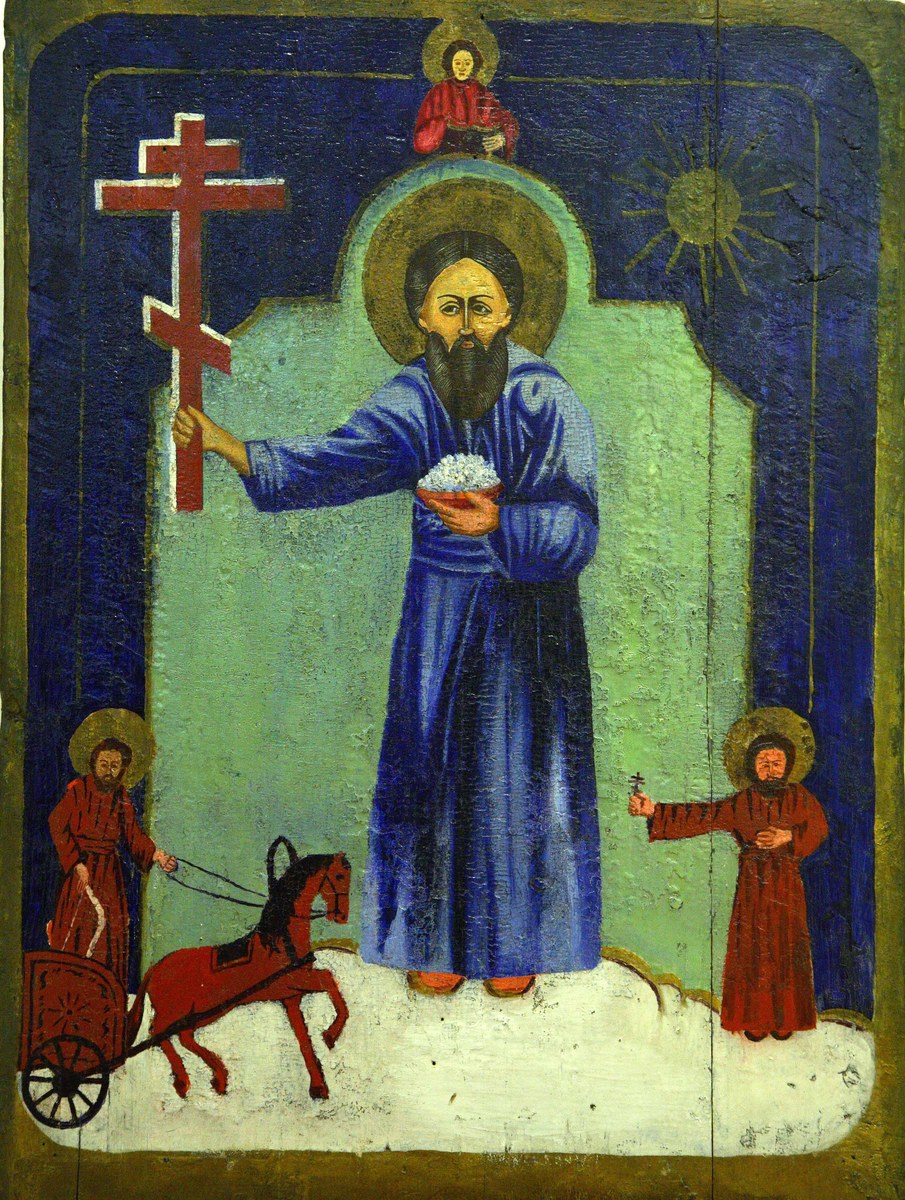

Little is recorded of Conon the Gardener beyond the few lines of the synaxarion, and no honest account inflates them; what the tradition preserves is a portrait of holiness in the humblest of lives. He was born, the notice says, at Nazareth of Galilee — the town of the Lord's own upbringing — but lived in the town of Mandon (Μανδών; also Mandona) in Pamphylia, the coastal region of southern Asia Minor bordering on Isauria. There he kept a garden, and by that work he lived: a gardener, not a scholar or a soldier or a bishop, remembered for no learning and no office but only for the plainness and purity of his soul. The synaxarion's phrase has fixed his memory — he was "a God-fearing man, sincere in heart, and without malice" (ἄκακος), a man of such simplicity and innocence that guile had no place in him.
That simplicity was itself his witness. When the persecution under the emperor Decius (249–251) came upon Pamphylia and the Christians were sought out and haled before the magistrates, Conon was taken and questioned. Guileless as he was, he neither dissembled nor argued: he confessed Christ plainly and would not sacrifice to the idols. For this the governor gave him over to torture, and the manner of his martyrdom has kept his memory vivid: his persecutors drove nails through his feet and then compelled him to run before the chariot of the governor as it drove on, so that the wounded man was dragged and driven along the road until, spent and broken, he fell to the ground. There, kneeling in prayer, he surrendered his spirit to the Lord, and received the crown of martyrdom about the year 251.
Feast and commemoration
Conon the Gardener is kept on March 5 (church date; New Calendar civil March 5; Old Calendar civil March 18), the same day as Conon of Isauria — a coincidence of name and day that the synaxaria are at pains to untangle, and that this collection keeps distinct with a separate entry for each (see Disputed questions). The Greek Menaion, the Synaxarion of Constantinople, and the Slavic calendars all commemorate him. No proper hymnography is appointed to him; his memory is honoured with the common office of a martyr.
Hymns
Troparion — Tone 4 (common of a martyr)
Thy Martyr Conon, O Lord, in his contest received from Thee our God the crown of incorruption; for, having Thy strength, he cast down the tyrants and shattered the feeble insolence of the demons. By his intercessions, O Christ God, save our souls.
Original translation from the Greek
Iconography
The distinction from the wonderworker Conon of Isauria of the same day — which long kept this entry imageless — is settled by the stored icon's own inscription. His proper iconographic type is the martyrdom: a plainly dressed young or middle-aged layman, sometimes shown as a gardener, his feet pierced, driven or dragged before a chariot — the very image his synaxarion gives. Where he is shown in portrait he carries the martyr's cross.
The stored image is a 19th-century Russian icon inscribed for Conon the Gardener (Конон Градарь) — the inscription mattering doubly here, the calendar holding a second Conon (of Isauria) whose day he shares.
Disputed questions
- Not to be confused with Conon of Isauria, the apostolic-age wonderworker of Bidana with whom he shares March 5 — a different person of a different century (first–second, against this Conon's third), a monk and worker of miracles who reposed in peace, where this Conon is a lay gardener who died under torture. The two are constantly confused precisely because they fall on the same day; the calendars, and this collection, keep them separate. He is likewise distinct from Conon of Penthucla (Feb 19), from the monk-martyrs Conon and his son Conon of Iconium kept the next day (March 6, †c. 270–275), and from the other Conons of the calendar.
- Origin and place. The synaxarion's "Nazareth of Galilee" for his birth and "Mandon in Pamphylia" for his home are the constant data; some notices attach him to Isauria rather than Pamphylia (the two regions adjoin), and the proximity is part of what draws him and Conon of Isauria together in the memory.