
Cornelius of the Pskov Caves
Our Venerable Father and Martyr Cornelius, Abbot of the Pskov Caves
Venerable Martyr · Priest · b. 1501, at Pskov — d. 1570, at the Pskov Caves Monastery
Commemorated 20 February — Martyrdom (beheading) at the gates of the monastery
Cornelius (1501–1570) was the great abbot of the Pskov Caves (Pskovo-Pechersky) Monastery, under whom that border-house rose to be one of the foremost monasteries of Russia. Born of a noble Pskov family and schooled at the Mirozh monastery, he became a monk at the Caves and was made abbot at twenty-eight; for forty years he built and adorned the monastery, ringed it with a stone fortress-wall, expanded the God-hewn caves and their church, gathered a great library, wrote and continued the Pskov chronicle, and carried the Gospel to the Estonian and Setu peoples of the borderland, founding churches among them. In 1570, during Ivan the Terrible's terror against Pskov and Novgorod, the Tsar, persuaded that Cornelius was a traitor, struck off his head at the monastery gate as the abbot came out to bless him — then, seized with remorse, took up the body in his own arms and bore it into the church, so that the way is called the Bloody Path to this day. Venerated at once as a martyr, Cornelius is commemorated on February 20.

Origins and monastic beginnings
Cornelius was born in 1501 at Pskov, into the noble family of Stephen and Maria. As a boy he was given to the Mirozh Monastery in Pskov for his schooling, where he learned letters, the copying of books, and the painting of icons, and where the ascetic life took hold of him. Still young, he came to the Pskov Caves Monastery — the Pskovo-Pechersky house, then a small and poor foundation set in a ravine on the western marches of Russia, its church hollowed in the sandy hillside — and there received the monastic tonsure. In 1529, at the age of twenty-eight, he was chosen its abbot (hegumen).
The building of the Caves Monastery
Cornelius's forty-year abbacy transformed the monastery. Under him the brotherhood grew many times over; he enlarged the God-hewn caves and their churches, built new stone churches within and above the ravine, established a hospice, an almshouse, and workshops, and gathered one of the finest libraries of the Russian north. A man of learning as well as a builder, he continued and compiled the Pskov chronicle and wrote a history and description of his own monastery, and under him its scriptorium and icon-painting flourished. Set on the contested frontier with Livonia, the monastery under Cornelius became also a fortress: he girdled it about with a great stone wall and towers — the fortification that would withstand siege in the wars of the following years — and this very strengthening of a border-house, in the end, drew upon him the suspicion that cost his life.
His zeal reached beyond the walls. Cornelius was a missionary to the half-pagan peoples of the borderland — the Setu and the Estonians (the Chud) — among whom he preached, baptized many, built churches, and founded chapels, extending the Orthodox faith along the western edge of the Russian land.
Martyrdom
In 1570 the storm of Ivan the Terrible's wrath broke over the north-west. Returning from the sack of Novgorod, where his oprichniki had slaughtered thousands on the charge of treasonous dealing with Lithuania, the Tsar came to Pskov, and his suspicion fell on the Caves Monastery and its powerful abbot — the more so, the tradition holds, because of the fortress Cornelius had raised, which slanderers represented as the work of a man preparing to go over to the enemy. When Cornelius came out through the monastery gate bearing the cross to bless the Tsar, Ivan in a fit of rage struck off his head with his own hand, on February 20, 1570.
At once, the tradition relates, the Tsar was pierced with remorse: he lifted up the body of the murdered abbot in his own arms and carried it from the gate into the monastery church, the blood marking the path — which from that day has borne the name of the "Bloody Path" (Krovavy put'), the ascent from the lower gate to the Dormition church that pilgrims tread still. Cornelius was laid to rest in the caves; and Ivan, it is said, gave gifts to the monastery in penance for the deed.
Relics and veneration
Cornelius was honoured as a martyr from the time of his death; his relics rested in the God-hewn caves, and in 1690 they were solemnly translated into the Dormition Cathedral of the monastery, where they lie in a reliquary and are venerated to this day. He is numbered among the Synaxis of the Saints of the Pskov Caves and the Synaxis of the Saints of Pskov, and is one of the best-loved saints of the Russian north-west — abbot, builder, chronicler, missionary, and martyr.
Feast and commemoration
Cornelius is kept on February 20 (church date; Old Calendar civil March 5), the day of his martyrdom, in the Russian Church and on the OCA calendar; the day, as his uncovering and translation of relics fell later, is that of the beheading. He is also commemorated in the Synaxis of the Pskov-Caves Saints and the Synaxis of the Pskov Saints. The commemoration falls in most years within Great Lent, and the office is sung with the Triodion.
Iconography
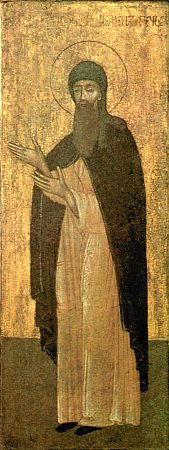
Cornelius is depicted as a Russian abbot — in the monastic mantiya and klobuk, a scroll in his hand, grey-bearded — and, in the narrative type, at the moment of his martyrdom before the Tsar, or with the model of his monastery. The stored image is an eighteenth-century icon (c. 1750) of the Pskov-Caves Dormition Monastery: Cornelius shown full-length as a holy abbot in prayer (source, public domain, pd-old-work).
Disputed questions
- Martyr or hieromartyr. The Russian tradition styles Cornelius преподобномученик — a venerable-martyr, a martyred monastic — which the entry follows, since he suffered as the monastic abbot of his house. The Orthodox Church in America renders his title in English as hieromartyr, on the ground that as abbot he was an ordained priest; both stylings are recorded, and the divergence is one of English usage over the same Slavonic office.
- The circumstances of his death. That the Tsar himself struck the blow, and then in remorse bore the body up the Bloody Path, is the constant tradition of the monastery; the details vary in the telling, but the day (February 20, 1570) and the fact of his violent death at the Tsar's hand are firm.