
Cornelius the Centurion
The Holy Martyr Cornelius the Centurion
Righteous · Bishop · d. 1st century
Commemorated 13 September — Principal commemoration, with the Encaenia of the Anastasis
Cornelius the Centurion is the Roman officer of Acts 10 — a devout, alms-giving "God-fearer" of the Italian Cohort at Caesarea in Palestine — whose baptism by the apostle Peter, at the command of an angel and after Peter's vision of the sheet of clean and unclean creatures, opened the Church to the Gentiles: he is venerated as the first-fruits of the nations. Later tradition makes him a companion of Peter's preaching and bishop of Skepsis in the Troad, where he overthrew a pagan temple by prayer, converted the city's ruler Demetrius, and — despite the "hieromartyr" styling of many calendars — reposed in peace in old age. His feast is September 13.
.jpg)
The centurion of Caesarea (Acts 10–11)
Luke introduces Cornelius at Caesarea Maritima, the Roman administrative capital of Judaea: "a centurion of the band called the Italian band, a devout man, and one that feared God with all his house, which gave much alms to the people, and prayed to God alway" (Acts 10:1–2). He belonged, that is, to the class the synagogue knew as God-fearers — Gentiles who worshipped the God of Israel without becoming proselytes. About the ninth hour of the day an angel of God appeared to him, told him that his prayers and alms had "come up for a memorial before God," and commanded him to send to Joppa for Simon called Peter, who lodged with Simon the tanner by the sea. Cornelius sent two household servants and a devout soldier.
While they travelled, Peter, praying on the housetop at the sixth hour, fell into a trance and saw a great sheet let down from heaven by four corners, full of all manner of four-footed beasts and creeping things and birds, and heard a voice: "Rise, Peter; kill, and eat." Three times he refused — "I have never eaten any thing that is common or unclean" — and three times the voice answered: "What God hath cleansed, that call not thou common" (Acts 10:15). As Peter pondered the vision, the messengers arrived, and the Spirit bade him go with them "doubting nothing."
At Caesarea Cornelius had gathered his kinsmen and near friends. He fell at Peter's feet; Peter raised him — "Stand up; I myself also am a man" — and confessed openly the lesson of the vision: "God hath shewed me that I should not call any man common or unclean… Of a truth I perceive that God is no respecter of persons: but in every nation he that feareth him, and worketh righteousness, is accepted with him." While Peter was still preaching Christ crucified and risen, the Holy Spirit fell on all who heard — the "Pentecost of the Gentiles" — and the circumcised believers who had come with Peter were astonished that the gift of the Spirit was poured out on the nations. Peter commanded them to be baptized in the name of the Lord (Acts 10:44–48). When the apostles and brethren in Judaea contended with Peter over his entering a Gentile house, his account of Cornelius silenced them: "Then hath God also to the Gentiles granted repentance unto life" (Acts 11:18). The Council of Jerusalem later appealed to the same event (Acts 15:7–9). In the Church's memory Cornelius is therefore the first-fruits of the Gentiles — the synaxarion verses for his feast address Christ: "Thou leadest Cornelius out of an unbelieving life, O my Christ, first-fruits of the nations that believe."
The later tradition: Skepsis
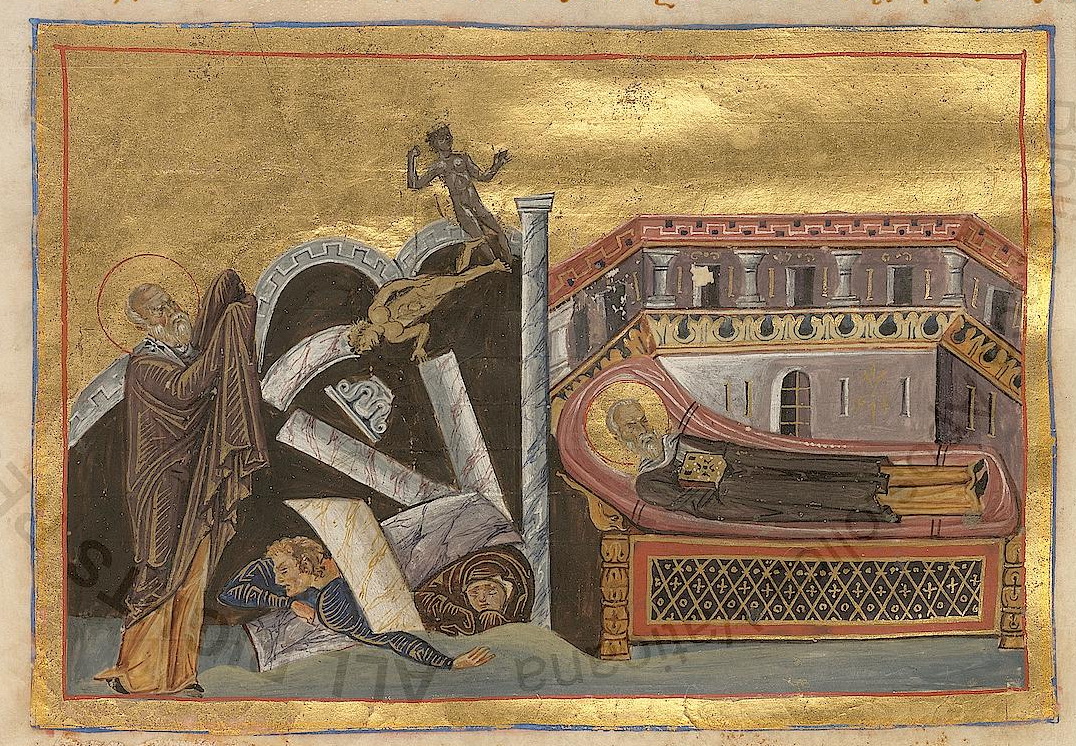
The New Testament says nothing further of him. The hagiographic tradition — transmitted in the Greek Life reworked by Symeon Metaphrastes, and thence in the synaxaria — continues the story: Cornelius left the world to follow the preaching of the apostles, was ordained by Peter (the tradition styles him bishop), and accompanied the chief of the apostles in his missionary labours. When word came of the fervent idolatry of Skepsis, a city of the Troad in Asia Minor (the tradition names its ruler, the prince Demetrius, a student of Greek philosophy), the lot fell to Cornelius to go there. Summoned before Demetrius and commanded to sacrifice, he asked to be shown the gods; entering the temple of Zeus, he prayed toward the east, and an earthquake brought down the temple and its idols. He was bound and imprisoned overnight — and word came to Demetrius that his wife and son had been buried in the temple's collapse. When a pagan priest reported hearing their voices alive under the ruins, praising the God of the Christians, the prince hastened to the prison, believed, and at the saint's prayer received his wife and son alive from the rubble. Demetrius and his house were baptized with many of the city; Cornelius laboured at Skepsis long after, ordained a presbyter Eunomius, converted the remaining pagans, and reposed in old age, being buried near the ruined temple he had overthrown. A later strand of the tradition adds that his neglected tomb was revealed in a vision to Silvanus, bishop of nearby Troas, and a church raised over his relics, which became a source of healings.
Veneration
Cornelius's veneration is ancient and universal: he appears in the Byzantine synaxaria on September 13 (with the Menologion of Basil II devoting him a miniature), and in the Roman Martyrology on February 2. In Byzantine usage his memory is joined to the feast of the Encaenia of the Church of the Resurrection, so that the first-fruits of the Gentile Church is commemorated on the dedication-day of the mother church of the Resurrection — a pairing the hymnographers exploit: his kontakion calls him the "holy first-fruits" whom "the Church received from among the nations." Several later saints bear his name (notably Cornelius of the Pskov Caves, †1570); they are distinct persons.
Feast and commemoration
September 13 (church date; Old Calendar civil September 26), together with the Encaenia of the Church of the Resurrection and the forefeast of the Elevation of the Cross; the Menaion service of the day interweaves all three. The feast is universal in the Byzantine rite. The Roman Church commemorates him on February 2 (formerly, in local usage, also September 13). The classification of the saint differs by jurisdiction — hieromartyr in the Slavic and OCA calendars, martyr in the Greek Menaion's heading, while the synaxarion accounts themselves relate a peaceful repose (see Disputed questions).
Hymns
Troparion — Tone 4
Sharer of the ways and successor to the throne of the apostles, divinely inspired one, thou didst find thy deeds a ladder to divine vision; wherefore, rightly dividing the word of truth, thou didst suffer for the faith even unto blood. O hieromartyr Cornelius, entreat Christ God that our souls may be saved.
Original translation from the Slavonic
Kontakion — Tone 4
The Church received thee as a holy first-fruits from among the nations, enlightening her with thy virtuous deeds, O sacred initiate of God's mysteries, divinely-minded Cornelius.
Original translation from the Greek
Iconography
Cornelius is depicted as an aged bishop of the early Church: white-haired and bearded, vested in phelonion and omophorion, holding the Gospel book — his military past is almost never shown, the icon presenting him in the dignity of his apostolic office. Narrative scenes of the Baptism of Cornelius (Peter baptising the kneeling centurion, sometimes in Roman dress) belong chiefly to Western art. The stored image is the miniature of the saint from the Menologion of Basil II (c. 985, Vatican Library), which shows him standing in episcopal vestments in an architectural landscape.
Disputed questions
- Martyrdom. Many calendars — the Slavic tradition, the OCA, and the heading "Holy Martyr" in the Greek Menaion — style Cornelius hieromartyr or martyr. The received Life itself, however, records no violent death: after imprisonment and threats at Skepsis he converted his persecutor, lived to old age, and reposed in peace, and the Greek synaxaria relate exactly this. The martyr styling appears to rest on his sufferings and bonds for the faith (the Slavic books even appoint him the common troparion of a hieromartyr, "and for the faith thou didst suffer even unto blood"), not on an attested martyrdom. This entry therefore classifies him among the righteous and as a bishop of the apostolic age, recording the divergent usage here rather than silently adopting it.
- Bishopric. The episcopate at Skepsis belongs to the later hagiographic tradition, not to Acts; some Western reference works style him first bishop of Caesarea instead. The Byzantine tradition of Skepsis is followed here as the one the Church's synaxaria transmit.
- The Italian Cohort. The cohors II Italica civium Romanorum is epigraphically attested in Syria later in the first century; the notice of Acts is historically plausible, though the garrison history of Caesarea in the 30s–40s cannot be reconstructed precisely.
- Not to be confused with Cornelius the pope of Rome (†253, June 21 in Slavic calendars), nor with the Russian venerables Cornelius of the Pskov Caves or Cornelius of Komel.