
Dasius of Dorostorum
The Holy Martyr Dasius of Dorostorum
Martyr · d. c. 303
Commemorated 20 November — Martyrdom at Dorostorum on the Danube
Dasius was a Christian of Dorostorum on the lower Danube who was beheaded for Christ, by tradition on November 20 of about the year 303, in the persecution of Diocletian and Maximian. His Passion tells that he was chosen by lot to play the mock-king of a pagan Saturn-festival — a youth honoured and indulged for a month and then sacrificed to the god — and that he refused the whole blasphemous rite, declaring that if he must die he would die as a Christian for Christ rather than as a victim for an idol. He confessed his faith openly, was tortured, and was put to the sword. His Passion is a document of unusual interest for the light it throws on the survival of the Roman Saturnalia among the soldiers of the Danube frontier. He is commemorated on November 20.

Dorostorum and the mock-king of Saturn
Dasius lived at Dorostorum (Durostorum), a fortress-city and legionary station on the right bank of the Danube in the Roman province of Lower Moesia — the modern Silistra in Bulgaria. His Passion, preserved in Greek and much studied by historians, sets his death in the reign of Diocletian and Maximian, when the whole empire was under order to sacrifice to its gods.
The city was preparing to keep a festival of the god Saturn, and the Passion describes the custom attached to it. By long usage the soldiers chose one of their number — a young man of good looks — to be the "king" of the feast. For thirty days before it he was clothed in royal robes, given royal honours, and allowed every licence and indulgence of the appetites; then, on the day of the festival itself, this counterfeit king was led before the altar of Saturn and put to death as a sacrifice to the god whose part he had played. The lot, or the choice of his fellows, fell upon Dasius, as the handsomest of the young men.
Confession and martyrdom
Dasius refused. Learning what was intended, he reasoned — in the words his Passion gives him — that if he must die in any case, it was better to die for Christ, as a Christian, than to be slaughtered for an idol after a month of shameful pleasures. He would neither wear the robes nor keep the licence nor go to the altar. Instead he confessed himself openly a Christian before his fellow citizens, denounced the folly and impurity of the idol-worship, and, the account adds, turned many of those who heard him to Christ. For this he was brought before the authorities and, under the edicts of Diocletian and Maximian, tortured and then beheaded. The Passion dates the execution precisely — the twentieth day of November — and names the officer who condemned him; the year is reckoned about 303, in the great persecution.
Relics and the interest of his Passion
Dasius's Passion is one of the more remarkable martyr-acts of the Danube region, and it drew wide attention when it was published in modern times, because of the Saturnalian rite it describes: it was read as a rare and vivid witness to the persistence of the old Roman festival of Saturn, with its temporary king of misrule, among the frontier legions of late antiquity, and it entered the scholarly debate over the origins and meaning of the Saturnalia. His relics were in later centuries translated westward to Ancona in Italy, where a sarcophagus bearing his name preserved his memory — a token of the reach of the cult of a Danubian martyr into the Adriatic West.
Feast and commemoration
November 20 (church date; Old Calendar civil December 3), kept in the Byzantine rite among the several commemorations of the day, which is governed by the Forefeast of the Entry of the Theotokos and led by Gregory the Decapolite and Proclus of Constantinople. Dasius has no proper liturgical service of his own; where one is required his memory is kept from the common of a holy martyr.
Hymns
Troparion — Tone 4
Thy martyr Dasius, O Lord, in his contest received the crown of incorruption from Thee our God; for, possessed of Thy strength, he cast down the tyrants and shattered the powerless boldness of the demons. By his intercessions, O Christ God, save our souls.
Original translation from the Greek
Iconography
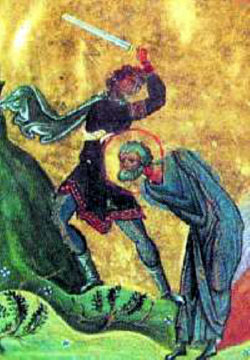
Dasius is shown as a martyr, a young man in the tunic and cloak of a layman or the dress of a soldier, holding the cross of martyrdom; where his passion is depicted, the scene is his beheading. The stored image is his miniature from the Menologion of Basil II (c. 1000): the executioner, in a short dark tunic and with a swinging cloak, raises his sword in both hands over the martyr, who kneels with head bowed, nimbed, at the right, against the gold ground and green rock of the manuscript's landscape — the standard Menologion formula for a martyrdom by the sword.
Disputed questions
- Soldier or citizen. The tradition presents Dasius in a military setting — the festival is that of the garrison, and the mock-king is chosen from among the soldiers — and he is often called a soldier-martyr; the synaxarion notices describe him more simply as a young man of the city chosen for the rite. The two are not in conflict at a legionary town like Dorostorum.
- Historical value of the Saturnalia detail. The Passion's account of the thirty-day mock-king has been treated both as genuine ethnographic memory of a frontier survival of the Saturnalia and as a hagiographic elaboration; the martyrdom itself, in the Diocletianic persecution, is not in doubt.