
David the Builder
The Holy and Right-Believing King David the Builder, King of Georgia and the Abkhazians
Righteous · King · b. c. 1073 — d. 1125
Commemorated 26 January — Commemoration of the holy king (reposed 24 January 1125)
David the Builder (c. 1073–1125), David IV of the Bagrationi dynasty, was the greatest of the kings of Georgia and is venerated by the Georgian Orthodox Church as a holy and right-believing sovereign. Coming to the throne at sixteen over a land broken by the Seljuk Turks, he rebuilt the kingdom in a reign of thirty-six years: reforming and cleansing the Church at the Council of Ruisi-Urbnisi, resettling and converting Kipchak warriors to form a standing army, shattering the Turkish coalition at the Battle of Didgori in 1121, recovering Tbilisi in 1122, and uniting Georgia for the first time in centuries into the realm that would flower in the Golden Age of his great-granddaughter Tamara. A man of deep personal repentance who carried a Gospel-book everywhere and composed his own Hymns of Repentance, he founded the monastery and academy of Gelati and asked to be buried beneath its gate, that all who entered might tread upon his grave. He is kept on January 26.

Accession over a broken kingdom
David was born about 1073, son of King George II of the Bagrationi line, the ancient royal house of Georgia that reckoned its descent from the Prophet-King David of Israel — a lineage the kings bore as a sacred charge. He came to the throne about 1089, at some sixteen years of age, when his father, unequal to the disasters of the time, abdicated in his favour. The Georgia he inherited was prostrate: the Seljuk Turks, since their victory over Byzantium at Manzikert (1071) and the years of the "great Turkish troubles," had overrun the countryside, their nomads pasturing their flocks where towns had stood, the churches emptied, the nobility fractious, and the royal power a shadow. The young king set himself, with a patience and resolve the chroniclers marvel at, to raise the dead kingdom to life — the labour that won him his name, Aghmashenebeli, "the Builder" or "the Restorer."
The renewal of the Church
David understood the restoration of Georgia as first of all a restoration of the Church, and reformed it before he reformed the army. At the Council of Ruisi-Urbnisi (1103) he purged the episcopate of unworthy and simoniac prelates, ended the treating of sees as hereditary family property, raised able and holy men to the hierarchy, and bound the reformed Church closely to the crown — uniting in one trusted person the offices of mtsignobartukhutsesi (chancellor) and bishop of Chqondidi, so that the head of the royal administration was also a chief pastor. He built and restored churches and monasteries across the land, endowed them richly, and cared for the Georgian communities and foundations abroad, from the Holy Mountain to Palestine and Sinai. His aim throughout was a kingdom whose strength rose from a purified faith.
Didgori, Tbilisi, and the unification of Georgia
Against the Turks David built a new army. Most strikingly, he resettled some forty thousand families of the Kipchaks (Cumans) from the north Caucasian steppe into Georgia, baptised many of them, and formed of their horsemen, with his own picked guard, a disciplined standing force. Year by year he pressed the Seljuks back. The crisis came in 1121, when a great coalition of Muslim powers, summoned to crush him, invaded with an army many times the size of his own. In the narrow ground at Didgori, west of Tbilisi, David met and utterly destroyed them on 12 August 1121 — a victory Georgian memory calls dzlevai sakhirveli, "the wonderful victory," and reckons the turning-point of the nation's history. The next year, 1122, he took Tbilisi, the old capital held by Muslim emirs for four centuries, and made it once more the seat of the Georgian kings; by 1123 his rule reached, the chroniclers say, "from the sea unto the sea," from the Black Sea to the Caspian. Yet the conqueror was famed for clemency: on entering Tbilisi he protected the Muslim and Jewish populations, respected the mosque, and governed his mixed subjects with a justice that his enemies acknowledged.
Gelati: the monastery and the academy
The crown of David's building was the monastery of the Mother of God at Gelati, near Kutaisi, founded in 1106 — at once a great church, a royal mausoleum, and an academy that he peopled with the ablest Georgian scholars, gathering learned men from Byzantium and the Georgian houses abroad. Gelati became, in the phrase of its own charter, a "second Jerusalem" and "new Athens," the intellectual heart of medieval Georgia, where theology, philosophy, and the sciences were taught and the works of the Fathers and of Greek learning translated and copied. Through it and its like David gave his restored kingdom not only arms and order but a mind.
Repentance and repose
For all his greatness David was, in the Georgian memory, above everything a penitent. He carried a book of the Gospels with him wherever he went and read in it daily; he gave alms with his own hand, kept the fasts, and reproached himself continually before God for the sins that power and war bring. Out of this came the poems for which he is loved as much as for Didgori — the Galobani Sinanulisani, the Hymns of Repentance, eight penitential odes in which the victorious king lays his soul bare before God as a sinner needing mercy, among the finest religious poetry in the Georgian tongue. He died on 24 January 1125, after a reign of some thirty-six years, and was buried, at his own request, beneath the gate of Gelati, where every person entering the monastery must step over his grave — the last humility of the greatest of the kings, who would have all who came pray for him and tread upon his royal dust. Over the tomb was set the plain petition that those who passed should ask God's mercy on his soul.
Veneration
David was venerated as a saint from soon after his death, honoured by the Georgian Church as a holy and right-believing king — the model of the Christian sovereign who rules as a servant of God and a penitent, and the restorer of both the nation and its faith. His cult is the special glory of the Georgian Orthodox Church, which keeps his memory with particular solemnity; through the Georgian and Russian calendars, and now the OCA, his commemoration has passed into the wider Orthodox world. He is reckoned among the greatest of Orthodox royal saints, set beside his own descendant Tamar the Queen as the two pillars of Georgia's Christian kingship.
Feast and commemoration
David is commemorated on January 26 (church date; Old Calendar civil February 8). Although he reposed on 24 January 1125, his feast is kept on the 26th, the day assigned him in the Georgian and Russian calendars and by the OCA. He is styled "the Builder" (Aghmashenebeli) — sometimes Englished "the Restorer" — and in the older Western enumerations of the Georgian kings appears as "David III," where the Georgian reckoning that this entry follows numbers him David IV. His veneration is proper to the Georgian Church above all, and is received in the Slavic calendars and by the OCA.
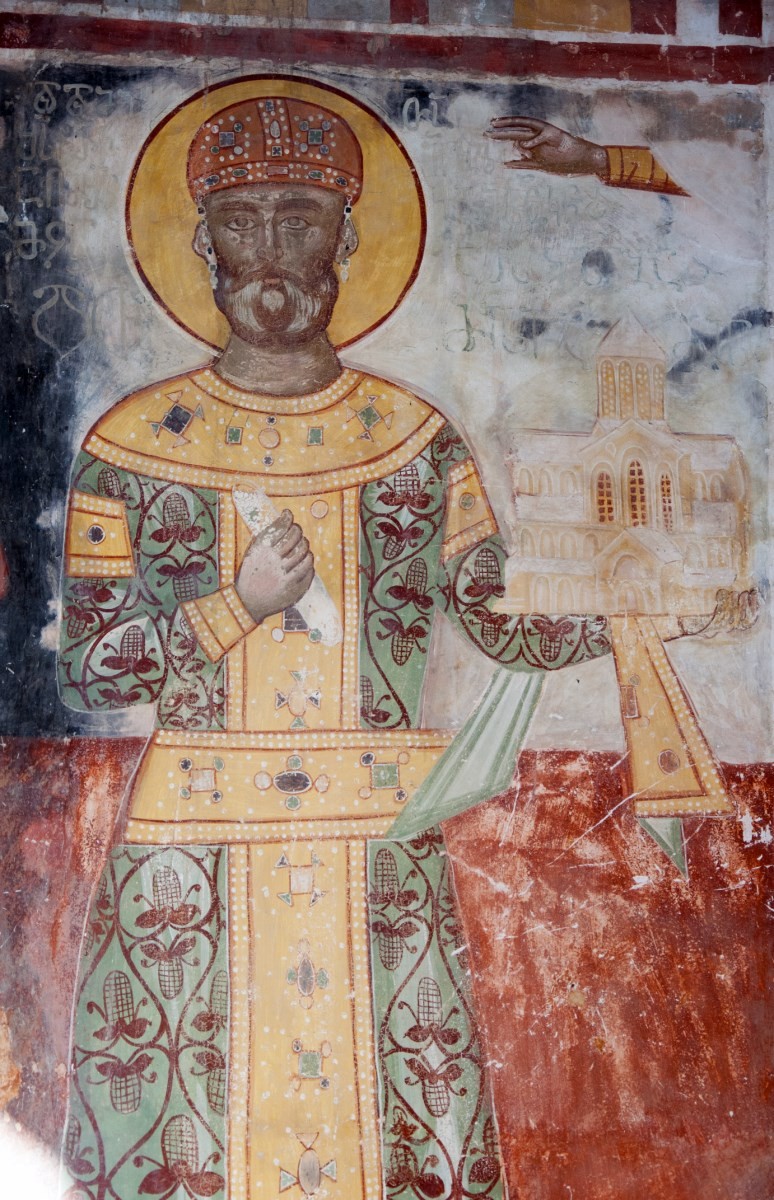
Iconography
David is depicted as a crowned king in the rich robes of a Georgian sovereign, often holding a model of a church (the church-builder's attribute) or a scroll, and sometimes a Gospel-book or a cross; he is shown as a bearded man in his maturity, of grave and majestic bearing. Medieval and post-medieval frescoes at Gelati and other royal foundations preserve his portrait among the Bagrationi kings. The stored image is the fresco of King David the Builder from Gelati Monastery (sixteenth century), depicting the holy king crowned and enthroned in his own foundation (source, public domain, pd-old-work).