
Dionysius of Zakynthos
Our Father among the Saints Dionysius the New, Archbishop of Aegina, Wonderworker of Zakynthos
Bishop · Wonderworker · b. c. 1547 — d. December 17, 1622
Commemorated 24 August — Translation and enshrinement of the relics, 17 December — Repose on Zakynthos; falls within the Nativity Fast
Dionysius (c. 1547–1622) was a nobleman of the Ionian island of Zakynthos who became a monk and then Archbishop of Aegina, but soon resigned his see to return to the monastic quiet of his native islands. He is remembered above all for one act of Gospel forgiveness: when the man who had murdered his own brother fled to him for refuge, not knowing whose house it was, Dionysius sheltered and released him rather than deliver him to justice. His incorrupt relics remain on Zakynthos, of which he is the patron saint and heavenly protector, and he is venerated across the Greek world as "the saint of forgiveness."

Origins and monastic beginning
He was born about 1547 on Zakynthos into the noble Sigouros family and baptised, by the tradition, Draganigos (Draganígos). Raised in piety and learning, he entered the monastery of the Strophades — the small, storm-beaten islands south of Zakynthos that housed a fortified house of monks — and was tonsured with the monastic name Daniel, later taking the great schema as Dionysius. Ordained priest, he was known for his gentleness, his learning and his ascetic seriousness.
Archbishop of Aegina
On a pilgrimage to the Holy Land, passing through Athens, his evident holiness and gifts led to his being consecrated Archbishop of Aegina (with the Ionian dependencies), a see then under Venetian rule. He governed it well but briefly: drawn back to the monastic life and to his own islands, he resigned the archbishopric and returned to Zakynthos, where he served for a time as administrator of the vacant see and lived in the monastery of the Strophades and the church of St Nicholas of the Mole in the harbour town, in prayer, almsgiving and the care of souls.
The forgiveness of his brother's murderer
The event for which he is most loved belongs to these later years. Dionysius's own brother was murdered in one of the blood-feuds of the island. The killer, pursued by the dead man's kin and by the authorities, fled and by night sought sanctuary at the monastery — coming, unknowing, to the very brother of the man he had slain. When in conversation he confessed what he had done and named his victim, Dionysius, though pierced with grief, mastered himself, forgave the man, hid him from the pursuers, and helped him escape from the island. The account, preserved in his Life, became the defining image of his sanctity: a literal enactment of the Lord's command to love one's enemies and forgive from the heart.
Repose and relics
Dionysius reposed on December 17, 1622, at the monastery of the Strophades, and was buried there. When his tomb was later opened his body was found incorrupt and fragrant, and it became a source of healings. During the depredations of pirates on the Strophades the relics were removed for safety to the town of Zakynthos, where they remain, enshrined in the great church dedicated to him; the saint's slippers are, by a persistent island tradition, found worn as though he still walks the island by night on errands of mercy. His relics survived the catastrophic earthquake and fire of 1953 that levelled much of the town. He is the patron of Zakynthos, and his summer feast of the translation of the relics on August 24 is the island's greatest festival.
Feast and commemoration
December 17 (church date; Old Calendar civil December 30) is his principal feast, the day of his repose, kept within the Nativity Fast. A second feast on August 24 commemorates the translation and enshrinement of his relics and is the chief celebration on Zakynthos itself. His veneration, at first local to the Ionian Islands, spread through the Greek-speaking Churches, where he is one of the most beloved of the post-Byzantine saints; the Orthodox Church in America lists him under the style "Dionysius of Aegina."
Hymns
Troparion — Tone 1
O offspring of Zakynthos and protector of Aegina, guardian of the Strophades and boast of the Church, let us the faithful honour Dionysius; for he pours forth healings of every kind on those who cry to him with faith: Glory to Christ who glorified thee, glory to Him who made thee wondrous, glory to Him who through thee works healing for all.
Original translation from the Greek
Kontakion — Tone 3
Let us praise Dionysius, the boast of Zakynthos and the newly-shining star of the Church, who forgave his own brother's slayer and by that mercy conquered the passions; for he intercedes unceasingly with the Lord on behalf of us all.
Original translation from the Greek
Iconography
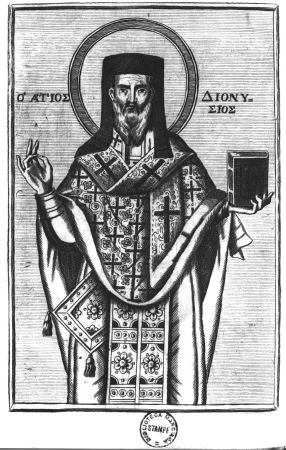
Dionysius is depicted as an archbishop in old age: a long grey beard, episcopal vesture (sakkos and omophorion) or monastic mantle, the mitre, blessing with one hand and holding the Gospel or a scroll in the other. Island iconography often shows him with his church and harbour of Zakynthos, or in the narrative scene of his forgiveness — receiving the fugitive at the monastery. The stored image is an eighteenth-century Greek representation of the saint (dated 1774).