
Dometius of Persia
The Holy Venerable-Martyr Dometius the Persian and his Two Disciples
Venerable Martyr · Martyr · d. 363, in Syria near Cyrrhus
Commemorated 7 August — Martyrdom with his two disciples under Julian the Apostate
Dometius was a Persian by birth who came to faith in Christ through a Christian of his own household or acquaintance, and who — driven out by his own people for that faith — crossed the frontier into the Roman world, was baptised and tonsured at Nisibis, and afterwards lived as a monk and deacon at the monastery of Saints Sergius and Bacchus at Theodosiopolis. Fleeing the honour of the priesthood, he withdrew with two disciples to a cave on a bare mountain in the region of Cyrrhus in Syria, where the multitudes came to him for healing and where he turned many pagans to Christ. About the year 363, as the emperor Julian the Apostate passed that way on his Persian campaign, he sent soldiers who found the three at prayer in the cave and killed them — by the older Greek verse-synaxarion, stoned where they stood. He is honoured as a hosiomartyr, a venerable-martyr: a monk who ended as a witness in blood.

A Persian who found Christ
The tradition places Dometius' origin unambiguously in Persia — hence his constant epithet, ὁ Πέρσης, "the Persian." He was of the Persian religion, that is, of the fire-worship of the Magi, and the hymn of the day makes the point plainly: taking up "the word of grace," he cast off the fraud of the fire-worshippers. The instrument of his conversion was a Christian whose name the sources transmit variously — Abaros (Ἄβαρος) in the Greek synaxarion, and Uaros/Varus in the Slavonic tradition — a man of no other fame than this.
The conversion cost him his home. When those of his own household discovered what he had become, they rose against him, and Dometius left Persia altogether. He fled to the frontier city of Nisibis in Mesopotamia — the great border-fortress between the two empires, ceded by Rome to Persia in 363 but at this time still a Christian city of the Roman east and the home of Ephrem the Syrian's school. There he entered a monastery, was baptised, and received the monastic tonsure.
Theodosiopolis and the flight from ordination
The synaxarion notes that he did not remain at Nisibis: the tradition speaks of the ill-will of some among the brethren, and Dometius withdrew again — this time to the monastery of the Holy Martyrs Sergius and Bacchus at Theodosiopolis. Its superior was an archimandrite named Urbelos (Ουρβέλ), remembered for an asceticism of the older, harder kind: it was said of him that in sixty years he had not tasted cooked food, and that he never lay down to sleep but took his rest standing, propped on his staff.
Under such a father Dometius flourished. He was ordained deacon; and when Urbelos determined to have him raised to the presbyterate, Dometius did what a whole class of monastic saints has done before and since — he judged himself unworthy and fled the honour. The Greek notice draws out the moral: his contest was not how to seize dignities but how to escape them, having learned of the Lord Jesus to be "meek and lowly in heart."
The cave near Cyrrhus
He went into the mountains of Syria, into the region of Cyrrhus — the country of Theodoret's Historia Religiosa, thick with hermits — and settled in a cave with two disciples. The solitude did not last. Word of him spread among the villages, and the local people began to come up the mountain for healing and for counsel; and the hagiographic record is emphatic that many pagans of that district were brought to faith in Christ through him. It is this, and not merely his monastic reputation, that makes the manner of his death intelligible.
Martyrdom under Julian the Apostate
In 362–363 the emperor Julian, called the Apostate, marched east through Syria and Mesopotamia on the Persian campaign from which he did not return. His route lay through the country where Dometius was living, and the crowds streaming to the monk's cave were reported to him. Julian's method against the Church was rarely open persecution; but here — a Persian renegade from the fire-worship, drawing off the country people from the temples on the emperor's own line of march, in the season of a Persian war — he ordered the man killed.
The soldiers climbed to the cave and found Dometius and his two disciples chanting the psalms. What followed is transmitted in two forms:
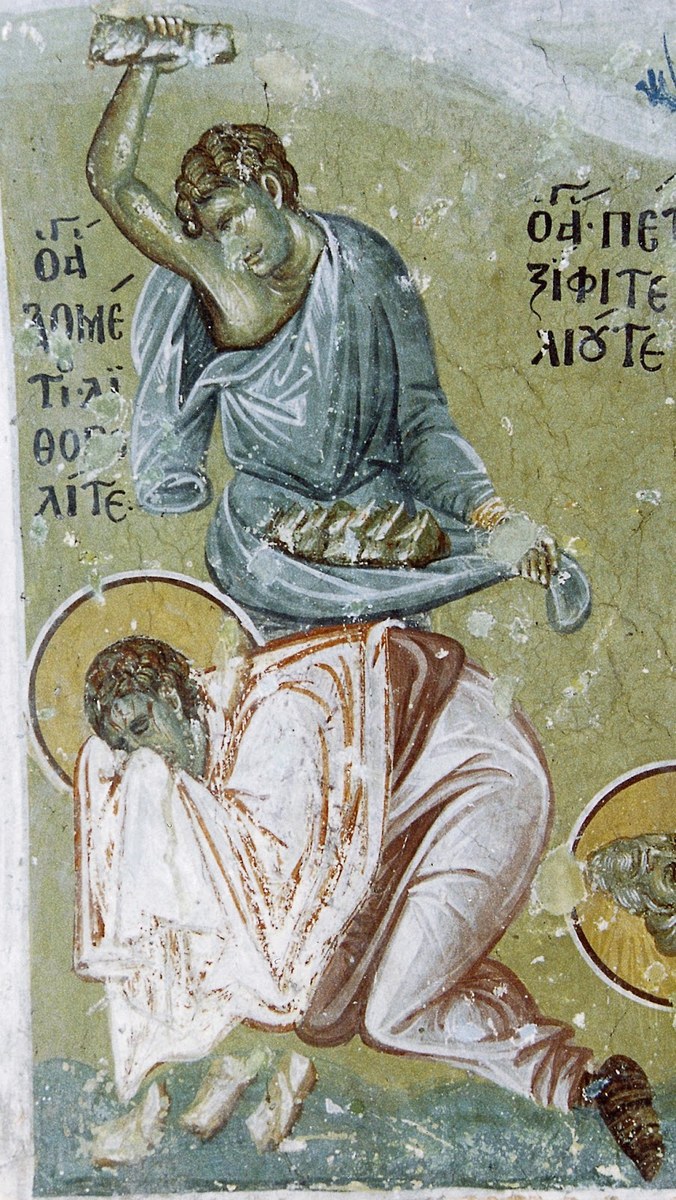
- The Greek synaxarion and its verse-couplets — the older and metrically fixed witness — say the three were stoned to death on the spot: "With his two initiates, on the seventh, Dometius was stoned." The stanza above it turns the fact into a compliment to his teaching: he had trained his disciples so well that they contended with him even out of stones.
- The Slavonic tradition, followed by modern Russian and American synaxaria, says instead that the soldiers walled them up alive inside the cave.
Both accounts agree on place, company, agent and year: the cave, the two disciples, Julian's soldiers, 363. The stoning is the reading carried by the Greek liturgical books, and it is the one the Byzantine painters illustrate.
Feast and commemoration
August 7 (church date; New Calendar civil August 7, Old Calendar civil August 20), within the afterfeast of the Transfiguration — the day falls on the second day of the feast, and the propers of the Transfiguration are sung with the saint's — and within the Dormition fast (August 1–14), so that his memory is kept on a fast day. Dometius is the principal commemoration of August 7 in the Greek and Antiochian books, and the day's dismissal hymn belongs to him. His two disciples are commemorated with him and are not named in the tradition. He is universally kept, East and West, and appears in the Roman martyrology as well.
Hymns
Apolytikion
Having made the word of grace thine own, thou didst wisely put away the deceits of the fire-worshippers, and wast wholly given to Christ, O father Dometius; and unbending in thy contest, as an imitator of the venerable ones thou wast shown forth a venerable-martyr. Wherefore with hymns we honour thee, O wise one, together with the pair of thy disciples.
Kontakion — Tone 4
Thou didst forsake fatherland and kindred for the love of Christ, and didst take up the yoke of the monastic life; then, watered with thine own blood in the cave of thy stillness, thou didst blossom as a martyr. Wherefore, O all-blessed Dometius, cease not to intercede for us all.
Original translation from the Greek
Iconography
Dometius is painted as a monk: in the dark analavos and mantle, bearded, sometimes bare-headed and sometimes cowled, and — as a martyr — bearing the cross. Because the Greek passion makes him a deacon, some Greek panels vest him in the sticharion with the orarion instead, which is a useful mark of identification. His two disciples flank him, unnamed and usually younger.
The scene proper to him in the menologion cycles painted round the walls of late-Byzantine and Balkan churches is his stoning: the saint prostrate on the ground under a hail of stones, an executioner standing over him with a stone raised in the right hand and a fold of his tunic full of stones gathered in the left, and the heads of the two disciples in the same field. That is precisely the composition stored here — a fourteenth–fifteenth-century fresco, inscribed in Greek Ο Α(ΓΙΟΣ) ΔΟΜΕΤΙ(Ο)Σ beside the falling saint, with the neighbouring commemoration of the day ("perfected by the sword") lettered at the right.
Disputed questions
- The date of his flight from Persia. The Greek synaxarion opens by placing him "in the years of Constantine the Great" (†337), while his death is fixed under Julian (361–363). The two statements are not in conflict — a conversion and monastic career begun in the 330s and ended in 363 is an ordinary span — but they are sometimes reported as a contradiction. Nothing requires him to have been young at his death.
- The manner of death — stoning (Greek) versus immurement in the cave (Slavonic): see above. This entry records both and privileges neither, though the iconography follows the Greek.
- The name of the man who converted him — Abaros in the Greek, Uaros/Varus in the Slavonic. The variation is a transmission accident of a name known from nowhere else.
- Not to be confused with Dometius the Wonderworker, the venerable monk of March 8. The Greek Menaion keeps a bare notice of a hosios Dometius on that day, while the Slavic reckoning for March 8 sometimes names "Dometius of Persia" outright; the tradition has never settled whether the March saint is a distinct ascetic or a doublet of this one. The two are kept apart here, and the question is recorded in both entries.
- Not to be confused with Dometius of Philotheou, the sixteenth-century Athonite elder commemorated on this same day, nor with Dometius of Dionysiou (June 25), nor with Dometian of Melitene (January 10).