
Elias of Murom
Our Venerable Father Elias of Murom, Wonderworker of the Kiev Near Caves
Venerable · Wonderworker · b. 12th century — d. c. 1188
Commemorated 19 December — Repose
Elias of Murom (died c. 1188) was a monk of the Near Caves of the Kiev Caves Lavra, remembered in the Church as a wonderworker and, in Russian popular memory, identified with Ilya Muromets, the greatest of the bogatyrs — the warrior-heroes of the Kievan epic ballads. His incorrupt relics rest in the Near Caves with the fingers of the right hand joined for the sign of the Cross in the three-finger form, a detail that made him a witness in the seventeenth-century disputes with the Old Ritualists. Commemorated on December 19 and among the assembled fathers of the Kiev Caves, he is honoured as a saint in whom the warrior's courage and the monk's humility met.
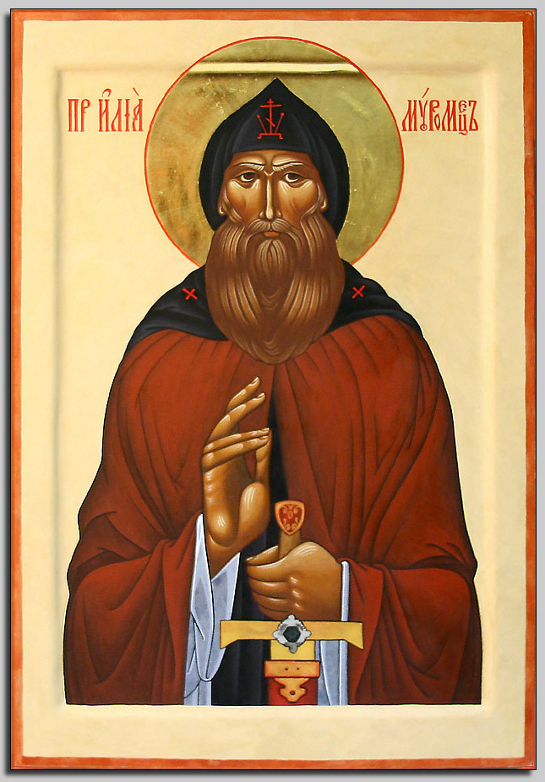

The monk of the Near Caves
What the Church transmits with certainty is brief. Elias was a monk of the Near (Anthony's) Caves of the Kiev Caves Lavra, a native of the city of Murom on the Oka, in the north-east of the Rus' lands. He bore the byname Chobotok — "the little boot," rendered in the calendars "the Shoemaker" or "the Cobbler," a nickname explained in the legends by a feat performed with a boot in his hand. He is placed in the twelfth century, his repose set by tradition around 1188, and he was numbered among the venerable fathers of the Caves whose relics lie incorrupt in the Near Caves.
The three-fingered sign of the Cross
One physical detail of his relics became, in a later age, theologically famous. Saint Elias reposed with the first three fingers of his right hand joined together and the two outer fingers folded to the palm — that is, in exactly the form of the sign of the Cross used in the Russian Church today, and not in the two-fingered form of the Old Ritualists. During the long struggle over the Nikonian reforms in the seventeenth to nineteenth centuries, the incorrupt hand of a saint of the twelfth century, frozen in the three-finger sign, was cited as a weighty proof in favour of the received practice.
The warrior Ilya Muromets
In the popular imagination Elias of Murom is one and the same as Ilya Muromets, the foremost hero of the Russian byliny — the oral epic ballads of Kievan Rus'. In these songs Ilya is a peasant's son of Murom who lay paralysed for thirty-three years until healed by wandering pilgrims (kaliki), then took up arms as the mightiest of the warriors at the court of Prince Vladimir "Fair Sun," defending Holy Rus' against her enemies. The Church has kept a certain reserve about the identification: the Orthodox Church in America notes plainly that "there is no strong basis" for simply equating the epic hero with the monk. Yet the two memories converged in the veneration of the Caves saint, whose inscribed icons name him "Ilya Muromets," and the tradition that a great warrior ended his days as a penitent monk of the Caves is old and tenacious. A forensic examination of the relics in 1988 was widely reported to have found a powerfully built man of middle height who had suffered in youth from a disease of the spine — consistent with the legend of long paralysis — and who bore old combat wounds, dying at last of a wound to the chest; such findings are read by many as support for the traditional identification, while the historians' caution remains. The hero also passed into art beyond the Church, most famously in Reinhold Glière's Third Symphony, "Ilya Muromets" (1911).
Feast and commemoration
December 19 (church date; Old Calendar civil January 1) is the principal commemoration of his repose. As one of the fathers of the Kiev Near Caves he is also commemorated on the Second Sunday of Great Lent (the Synaxis of all the Venerable Fathers of the Kiev Caves), and on September 28 (the Synaxis of the Fathers whose relics lie in the Near Caves of Saint Anthony); the Russian calendars further name him among the Saints of Ryazan and Siberia (June 10) and the Saints of Vladimir (June 23). His veneration is proper to the Russian and Ukrainian Churches and the Orthodox Church in America; the feast lies within the Nativity Fast.
Hymns
Troparion — Tone 3
The Russian land rejoices today, glorifying its warrior and wonderworker Elias of Murom; for abiding in the Church triumphant, he fights together with his kinsmen and with the Church militant, entreating help from the Lord for Holy Rus' against her enemies visible and invisible, that the Russian people may without hindrance glorify and honour Christ God.
Original translation from the Slavonic
Kontakion — Tone 8
As a great luminary of the Russian land you shone forth, an unconquered commander of the Heavenly King and a God-inspired adornment of monastics. And now, standing with the angels before the throne of God, entreat Christ the Master and Creator of all, that those who honour your holy memory may be delivered from every affliction and sorrow, that we may cry to you: Rejoice, O Elias, our venerable father.
Original translation from the Slavonic
Iconography
Elias is shown as a monk of mature age with a broad, full beard, in the dark mantle and cowl of the schema, characteristically making the three-fingered sign of the Cross with his right hand — the detail preserved in his relics — and often holding a sword or resting his hand upon its hilt, so that the icon unites the two strands of his memory, the warrior and the monk. The stored image is a modern Russian icon (2006) inscribed "Venerable Elias of Murom," depicting him in the schema, blessing with three joined fingers and grasping the hilt of a sword.