
Epimachus of Pelusium
The Holy Martyr Epimachus of Pelusium
Martyr · d. c. 250
Commemorated 11 March — Transfer of the relics (OCA and Slavic usage), 31 October — Martyrdom at Alexandria
Epimachus of Pelusium (†c. 250) was an Egyptian martyr of the Decian persecution. A native of Egypt, he lived for a long time as a solitary on Mount Pelusium; hearing that Christians were being persecuted at Alexandria, he came down to the city, publicly smashed a number of pagan idols, and confessed himself a Christian. Brought before the eparch, he refused to sacrifice and was subjected to prolonged and savage torture — during which a drop of his blood, falling into the blind eye of a watching woman, restored her sight and brought her to faith — before being beheaded. He is distinguished in the calendars as Epimachus "the New," and is commemorated on October 31, with a further commemoration of the transfer of his relics on March 11.
.jpg)
Epimachus (Ἐπίμαχος, "one who fights, a champion") was an Egyptian by birth. The tradition, following the Byzantine synaxaria, places his sufferings in the middle of the third century, in the persecution raised under the emperor Decius (249–251) which fell with particular ferocity on Egypt and its great city of Alexandria. Some strands of the account associate his martyrdom with the same wave of persecution that carried off other Alexandrian confessors of that time.
Ascetic struggle
Before his witness Epimachus had withdrawn to the ascetic life, spending a long period in seclusion on Mount Pelusium — the region of Pelusium at the eastern edge of the Nile Delta from which he takes the name by which he is best known. There he lived in solitude and prayer, unknown to the world.
Martyrdom
News that the Christians of Alexandria were being seized and tortured drew him out of his solitude. Coming into the city, he went openly to the temples and overturned and broke a number of the idols, then declared before all that he too was a Christian. He was arrested and brought before the eparch — named Apellianus in the tradition — who ordered him to sacrifice to the gods. When he refused, he was handed over to torturers and endured many fierce torments with unshaken constancy.
Among the crowd that watched his sufferings was a woman blind in one eye. A drop of the martyr's blood spattered into her sightless eye, and at once she could see; the miracle brought her, and others, to belief in Christ. After his long ordeal Epimachus was at last beheaded with the sword, and so received the crown of martyrdom.
Relics
His relics became a source of healing, and their transfer is commemorated separately, on March 11 in the OCA and Slavic calendars.
Feast and commemoration
October 31 (church date; Old Calendar civil November 13), his martyrdom; and March 11 (Old Calendar civil March 24), the transfer of his relics, kept in the OCA and Slavic calendars. He is commemorated across the Byzantine-rite calendars; the Greek Menaion carries his memory in the synaxarion notice for the day.
Hymns
Troparion — Tone 4
Your martyr Epimachus, O Lord, in his contest has received from you our God the crown of incorruption; for possessed of your strength, he cast down the tyrants and shattered the feeble insolence of the demons. By his prayers, O Christ God, save our souls.
Original translation from the Greek
Iconography
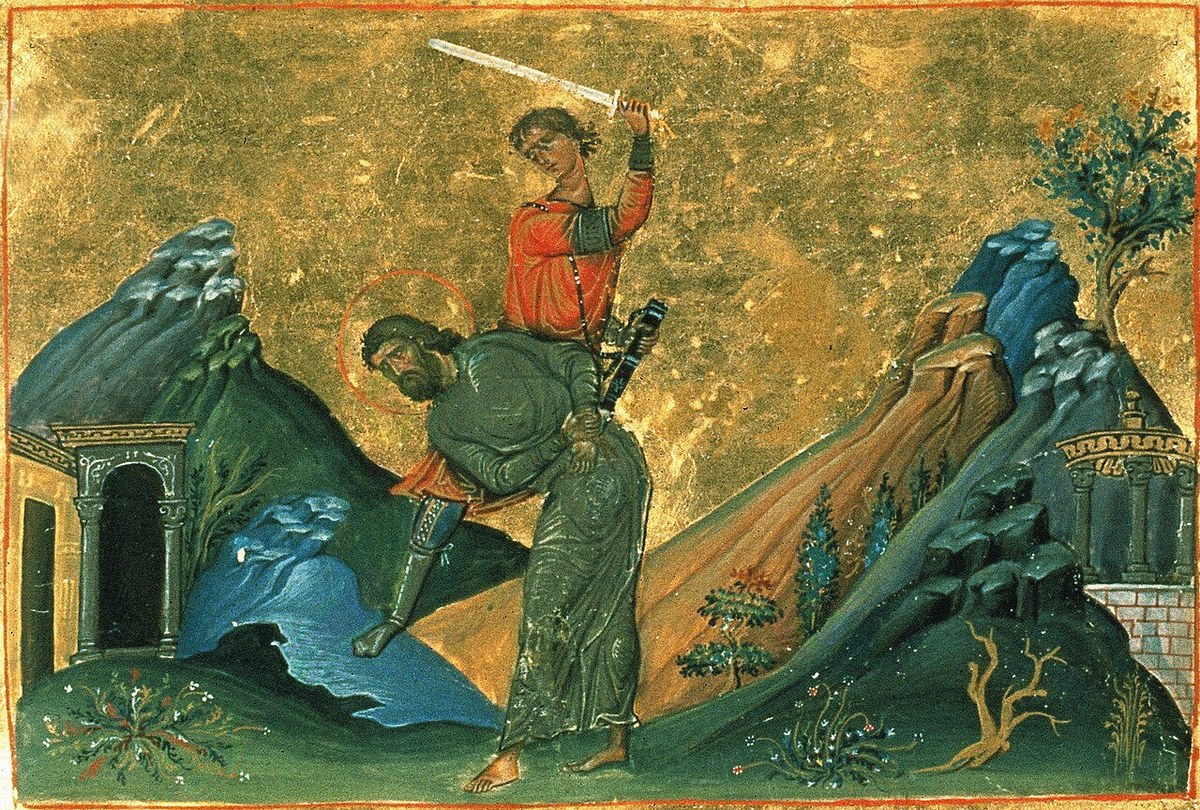
Epimachus is depicted as a martyr — a beardless or young man in the tunic and mantle of a layman, holding the cross of martyrdom, sometimes shown at the moment of his beheading. The stored image is his miniature from the Menologion of Basil II (Constantinople, c. 985; Vatican Library), inscribed "Epimachus the New, of Alexandria."
Disputed questions
- "The New" and the two Epimachi. The calendars style this martyr Epimachus the New (ὁ Νέος) to distinguish him from an earlier Epimachus venerated in the West with the martyr Gordian. The epithet, and the variant styling "of Alexandria," both belong to the Egyptian martyr kept on October 31.
- Pelusium or Alexandria? He is named indifferently "of Pelusium" (the place of his ascetic withdrawal) and "of Alexandria" (the place of his martyrdom); the Menologion of Basil II inscribes him "the New, of Alexandria." Both refer to the one saint.