
Erasmus of the Kiev Caves
Our Venerable Father Erasmus of the Kiev Caves
Venerable · b. 12th century — d. c. 1160
Commemorated 24 February — Principal commemoration of Erasmus of the Near Caves, 28 September — Synaxis of the Venerable Fathers of the Near (Antoniev) Caves
Erasmus of the Kiev Caves (†c. 1160) was a monk of the Near Caves of the Kiev Caves Lavra whose whole substance went into the adorning of the monastery church with holy icons. Having spent all he had on the beauty of God's house, he was assailed by the thought — the tradition names it a demonic temptation — that he had done better to give his wealth to the poor; falling thereby into despondency and a careless life, he was brought back by a mortal illness in which the Mother of God appeared to him and promised to adorn and exalt in her Son's Kingdom the one who had adorned her church. Rising from unconsciousness, he confessed his sins before the brethren, received the great schema, and reposed on the third day. His relics rest in the Near (Antoniev) Caves, and his story is preserved in the Kiev Caves Paterikon.
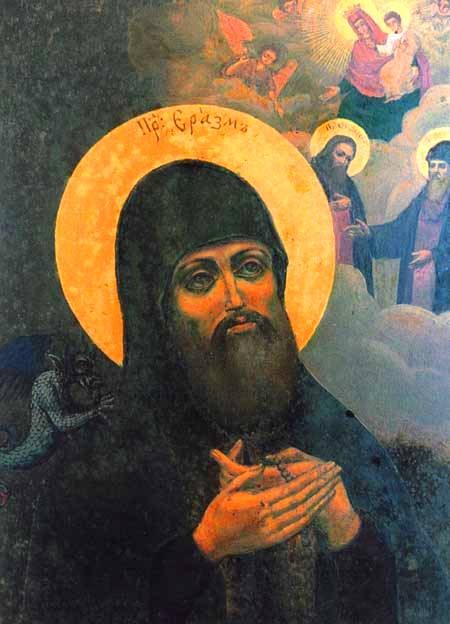

Erasmus is one of the ascetics of the Kiev Caves whose memory is preserved not in a full biography but in a single vivid episode, transmitted in the Kiev Caves Paterikon — the collection of lives and edifying tales of the monastery's fathers, in the letter of Bishop Simon of Vladimir and Suzdal to the monk Polycarp. Nothing is recorded of his origins or of the years of his monastic life before the events for which he is remembered; he appears in the tradition already as a monk of the Caves, a man of some wealth, in the middle of the twelfth century.
The adorning of the church
What is remembered of Erasmus is his single-hearted love for the beauty of the house of God. He possessed a substance of his own, and he spent it entirely — to the last of it — on the adornment of the great church of the Caves: on holy icons and on the gilding and ornament of the images, many of which, Bishop Simon writes, "even now may be seen over the altar." He kept nothing back and became poor, having turned all he had into the beauty of worship.
Temptation, despondency and repentance
Poverty of this kind is the ground on which the tempter works. When Erasmus had nothing left, the thought came to him — the Paterikon reads it as a suggestion of the demons — that he had spent his goods wrongly, that he should rather have distributed them to the poor, and that his adorning of the church had been vanity. The thought, brooded on, bred despondency; and from despondency Erasmus slid into a careless and negligent manner of life, unworthy of his earlier zeal. God, the tradition says, did not abandon him but sent him a saving illness: he fell gravely sick and lay seven days as one senseless, scarcely breathing.
On the seventh day the brethren gathered about him, wondering at the strange manner of his suffering, and Erasmus suddenly opened his eyes, rose up in his bed, and told them what he had seen. The founders of the monastery, Anthony and Theodosius of the Kiev Caves, had appeared to him and said, "We have prayed for thee, and the Lord hath granted thee time for repentance." And then he had seen the Most Holy Theotokos, bearing the Christ Child in her arms, who said to him: "Erasmus, forasmuch as thou hast adorned my church with holy icons, so will I adorn thee and exalt thee in the Kingdom of my Son." Bidden to rise and confess, Erasmus stood, made open confession of his sins before all the brethren, received the great schema, and on the third day thereafter reposed in peace. He was buried in the Near Caves of the Lavra, where his relics rest incorrupt among the fathers.
Meaning of the story
The Paterikon preserves Erasmus's tale as a lesson on the honour due to the beauty of worship and on the mercy that meets even those who fall from their first zeal. Against the plausible and pious-sounding thought that money spent on icons were better given to the poor, the tradition sets the word of the Mother of God herself: that the adorning of the church is not waste but an offering received and repaid in the Kingdom. And against Erasmus's despair it sets the intercession of the holy founders and the space for repentance granted at the very edge of death — so that the monk who had made God's house beautiful was himself, at the last, made beautiful by the Theotokos he had honoured.
Feast and commemoration
February 24 (church date; New Calendar civil February 24; Old Calendar civil March 9) is Erasmus's principal commemoration, kept in the Russian Church and by the churches of Russian tradition (his cultus is that of a Kiev Caves father and is not on the universal Byzantine calendar). He is commemorated also on September 28 with the Synaxis of the Venerable Fathers of the Near (Antoniev) Caves, and on the Second Sunday of Great Lent with the Synaxis of all the Venerable Fathers of the Kiev Caves. Because his February 24 falls on the day of the great feast of the First and Second Finding of the Head of the Forerunner, his memory is kept as a lesser commemoration alongside it. There is no proper hymnody to Erasmus alone in the common service-books; he is served under the common office of a venerable monastic and within the offices of the Kiev Caves synaxes.
Hymns
Troparion
In thee, O Father, was the divine image surely preserved; for taking up thy cross thou didst follow after Christ, and by thy deeds thou hast taught us to despise the flesh, for it passeth away, but to care for the soul, a thing immortal; wherefore, O venerable Erasmus, thy spirit rejoiceth with the angels.
Original translation from the Slavonic
Iconography
Erasmus has no widely diffused independent icon. Where he is depicted it is in the communal image of the Synaxis of the Venerable Fathers of the Kiev Caves, the great assembly-icon in which the founders Anthony and Theodosius and the ranks of the Caves saints are ranged in tiers, each a small robed and cowled figure named by inscription; and in the engraved plates of the Kiev Caves Paterikon, where the episode of his repentance — the sick monk on his bed, the Mother of God appearing with the Christ Child — is sometimes shown. As a schema-monk he is figured in the dark monastic habit and the great schema, an aged ascetic with a grey beard. The stored image is a 19th-century icon of exactly the Paterikon episode: the schema-monk inscribed "Пр(еподобный) Еразм" at the halo, the tempting demon small and dark at his shoulder, and above him the vision — the Mother of God with the Child amid the saints — that sealed his repentance.