
Etheldreda of Ely
Our Venerable Mother Etheldreda, Queen of Northumbria and Abbess of Ely
Venerable · Virgin · Queen · b. c. 636, at Exning in East Anglia — d. 23 June 679, at Ely
Commemorated 23 June — Repose at Ely, 679, 17 October — Translation of the incorrupt body by her sister Seaxburh, 695
Etheldreda — Æthelthryth in her own tongue, Audrey in the mouths of later Englishmen — was a princess of the royal house of East Anglia who passed through two marriages without surrendering the virginity she had vowed, was for twelve years queen of Northumbria, and at last obtained her husband's leave to take the veil. In 673 she founded the double monastery of Ely on the island in the fens that had come to her as a marriage gift, and ruled it as abbess with a severity she imposed first on herself: one meal a day, wool rather than linen, and prayer from the night office until daybreak. She died on 23 June 679 of a tumour in the neck, which she received as the just penalty for the necklaces of her girlhood. Sixteen years later her sister Seaxburh raised her body and found it incorrupt, the surgeon's incision healed to a scar. Bede, who tells her story at length and adds a hymn of his own composition in her honour, made her the most celebrated of Anglo-Saxon women saints; Ely remained her city, and her name survives, by an odd descent, in the English word tawdry.

Origins and the first marriage
Etheldreda was born about 636 at Exning in Suffolk, one of the daughters of Anna, king of the East Angles, in a dynasty remarkable even in that age for the number of its saints: her sisters Seaxburh, queen of Kent and afterwards abbess of Ely, Æthelburh, abbess of Faremoutiers in Gaul, and Wihtburh of Dereham, and her half-sister Sæthryth, are all commemorated. East Anglia had been Christian for barely a generation, converted under her uncle Sigeberht, and the royal women of the house were among its principal patrons.
About 652 she was married to Tondberht, chief (princeps) of the South Gyrwe, the marsh people of the southern fens. Bede states plainly that the marriage was never consummated: she had already vowed her virginity, and her husband, who did not long survive the wedding, respected the vow. On his death in 655 she received as her morning-gift the Isle of Ely, and there she lived in retirement for some five years — her first experience of the place that would be her monastery and her shrine.
Queen of Northumbria
In 660 the politics of the northern kingdoms took her out of that retirement. She was married a second time, to Ecgfrith, son of Oswiu of Northumbria, a boy of fourteen or fifteen, in an alliance meant to bind East Anglia to the Northumbrian house. Ecgfrith succeeded to the throne in 670, and Etheldreda was queen of the most powerful kingdom in Britain.
The marriage lasted twelve years and was, on Bede's testimony, never consummated either. Bede is unusually explicit about his evidence: he says that he had the fact from Bishop Wilfrid himself, who told him that Ecgfrith had offered him lands and money to persuade the queen to yield, and that Wilfrid had told the king she would not. As Ecgfrith grew older he pressed harder, and Wilfrid — who supported the queen — earned by it a share of the enmity that would afterwards drive him from his see. At last the king consented, and Etheldreda entered the monastery of Coldingham, on the cliffs above the sea, under his aunt the abbess Æbbe, and received the veil from Wilfrid.
The later Ely tradition, not found in Bede, adds that Ecgfrith repented of his consent and came to take her back; that she fled south with two nuns; that the tide rose about them for seven days on a headland and would not let the pursuit across; and that when she rested on the way her staff, thrust into the ground, took root and became an ash tree. These are legends of the twelfth-century Liber Eliensis and should be read as such.
Ely
In 673 she came back to her own island and founded there a double monastery of men and women, the usual Anglo-Saxon form, and governed it as abbess. Bede's account of her rule is the fullest portrait we have of an English abbess of the first generation, and it is a portrait of austerity rather than of administration: she wore wool and not linen; she ate once a day except in sickness or at the great feasts; from the office of matins she remained in the church at prayer until daybreak; and she took the hot baths that were the ordinary comfort of the time only at the four great feasts, and then only after she had washed the other sisters with her own hands and served them last.
Bede records also her prophecy of the plague that would come upon the house, of the number who would die in it, and of her own death among them.
Repose and the finding of the relics
She died on 23 June 679, of a tumour beneath the jaw. The physician Cynefrith, who attended her, told Bede that he had lanced the swelling to let the matter run, and that she lived three days after. She had said, when the pain was on her, that God was merciful in laying it there: in her youth she had worn gold and jewelled necklaces, and now the weight of her vanity was repaid in her neck, and the burning of the tumour would burn the guilt away. She was buried, at her own command, in a plain wooden coffin among the rest of the community.
Sixteen years later, in 695, her sister Seaxburh, who had succeeded her as abbess, resolved to translate her to the church. The brethren were sent to look for stone in a country that has none, and found at the deserted Roman town of Grantchester a sarcophagus of white marble, with a lid, which proved to fit the body as though it had been made for it. When the grave was opened the body was found incorrupt, as if she had died that day; the linen wrappings were fresh; and the incision Cynefrith had made in the living flesh was healed to a thin scar. The physician, still alive, was among the witnesses, and it is from him that Bede's account descends. Demons were said to have been driven out, and diseases cured, by the linen in which she had been wrapped and by the wooden coffin she had lain in.
Ely and the later cultus
The house was destroyed by the Danes in 870 and refounded as a Benedictine abbey by Æthelwold of Winchester about 970; the Norman cathedral raised over the site from 1083 kept the shrine of St Etheldreda at its heart until the shrine was destroyed in 1541. A hand said to be hers, hidden at the Reformation and rediscovered in the nineteenth century, is venerated at the Roman Catholic church of St Etheldreda in Ely; the church of St Etheldreda in Ely Place, Holborn, was the chapel of the bishops of Ely in London.
Her name, worn down in English mouths to Audrey, was given to the fair held at Ely on her October feast, at which cheap lace necklets called St Audrey's lace were sold — hence tawdry. The word is a small monument to the necklaces she blamed for her tumour.
Orthodox veneration of Etheldreda belongs to the general recovery of the pre-schism saints of the British Isles in the twentieth century. She is kept by the Orthodox parishes of Britain and Ireland, is carried in the ROCOR and OCA calendars, and was included in the list of western saints of the undivided Church approved for Orthodox veneration under the Moscow Patriarchate's exarchate in Britain.
Feast and commemoration
June 23 (church date; New Calendar civil June 23, Old Calendar civil July 6) is the day of her repose and her primary feast, on which the Orthodox calendars that carry the western saints commemorate her; her second feast is October 17 (Old Calendar civil October 30), the translation of the incorrupt body by Seaxburh in 695.
She has no Byzantine office. Where she is served in Orthodox parishes today it is with the common of a venerable woman, or with one of the modern English propers composed for the British saints — texts which are under copyright and are therefore not reproduced here. Her commemoration does not appear in the Greek or Antiochian Menaia, which carry no Anglo-Saxon saints at all; it reaches the Orthodox calendar through the Russian and OCA day-books and through the local usage of the Orthodox in Britain.
Hymns
Apolytikion — Tone 8
In thee, O mother, was the divine image preserved with exactness; for taking up the cross, thou didst follow Christ, and by thy deeds thou didst teach us to despise the flesh, for it passes away, and to care rather for the soul, a thing immortal. Wherefore, O venerable Etheldreda, thy spirit rejoices with the angels.
Kontakion — Tone 2
A king's daughter and a king's wife, thou didst keep thy virginity unspoiled in the midst of the palace, and didst exchange the crown of Northumbria for the veil; and founding thy monastery in the fen, thou wast made a mother of many daughters. Wherefore the Lord glorified thy body with incorruption, O righteous Etheldreda; entreat him that our souls may be saved.
Original translation from the Greek
Iconography
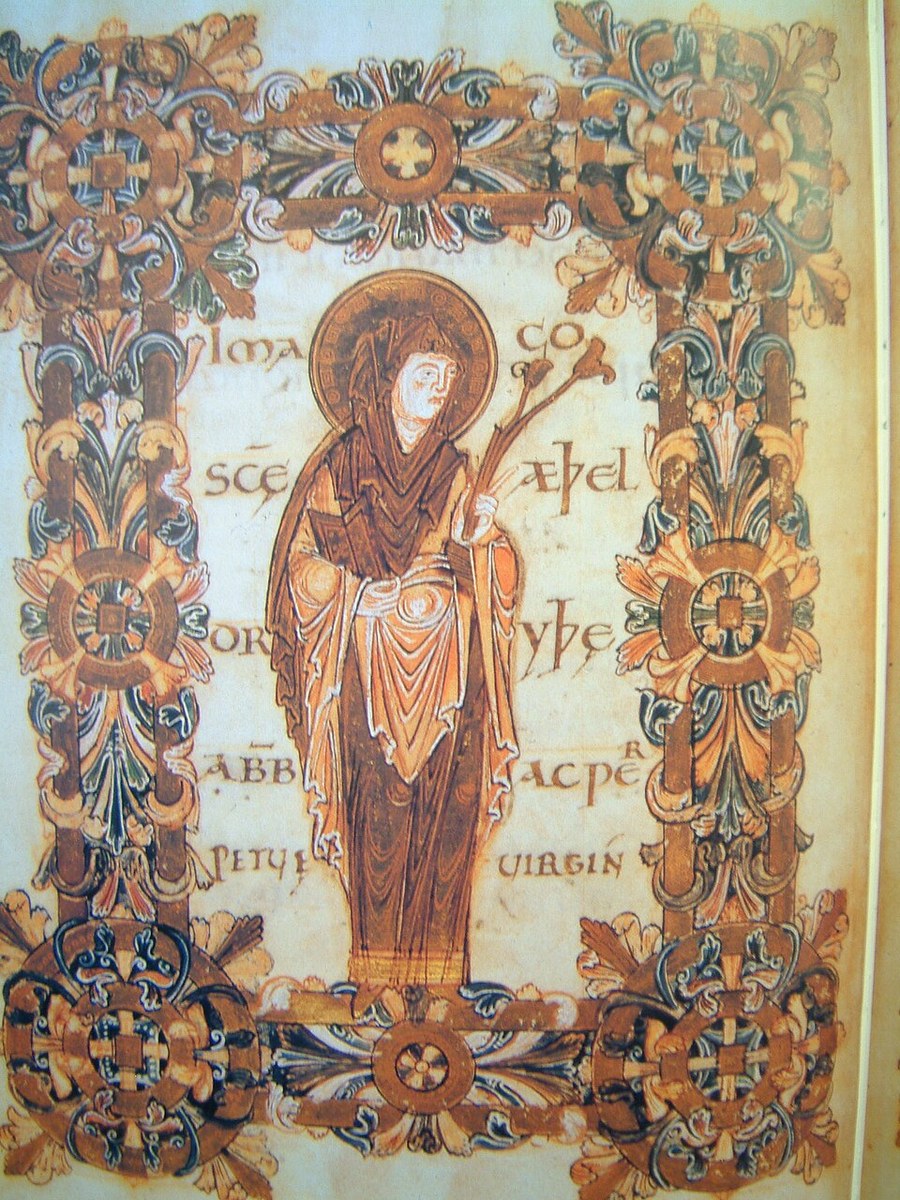
The Anglo-Saxon and medieval type shows Etheldreda as an abbess: veiled, in the dark habit with a mantle, holding the crozier or abbatial staff in one hand and a book or a flowering branch in the other. Her particular attributes are the crown, set on her veiled head or laid at her feet or held with the book, marking the queen who abandoned the crown; and, in East Anglian work, the budding staff of the Ely legend. In modern Orthodox icons written for her in Britain she is given the dark monastic koukoulion and mantle, a hand-cross, and often a small model of Ely cathedral.
The stored image is the miniature from the Benedictional of St Æthelwold, made at Winchester in the last quarter of the tenth century for Bishop Æthelwold, the refounder of her monastery — the earliest surviving portrait of the saint and one of the masterpieces of Anglo-Saxon painting. She stands full-length within the heavy gold acanthus frame characteristic of the Winchester school, veiled and mantled, holding a flowering staff in her right hand, the left raised; the text visible about her names her sanctae Æðelþryðe abbatissae ac perpetuae virginis — "St Etheldreda, abbess and perpetual virgin." The frame's rosettes and foliage are the ordinary Winchester repertoire; the figure is drawn with the nervous, fluttering hem-lines of that workshop.
Disputed questions
Whether she was ever a wife in fact. Bede's insistence on the virginity through two marriages is the load-bearing claim of the whole Life, and he supports it in the manner of a historian, by naming his informant (Wilfrid) and by reporting the physician's testimony for the incorruption. Modern historians have pointed out how convenient the claim was to Ely, and that Ecgfrith's later remarriage to Iurminburg shows a king who wanted heirs; but Bede was writing within living memory of people who had known her, and the tradition is as well attested as anything in seventh-century England.
The two feasts. June 23 is the day of her repose; October 17 is the translation of 695. English usage often calls the October day her "principal" feast because of the Ely fair, but liturgically the June day is primary. The Anglican calendar keeps October 17; Orthodox and Roman usage keep June 23.
Her name. Æthelthryth ("noble strength") appears as Etheldreda, Ediltrudis, Audrey and a dozen further forms. She is not to be confused with her sisters Seaxburh, Æthelburh and Wihtburh, all abbesses and all saints, nor with her niece Eormenhild, who also ruled Ely.