
Eudocia of Heliopolis
The Holy Venerable-Martyr Eudocia of Heliopolis
Venerable Martyr · b. 1st–2nd century, Heliopolis in Phoenicia — d. c. 152–170 (some reckonings c. 107)
Commemorated 1 March — Beheading at Heliopolis, 4 August — Second commemoration on this day
Eudocia of Heliopolis (†c. 152–170) was a wealthy Samaritan woman of Heliopolis in Phoenicia — the great sun-city the Romans called Baalbek — who lived by her beauty as a famed and dissolute courtesan, and amassed a fortune from her many lovers. Overhearing through a wall the monk Germanus reading aloud of the Last Judgement and the torments and rewards to come, she was pierced to the heart, sought him out, and was converted; baptised by the bishop Theodotus, she gave her whole fortune to the poor, entered a convent, and gave herself to so severe a repentance that she was counted worthy of the gift of wonders, raising the dead and turning her former companions and their persecutors to Christ. After many years as a nun and at length abbess, she was seized in a renewed persecution and beheaded for the faith. The Church honours her as a venerable-martyr — a monastic who sealed her repentance with her blood — and keeps her as one of its great models of conversion, that the deepest sinner may become the purest saint.

Heliopolis and the courtesan
Eudocia was a Samaritan by birth and religion, a native of Heliopolis — the ancient "City of the Sun" in the valley of the Beqaa in Phoenicia, the modern Baalbek in Lebanon, famed through the Roman world for the vast temples of its sun-cult. The tradition sets her life in the second century, in the age of the Antonine emperors, though the sources vary and some strands reach back to the reign of Trajan (see Disputed questions below).
Of extraordinary beauty, she used it, in the frank language of the synaxarion, as the instrument of a life of luxury and sin: she was a courtesan, sought by the wealthy and the powerful of the city and of the province, and by her trade she gathered a great fortune — gold, silver, precious stones, and estates — so that she was among the richest women of Heliopolis. Her name, "Eudokia," means good pleasure or good will; the Church loves the irony by which the woman who had lived for the pleasures of the flesh became, by repentance, a vessel of the good pleasure of God.
The reading through the wall
The turning of her life came not by a preacher sent to her, but by a word overheard. A travelling monk named Germanus, returning to his monastery, was lodged in a house that shared a wall with Eudocia's own; and in the night, keeping his rule, he read aloud — as was the ancient custom — from a book that set forth the Second Coming of Christ, the Last Judgement, the torments prepared for the unrepentant and the unfading joy prepared for the righteous. Through the wall the words reached Eudocia as she lay wakeful, and they entered her like fire. For the first time she saw her life as it was, and trembled at the account she would have to give; and when she could bear it no longer she sent to the stranger and begged him to come and speak with her.
Germanus came, and — carefully, as one instructing a soul that had never known the Gospel — he taught her the faith of Christ: the mercy of God that receives the returning sinner, the cleansing of baptism, the reward of repentance. He set her to a period of fasting and prayer, and left her to the working of grace. The tradition adds that in these days she was granted a vision — of an angel who caught her up and showed her the ranks of the blessed and the place prepared for the penitent, and of the Enemy raging at the loss of her — which sealed her resolve. She sent for the monk again, and asked to be made a Christian.
Baptism and the renunciation of her fortune
Eudocia was baptised by Theodotus, bishop of Heliopolis. Before or upon her baptism she made the great renunciation on which the whole of her later sanctity rests: she gave away her entire fortune — all the wealth gathered in her years of sin — distributing it to the poor and the churches through the hands of the bishop, keeping nothing back, that the price of her sin might become the seed of mercy. Stripped of everything she had lived for, she entered a convent near the city, received the monastic habit, and began the life of repentance that would fill the rest of her days.
The ascetic and wonderworker
In the convent Eudocia gave herself to a repentance as extreme as her sin had been. She wept without ceasing for her past; she fasted, kept vigil, and laboured in obedience, seeking to wear away in the flesh what the flesh had loved. Over the long years — the tradition speaks of a monastic course of some fifty-six years — she rose from penitent to mother, and was at length made abbess of her community, guiding others in the way she had learned so hard herself. And God, who had received her repentance, crowned it with the gift of wonders, so that the former courtesan became a worker of miracles and a raiser of the dead.
The synaxarion gathers several of these signs, in which her past and her sanctity meet. A former lover, Philostratus, unable to believe that the beauty of Heliopolis had truly forsaken the world, came to the convent to draw her back to her old life; at her word — or at the touch of her rebuke — he fell down dead, and then, at her prayer over him, was raised again, rose a changed man, and went away to be baptised and to end his days in penitence. When the governor Aurelian, stirred up against the Christians and against the wealth she had given away, sent soldiers to seize her, they were struck powerless; and when Aurelian's own son died, Eudocia raised him to life, so that the governor and his household believed and were baptised. The tradition tells also of a widow's son, killed by the bite of a serpent, whom she restored alive to his mother. Through these wonders many of the pagans of Heliopolis — among them her former companions in sin — were brought to Christ, so that her repentance became the salvation of others.
Martyrdom
The long course of her penitence was sealed at the last by martyrdom. In a renewed persecution, under a governor whom the sources name Vincent (Vicentius) — a fierce enemy of the Christians — Eudocia was arrested as the abbess who had turned the city, confessed Christ before the tribunal, and refused to sacrifice to the gods of Heliopolis whose temples still towered over the city. Condemned for her confession, she was led out and beheaded by the sword, and so the woman who had been baptised into the death of Christ was made perfect in His death — a venerable-martyr, a monastic crowned with the martyr's blood. The Church keeps the day of her beheading as her feast, March 1. The year is uncertain: the common reckonings give a date about 152, or between 160 and 170, in the Antonine age; an older strand, followed by some synaxaria, sets the whole story a generation earlier under Trajan and dates the martyrdom to 107 (see below).
Veneration and later cultus
Eudocia's memory spread early and widely, carried by her extraordinary story — the courtesan turned wonderworker and martyr — which made her, with Mary of Egypt, Pelagia of Antioch, and the harlot-saints of the desert tradition, one of the Church's supreme icons of repentance. Her Passion (the Acts of Eudocia) was read in the East and translated into Latin, and her feast, fixed at the head of March, opens the month in the Byzantine calendar. The Greek, Slavic, and Antiochian books all keep her on the day, and her name — Eudokia, Evdokia — has been borne by empresses and saints after her. That her home was Heliopolis in Phoenicia, a city long within the Patriarchate of Antioch, gives her a particular place among the saints of the Antiochian East, though her veneration is universal.
Feast and commemoration
Eudocia is kept universally on March 1 (church date; New Calendar civil March 1; Old Calendar civil March 14) — the head of the month in the Byzantine year, so that the calendar of March opens with the memory of a great repentance. Her feast most years falls within Great Lent, and where the day is a weekday her office is sung together with the ferial and Triodion propers of the fast; in years where March 1 coincides with the First Sunday of Great Lent (the Sunday of Orthodoxy), as it does in the present year, the resurrectional and Triumph- of-Orthodoxy propers take precedence and her commemoration is kept with them. The Greek Menaion styles her ὁσιομάρτυς (venerable-martyr), and the Slavic books преподобномученица, the nun-martyr; both traditions rank her as the leading saint of the day. Certain later Greek and Slavic calendars also style her abbess (ἡγουμένη, игумения), reflecting the tradition that she governed her convent in her latter years.
Hymns
Kontakion — Tone 4
In thy contest thou didst nobly struggle, and after death thou dost sanctify us by the outpouring of thy wonders, O all-praised one; therefore, honouring thy holy memory, we glorify Christ who is glorified in thee, O venerable Eudocia.
Original translation from the Slavonic
Troparion — Tone 4
Thy ewe-lamb, O Jesus, crieth out with a loud voice: "Thee, my Bridegroom, do I long for, and seeking Thee I contend; I am crucified and buried with Thee in Thy baptism, and I suffer for Thy sake, that I may reign with Thee; I die for Thee, that I may live in Thee: receive me, then, as an unblemished sacrifice offered to Thee with love." At her intercessions, O Merciful One, save our souls.
Original translation from the Greek
Iconography
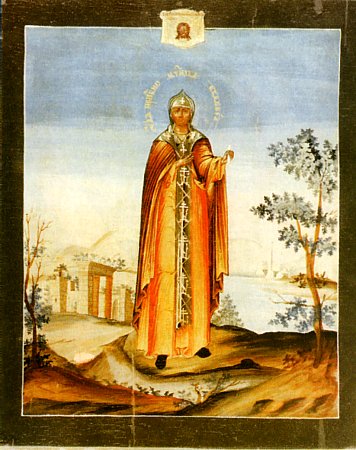
Eudocia is depicted as a nun — veiled and clothed in the dark monastic habit, her face grave and mature — most often holding a cross, the sign of both her monastic profession and her martyrdom, and sometimes a scroll. Where her story is told in scenes, the iconography shows the reading through the wall — the monk Germanus at his book, and Eudocia listening on the far side — and her beheading; older narrative cycles (as in illustrated synaxaria) set her raising of the dead beside her martyrdom. A distinct Byzantine tradition preserves her image in the sculpture and inlay of Constantinople, among them a marble icon of "Saint Eudocia" from the Lips monastery (now in the Istanbul Archaeological Museum).
The stored image is a nineteenth-century icon of the saint, showing her as a veiled nun bearing the cross of her martyrdom (source, public domain, pd-old-work).
Disputed questions
- The date, and the reign of the persecution. The sources hand down two chronologies that cannot both stand. One strand — followed by several synaxaria and by the OCA life — places Eudocia's conversion and death under Trajan (98–117) and dates her martyrdom to about 107. Another, and the fuller tradition of her Acts, sets her repentance and martyrdom under the Antonine emperors (Antoninus Pius, 138–161, or Marcus Aurelius), giving a date about 152 or 160–170 — a reckoning that better fits the fifty-six years of monastic life the same tradition assigns her, which cannot be squeezed into Trajan's reign. The entry follows the Antonine dating as the more coherent, while recording the Trajanic date the synaxaria also transmit; both belong to the received memory of the saint, and the century of her repose (the second) is not in doubt.
- Not to be confused with the several imperial Eudocias and Eudoxias of a later age: above all the empress Aelia Eudocia (Athenais, wife of Theodosius II, †460), the learned Athenian who wrote Christian verse and endowed the holy places of Jerusalem; and the empress Eudoxia (wife of Arcadius, †404), the antagonist of John Chrysostom. These were Byzantine imperial women of the fifth century and the turn of the fifth; the Eudocia of this day is a Samaritan penitent and martyr of the second, of Heliopolis in Phoenicia, and the epithet "of Heliopolis" belongs to her.