
Eudoxius, Zeno and Macarius
The Holy Martyrs Eudoxius, Zeno, and Macarius, and those with them
Martyr · d. c. 311–312
Commemorated 6 September — Martyrdom at Melitene
Eudoxius was a high military commander under Diocletian and his successors, a secret Christian who laid down his rank rather than sacrifice to the idols and was martyred at Melitene in Armenia about 311–312, in the last great persecution before the peace of the Church. With him suffered his friend Zeno, who confessed Christ at his execution, and his household steward Macarius, who came forward after a vision of the martyr; his wife Basilissa, who sought but was denied a martyr's death, buried him. More than a thousand soldiers are said to have cast down their military belts in confession of Christ at his trial. The three are commemorated together on September 6.

Eudoxius held high military command — the sources style him a commander (comes) in the imperial armies — in the reign of Diocletian and of Galerius who continued his persecution in the East. He was a Christian, as were his friend Zeno and Macarius, the steward of his household. When the imperial edicts went out condemning to death Christians who refused sacrifice to the idols, many believers fled with their families; Eudoxius resigned his rank and withdrew with his wife Basilissa and household into hiding in the country around Melitene in Armenia.
The governor of Melitene sent soldiers to search for him. Finding him in plain dress, they did not recognise him, and asked the stranger whether he knew where the commander Eudoxius might be found. Without revealing himself, Eudoxius received them into his house, fed them, and gave them lodging; and taking the encounter as God's sign that his martyrdom was at hand, he told them in the morning that he was the man they sought. The soldiers, in gratitude for his hospitality, offered to report that the search had failed; Eudoxius refused to be spared by a lie. He set his affairs in order, charged Basilissa not to mourn but to keep the day of his death as a festival, put on his military dress, and went with the soldiers to the governor, followed by Basilissa, Zeno, and Macarius.
Before the tribunal the governor pressed him to sacrifice and so keep life, rank, and property. Eudoxius refused, denouncing the folly of worshipping soulless idols, and, unclasping his military belt — the emblem of his commission — threw it in the governor's face. At this, the accounts relate, the secret Christians among the soldiers present, more than a thousand men, did the same; the shaken governor referred the matter to the emperor, who ordered the ringleaders tried and the mass of the soldiers released. After prolonged tortures Eudoxius was led out to beheading. To the weeping Basilissa he repeated his charge to rejoice; her he asked to bury his body at a place called Amimos; and to his friend Zeno, who also wept, he foretold that they would enter the Kingdom together — whereupon Zeno declared himself a Christian aloud and was executed at once with him.
Basilissa buried her husband as he had asked, unhindered. Afterwards she was seized and brought before the governor, and fearlessly denounced him and his gods, desiring to share her husband's death; but the governor, perceiving her intent, refused her the torture and dismissed her — to which she answered that God would receive the intention as the deed. Seven days later Eudoxius appeared to her in a vision, bidding her tell Macarius that he and Zeno awaited him. Macarius went at once to the governor, confessed Christ, and was beheaded. Many other Christians, the accounts add, suffered in the same persecution at Melitene.
Feast and commemoration
September 6 (church date; Old Calendar civil September 19), together with the Commemoration of the Miracle of the Archangel Michael at Chonae, whose service dominates the day in the Menaion; the martyrs are commemorated within it. The Greek calendars join Romulus to their company on this day, the Slavic calendars list him separately (see above).
Hymns
Troparion — Tone 4
Thy martyrs, O Lord, in their contest obtained from thee, our God, the crowns of incorruption; for possessing thy strength they cast down the tyrants and shattered the feeble insolence of the demons. By their intercessions, O Christ God, save our souls.
Original translation from the Greek
Iconography
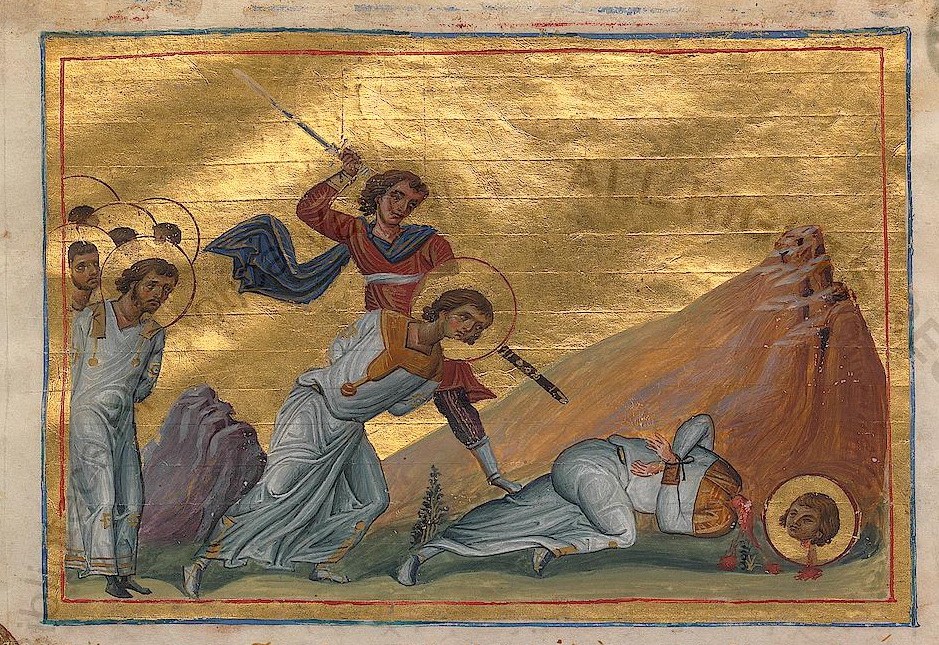
The martyrs have no widespread independent type. The stored image is the miniature of the Menologion of Basil II (c. 985, Vat. gr. 1613, p. 18) for September 6, which depicts the beheading of the martyrs Romulus and Eudoxius — the two principal martyrs of the day in the Constantinopolitan tradition — before a mountain, an executioner raising his sword over the kneeling saints. It thus shows Eudoxius in company with the Romulus whom the Greek calendars join to him (see Disputed questions).
Disputed questions
- The companions of the day. The Greek synaxaria commemorate on September 6 "the martyrs Eudoxius, Zeno, Macarius, and Romulus" as one company, and the Menologion of Basil II likewise pairs Romulus with Eudoxius in a single miniature. The Slavic tradition and the OCA, followed here, treat Romulus as a distinct martyr — a court official under Trajan (early second century) who suffered with many others — commemorated separately on the same day. The disagreement of the calendars is recorded, not resolved; Romulus is listed among the pending entries of the day.
- Dating. The OCA places the martyrdom under "Maximian Galerius," successor of Diocletian, i.e. about 311–312; some notices say simply "under Diocletian." The conventional date c. 311–312 is used here.
- Not to be confused with the martyr Eudoxius who suffered at Sebaste with Atticus, Agapius, Carterius, and their companions, commemorated November 3 — a different martyr, whose Menologion miniature is sometimes mislabelled as that of the September 6 Eudoxius.