
Eulampius and Eulampia
The Holy Martyrs Eulampius and Eulampia, brother and sister, of Nicomedia, and the two hundred martyrs with them
Martyr · Virgin · d. c. 303–311
Commemorated 10 October — Martyrdom at Nicomedia, with the 200 who believed through them
Eulampius and Eulampia (†c. 303–311) were a brother and sister of Nicomedia, the chief martyrs of October 10. A young man seized after reading aloud the imperial edict against the Christians posted in the city, Eulampius confessed Christ under torture and by his prayer cast down the idol in the temple of Mars; his sister Eulampia, seeing his sufferings, declared herself a Christian of her own accord and suffered beside him. Preserved unharmed in a cauldron of boiling matter and in the flames, they won some two hundred onlookers to Christ, who were beheaded with them; Eulampius died by the sword, and Eulampia, by the witness of the Greek verses, gave up her soul from her torments before the blade could fall.

The edict at Nicomedia
The martyrdom belongs to the great persecution that broke over Nicomedia, the eastern imperial capital, at the opening of the fourth century, when edicts commanding the arrest and execution of Christians were posted publicly in the city. The tradition relates that many of the Christians of Nicomedia had fled to the mountains and caves outside the city, and that the young Eulampius was sent in secretly to buy bread. In the marketplace he found the imperial decree nailed up for all to read, sentencing the Christians to death; and reading it, he did not hide his mind — grieving, as the accounts have it, that the emperor should take up arms against his own harmless subjects instead of the enemies of the state. He was recognised, seized, and brought to trial as a Christian.
The contest of Eulampius
Commanded to renounce the faith, Eulampius refused, and was put to the tortures the hymns of his service enumerate: raked with iron claws, burned with torches, stretched on a red-hot bed of coals, shut in prison, hung upon the wood. Then, to the delight of his judges, the sufferer asked to be taken to the pagan temple — they supposed him broken at last. But standing before the idol of Mars, Eulampius cried out, "In the name of the Lord Jesus Christ, fall!" — and the image crashed down and was shattered. The crowd cried out that the God of the Christians is the great and mighty God, and the martyr was led away to be tortured anew.
Eulampia
As her brother suffered, Eulampia came before the judges of her own will and declared that she too was a Christian — a voluntary self-surrender that the hymnography of the day makes her particular glory, singing that she "gave herself over to the tortures, minded as her brother was." Eulampius strengthened her with the word of the Gospel: "Fear not them which kill the body, but are not able to kill the soul" (Matthew 10:28). The two were tortured together and cast into a cauldron of boiling matter — the received accounts speak variously of a heated cauldron and of a red-hot furnace — and stood in it unharmed, the fire losing its power, so that the doxastikon of the day sings of the pair "trampling on the flame" and chanting, "Behold how good and how pleasant it is for brethren to dwell together in unity."
The two hundred, and the end
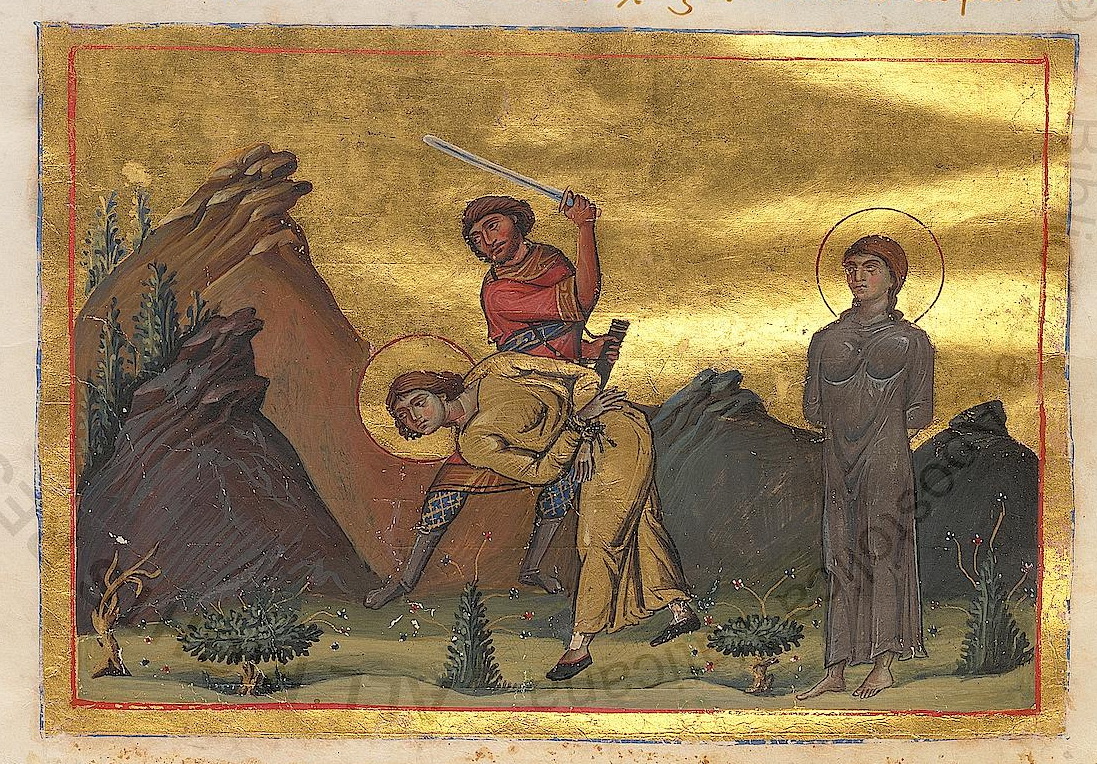
Seeing the miracles wrought in the martyrs' torments, about two hundred of the onlookers confessed Christ; the synaxarion commemorates them with the pair, its verses counting "a fourfold fifty of men perfected by the sword." Eulampius was beheaded; Eulampia, the Greek distich records, was "beforehand with the cut," giving up her soul from her torments before she could be beheaded — though part of the tradition, followed by some calendars, has both die by the sword. The two hundred were executed with them.
Veneration
The brother-and-sister pair entered the Constantinople synaxarion as the principal memory of October 10, with a full proper service in the Menaion: a cycle of stichera in Tone 4, a doxastikon ascribed to John the Monk, and a canon by Joseph the Hymnographer whose acrostic reads "I hymn the radiant yoke-pair of martyrs" — the hymnographers delighting throughout in the play on their shared name, "the well-shining" (εὐλαμπής). The Menologion of Basil II (c. 985) carries a miniature of their martyrdom at its notice of the day.
Feast and commemoration
October 10 (church date; Old Calendar civil October 23), the principal commemoration of the day in the Greek, Slavic, and Antiochian usage alike, with the two hundred martyrs commemorated jointly. The received Greek Menaion appoints the full proper service described above, with the common apolytikion of the martyrs; the Slavic books likewise use the common troparion in Tone 4 and the kontakion in Tone 3.
Hymns
Troparion — Tone 4
Thy martyrs, O Lord, in their sufferings received incorruptible crowns from thee, our God; for possessing thy strength they cast down the tyrants and broke the feeble insolence of the demons. By their prayers save our souls.
Original translation from the Greek
Kontakion — Tone 3
Let us honour the noble martyrs, brother and sister in the flesh, the wise Eulampius and Eulampia; for by the might of the Crucified they put to shame the contrivances of the tyrants, and therefore have been shown forth as the glory and the boast of martyrs.
Original translation from the Greek
Stichera
Likeness of name was tempered with love of kin, and purity was joined with dispassion, and kept the vigour of their purpose unharmed; for where God is the one desired, the whole world is despised. O wonder! the serpent is slain, and he that spoke unrighteousness on high has fallen beneath the earth before the brother-and-sister martyrs, Eulampius the wise and Eulampia. To them let us cry with well-aimed songs: O ye who finished the course nobly in Christ, ask for the world peace, and for our souls great mercy.
Iconography
Eulampius is painted as a beardless youth and Eulampia as a young woman, both bearing the martyr's cross; joint icons show them side by side, and narrative images show the cauldron or the sword. The stored image is the miniature of the Menologion of Basil II (Constantinople, c. 985; Vat. gr. 1613, p. 103), which depicts the moment of their martyrdom by the sword. A Russian lives-of-the-saints illustration of 1903–1911 of the pair standing crowned is also in the public domain.
Disputed questions
- The date and the emperor. The OCA life places the martyrdom at the beginning of the fourth century under "Maximian (284–305)" — Maximian Herculius, whose dates it gives — while the setting at Nicomedia belongs properly to the eastern persecution under Diocletian and Galerius (Maximian Galerius, 305–311); the Russian calendar (azbyka) dates the martyrs "303–311." No source resolves the year; this entry gives c. 303–311.
- Eulampia's death. The synaxarion distich states that she died before the beheading, sharing the crown with her beheaded brother; other retellings number her among the beheaded. Both forms of the tradition are recorded here.
- The two hundred. The received synaxarion commemorates two hundred men slain by the sword with Eulampius; the round number is the tradition's, not a documentary count.