
Eulogius of Alexandria
Our Father among the Saints Eulogius, Archbishop and Patriarch of Alexandria
Patriarch · Bishop · b. 6th century, in Syria — d. c. 607/608, at Alexandria
Commemorated 13 February — Commemoration of the Patriarch of Alexandria
Eulogius (died c. 607/608) was Patriarch of Alexandria for some seven-and-twenty years, one of the learned and vigorous hierarchs of the age of the emperor Maurice. A Syrian by origin, he had been abbot of the monastery of the Mother of God at Antioch before he was raised, about the year 580, to the ancient throne of Saint Mark. He gave his long patriarchate to the defence of the Orthodox faith against the heresies that divided Egypt — above all the Monophysite confusion of the two natures of Christ and the various sects it had spawned — writing many treatises in refutation, of which the learned Patriarch Photius, three centuries later, still read and summarised a great number. He was the close friend and correspondent of Saint Gregory the Great of Rome, whose letters to him survive as a monument of their friendship across the Churches. Honoured as a teacher, an ascetic hierarch, and a pillar of Orthodoxy, he is commemorated on February 13.
.jpg)
From the monastery of Antioch to the throne of Alexandria
Eulogius was a Syrian, formed in the monastic life of the region of Antioch, where he rose to be hegumen (abbot) of the monastery of the Mother of God — the house known as the Deipara, or, in some notices, the monastery founded by the emperor Justinian. A man of deep learning and firm Orthodoxy in a Syria riven by the Monophysite controversy, he was marked out for higher service; and about the year 580 (the notices give 579–581), on the vacancy of the great see of Egypt, he was chosen and consecrated Patriarch (Pope) of Alexandria, the third of the elder patriarchates and the throne of the Evangelist Mark. He held it, the tradition says, for twenty-seven years, through the reigns of the emperors Tiberius II, Maurice, and into that of Phocas.
The defender of Orthodoxy in Egypt
Eulogius came to Alexandria at a hard hour for the Chalcedonian, imperial Church there. Since the Council of Chalcedon (451) Egypt had been the heartland of Monophysitism — the confession of a single, divine nature in the incarnate Christ — and the great mass of the native (Coptic) Christians followed the rival, anti-Chalcedonian patriarchate, so that the Orthodox patriarch, in communion with Constantinople and Rome, shepherded a minority in his own city. Into this contest Eulogius threw the whole force of his learning. He preached and wrote tirelessly for the Chalcedonian faith of the two natures — one Christ in two natures, without confusion and without division — against the Monophysites and the many sects into which their movement had splintered: the Theodosians and Gaianites, the Severans, and the peculiar heresy of the Agnoetae, who held that Christ in his humanity had been ignorant of some things (as of the day of judgement). Against the Novatian rigorists too, who denied the Church's power to receive the lapsed, he wrote in defence of repentance and mercy.
His theological writings were many and were long esteemed. The great scholar- patriarch Photius of Constantinople, reading in the ninth century, devotes several notices of his Bibliotheca to the works of Eulogius — treatises and homilies against the Monophysite sects, in defence of the two natures and of the decrees of Chalcedon and of the Tome of Leo — and praises their learning and orthodoxy; it is largely through Photius's summaries that the content of Eulogius's now-lost books is known. He stands thus among the theologians of the sixth century who held the line of the Chalcedonian faith in the East.
Friend of Gregory the Great
The most celebrated bond of Eulogius's life was his friendship with Saint Gregory the Great (Gregory the Dialogist), Pope of Rome. The two men — the Pope of the elder Rome and the Pope of Alexandria — had known each other, the tradition holds, in earlier days at Constantinople, and their friendship was kept up by a warm correspondence of which Gregory's side largely survives among his letters. Gregory writes to Eulogius as to a beloved brother and fellow-labourer, rejoicing in his zeal against the heretics, sharing counsel on the government of the Churches and the reconciliation of schismatics, thanking him for his gifts, and treating the two apostolic sees of Mark (Alexandria) and Peter (Rome) as bound in one Petrine fellowship. Their letters are a precious witness to the communion of the Churches of East and West on the eve of their long estrangement, and to the mutual honour of two of the great saints of the age.
Repose
Eulogius reposed at Alexandria about the year 607 or 608 (the received date is 13 September 608), full of years and of labours, having kept the faith of Chalcedon on the throne of Saint Mark for over a quarter of a century. He is honoured as a holy hierarch, a teacher of Orthodoxy, and an ascetic bishop, and kept on February 13.
Feast and commemoration
Eulogius is commemorated on February 13 (church date; New Calendar civil February 13, Old Calendar civil February 26), kept in the Byzantine calendars as "the Righteous (or holy) Eulogius, Archbishop of Alexandria," among the saints of the day led by the hermit Martinian. His feast honours him as one of the learned defenders of the Chalcedonian faith and as the friend of Gregory the Great.
Hymns
Troparion — Tone 4
A rule of faith and an image of meekness, a teacher of temperance, hath the truth of things revealed thee to thy flock, O Father and Hierarch Eulogius; therefore hast thou gained by humility the things on high, and by poverty the things of wealth. Intercede with Christ our God that our souls may be saved.
Original translation from the Greek
Kontakion — Tone 2
As a divinely-eloquent teacher of the Orthodox faith and a defender of the two natures of Christ, O holy Eulogius, thou didst shepherd the throne of Mark; wherefore, entreat the Lord unceasingly on behalf of us all.
Original translation from the Greek
Iconography
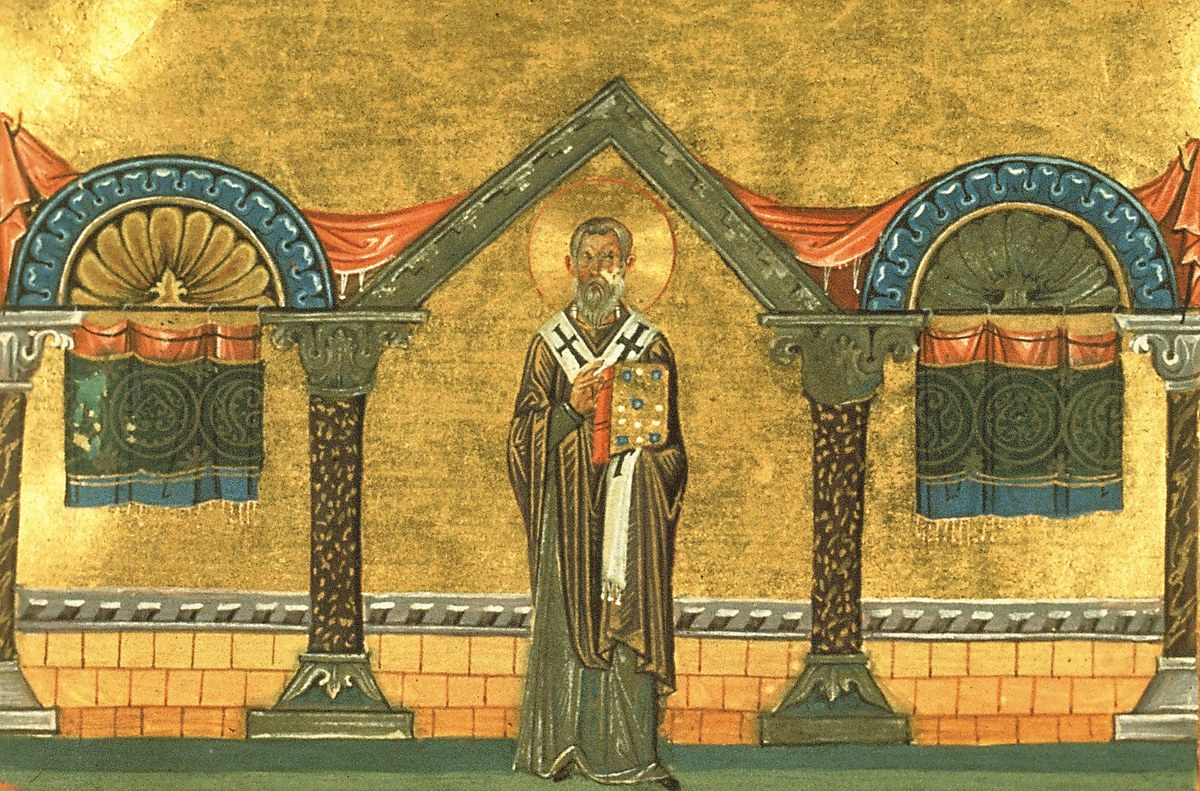
Eulogius is depicted in the settled type of an Orthodox patriarch and teacher — an aged hierarch, grey-bearded, vested in the phelonion or sakkos and the omophorion, holding the Gospel-book and giving the blessing, sometimes with a scroll of his writings, in token of the many treatises by which he defended the faith. As a patriarch of Alexandria he belongs to the line of the successors of Saint Mark. The stored image is the miniature of the Menologion of Basil II (Constantinople, 985; Vat. gr. 1613): the patriarch stands haloed between the draped arches of a golden architectural screen, grey-bearded, vested in phelonion and omophorion, the jewelled Gospel-book on his left arm and his right hand raised in blessing — the earliest surviving identified portrait of him.
Disputed questions
- The dates. His accession is variously given as 579, 580, or 581, and his repose as 607 or 608; the "twenty-seven years" of his patriarchate is the figure the notices transmit. The civil date of his death is remembered as September 13 (608), though his liturgical commemoration is February 13.
- Not to be confused with the several other saints named Eulogius — among them Eulogius of Córdoba, the ninth-century Spanish martyr and writer, and Eulogius the Hospitable — who are wholly distinct.