
Eumenes of Gortyna
Our Venerable Father Eumenes the Wonderworker, Bishop of Gortyna
Venerable · Bishop · Wonderworker · d. 7th century, in exile in the Thebaid
Commemorated 18 September — Repose; the day's chief saint, within the afterfeast of the Cross
Eumenes (7th century) was bishop of Gortyna in Crete, venerated as a wonderworker and honoured in the Menaion as the chief saint of September 18. Noted from youth for an ascetic and merciful life — he gave away his whole substance to the poor — he was raised to the first see of Crete, where he shepherded his flock as a compassionate father and by his prayer, the tradition relates, once ended a drought with abundant rain. A defender of the orthodox faith against the heresy of his day, he was exiled to the Thebaid in Egypt, where he reposed; his body was returned to Gortyna for burial.
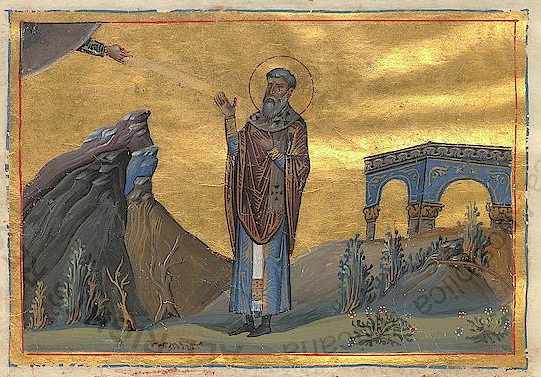
.jpg)
Origins and early life
Nothing is transmitted of Eumenes's family or birthplace. The synaxaria open with his character rather than his origins: from his youth he was distinguished by virtue, shunned the enticements of the world, and — the detail every account preserves — distributed all that he possessed to the poor, keeping nothing for himself. The Slavic Menaion's troparion compresses this remembered profile into two strokes: a life adorned with fasting, and goods given away out of love for the destitute.
Ministry
By the choice of God — so the synaxarion frames his election — Eumenes was made bishop of Gortyna, the metropolis of Crete and the island's first see, whose earlier occupants included the apostolic Titus and the hieromartyrs Philip and Cyril. The accounts of his episcopate dwell on two things. The first is his fatherly compassion: he comforted the sorrowing, cared for orphans and the poor, and governed the church of Crete as "a compassionate father" to his flock. The second is the power of his prayer, which earned him the fixed epithet "wonderworker" (θαυματουργός): the tradition relates that in a time of drought his intercession called down abundant rain upon the land. The hymnography of his feast, composed by Joseph the Hymnographer, plays throughout on his name — Eumenios, "the kindly one," who by his prayers makes Christ eumenēs, favourably inclined, toward those who honour him — and styles him "the adornment of the Cretans, the president of Gortyna, the unshakable foundation of the Church, great in wonders."
He was also a champion of orthodoxy. The sources agree that he contended against the heresy of his age and suffered banishment for it, though they name the heresy differently (see Disputed questions): he was exiled to the Thebaid, the upper-Egyptian desert province that Byzantine emperors used as a place of banishment for confessing bishops.
Repose, relics and veneration
Eumenes died in exile in the Thebaid in the seventh century. His body was brought back across the sea and buried at Gortyna, in his own see; the kontakion of his feast, sung in both the Greek and Slavic traditions, celebrates precisely his "revered, glorious and holy translation" (μετάστασις) — the saint's departure to God remembered together with the homecoming of his relics. His memory is kept universally in the Byzantine rite on September 18, and his service in the Menaion — a full canon by Joseph the Hymnographer, proper stichera, kathisma, kontakion with oikos, and exapostilarion — marks him as the principal saint of the day, sung together with the afterfeast of the Elevation of the Cross.
Feast and commemoration
September 18 (church date; Old Calendar civil October 1 — the Julian offset carries the day across the civil month boundary), within the afterfeast of the Elevation of the Cross, whose apolytikion and kontakion govern the day's services together with the saint's propers. Eumenes is the day's chief saint in the Menaion of both the Greek and Slavic traditions; the Greek books style him Ὅσιος (venerable) and wonderworker as well as bishop, and the Russian calendar likewise heads the entry "Прп. Евмения, епископа Гортинского." The commemoration is universal in the Byzantine rite.
Hymns
Troparion — Tone 7
With fasting thou didst adorn thy life, and, loving the poor, thou didst distribute to them all thy substance; thou didst shine forth in virtues like the sun, comforting the mourning and gladdening the sorrowful. And now, we pray thee, O father Eumenes, by thy prayers ask of Christ the forgiveness of our sins.
Original translation from the Slavonic
Kontakion — Tone 2
Illumined with divine light, O all-blessed one, thou dost enlighten us who lovingly hymn thy revered, glorious and holy translation, O father and hierarch Eumenes; for thou intercedest without ceasing on behalf of us all.
Original translation from the Greek
Magnification
We magnify thee, O holy hierarch, father Eumenes, and we honour thy holy memory, for thou prayest for us to Christ our God.
Original translation from the Slavonic
Iconography
Eumenes is depicted as an aged bishop with a pointed beard, vested in phelonion and omophorion, blessing or holding the Gospel book. The stored image is the miniature for September 18 from the Menologion of Basil II (Vatican, c. 1000): the saint stands in episcopal vesture between a mountain and a domed ciborium-shrine, the hand of God blessing him from heaven — the Menologion's visual shorthand for a hierarch who reposed in peace.
Disputed questions
- Century and heresy. The received dating is the seventh century (so the OCA life, the Moscow Patriarchate calendar, and the Greek synaxaristes), which suits the identification of his adversary as Monothelitism — the heresy named in the Russian calendar tradition. The OCA's life, however, names the Monophysite heresy, and the OCA's own readings page for the day prints "6th c."; a sixth-century Eumenes would fit the Monophysite controversies better. The witnesses cannot both be right as stated; this entry keeps the seventh century as the majority reading and records the divergence rather than resolving it.
- Identity of the see's saints. Gortyna's calendar carries several sainted bishops (Titus, Philip, Cyril, Eumenes); Eumenes is not to be confused with the hieromartyr Cyril of Gortyna (commemorated September 6 and July 9), an earlier occupant of the same see who died a martyr.